
Aged care facilities in Victoria handle a unique mix of waste streams that require careful management. Between clinical waste from nursing care, sharps from medication administration, incontinence products, kitchen waste from meal services, and standard general waste, a typical 80-bed facility generates between 1,500 and 3,000 kilograms of waste per week. Getting the classification and handling right is not optional: it is a compliance requirement with real penalties for getting it wrong.
This guide covers the waste categories specific to aged care, the Victorian regulatory framework, practical management systems, and strategies to optimise costs without cutting corners on compliance.
Waste Categories in Aged Care Facilities
Clinical Waste
Clinical waste in aged care includes any waste that has been in contact with blood, body fluids, or infectious material. Under Victorian regulations, this covers wound dressings with visible blood, used catheter bags, drainage bags, incontinence pads contaminated with blood, and any materials from residents with known infectious conditions.
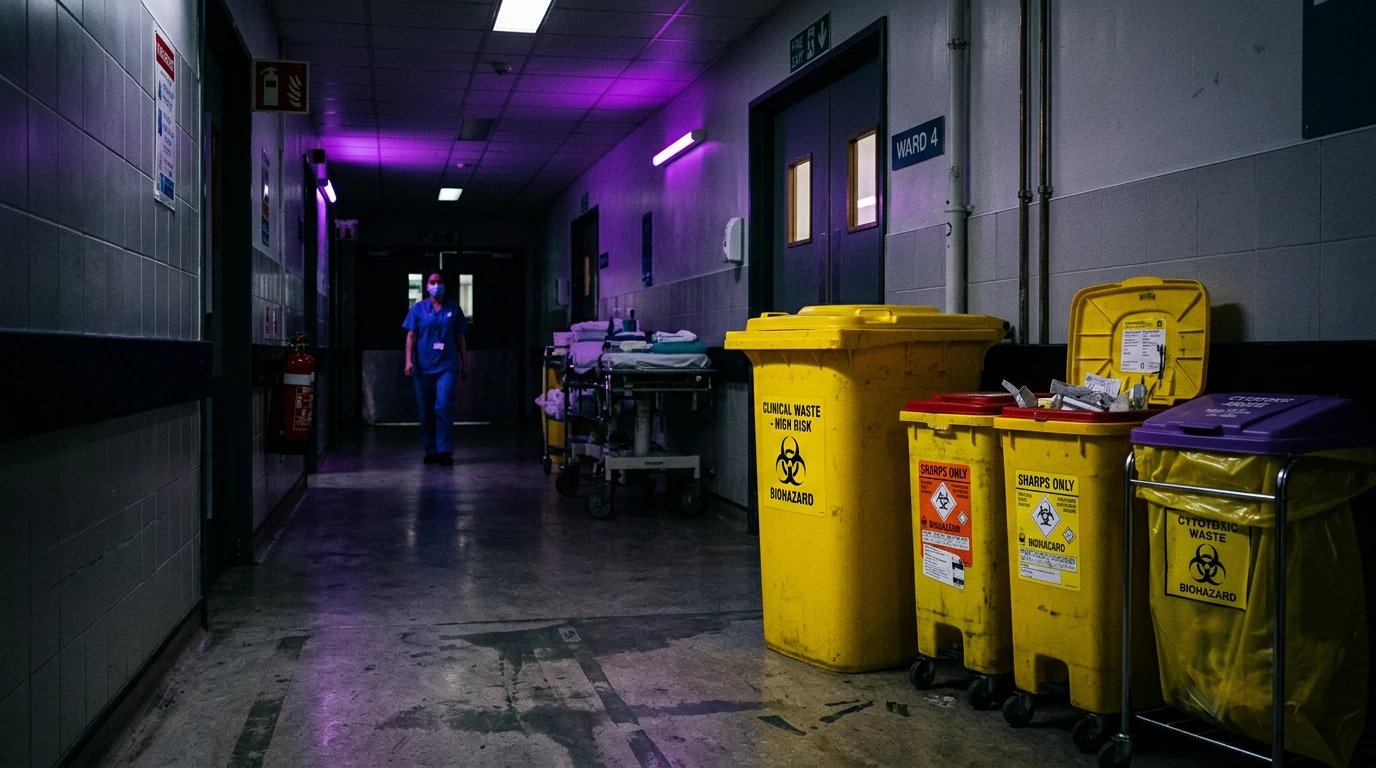
Clinical waste must be placed in yellow bins or bags that meet AS 4031 standards. These bins are collected by licensed healthcare waste operators and transported to approved treatment facilities for incineration or autoclaving. Collection costs for clinical waste typically range from $0.80 to $1.50 per kilogram, compared to $0.15 to $0.25 per kilogram for general waste. This price difference makes correct classification directly relevant to your bottom line.
Sharps
Sharps include needles, syringes, lancets, and any device capable of causing a penetrating injury. In aged care, the most common sharps come from insulin administration, blood glucose monitoring, and vaccination programmes. All sharps must be disposed of in AS 4031-compliant sharps containers, which are rigid, puncture-resistant, and clearly labelled.
Sharps containers should be available in every medication room, nursing station, and treatment area. They must never be filled beyond the marked fill line (typically three-quarters full). Overfilled sharps containers are a common compliance finding during aged care accreditation audits and WorkSafe inspections.
Incontinence Waste
This is often the most misunderstood waste stream in aged care. Standard used incontinence pads, without visible blood or known infectious contamination, are classified as general waste in Victoria, not clinical waste. This is a distinction that can save facilities thousands of dollars per year.
Many aged care facilities incorrectly place all incontinence waste into clinical waste bins, paying clinical waste rates for material that could legally go into general waste. A facility with 60 residents using an average of four incontinence products per day generates roughly 240 pads daily. At clinical waste rates, that costs approximately $8,600 per month. Correctly classified as general waste, the same volume costs around $1,400 per month. The difference is significant.
The exception is incontinence products contaminated with blood or from residents with diagnosed communicable infections. These must be treated as clinical waste.
Pharmaceutical Waste
Expired, unused, or contaminated medications require separate handling. Schedule 8 (controlled) drugs must follow specific destruction protocols documented in your facility's drug register. Non-controlled pharmaceutical waste should be collected through the Return Unwanted Medicines (RUM) programme or a licensed pharmaceutical waste service. Medications must never be placed in general waste or flushed into the sewer system.
General Waste and Recycling
General waste in aged care includes packaging, food scraps, cleaning materials, non-contaminated personal care products, and administrative waste. This stream typically accounts for 60 to 70 per cent of total waste volume in a facility. Standard general waste collection applies, and the same cost-reduction strategies used in any commercial setting work here: right-sizing bins, separating recyclable cardboard and packaging, and reviewing collection frequencies.
Victorian Regulatory Framework
EPA Victoria
The Environment Protection Act 2017 and the Environment Protection Regulations 2021 set the framework for waste management in Victoria. Clinical waste is classified as prescribed industrial waste, meaning it must be tracked, transported by licensed carriers, and treated at approved facilities. Facilities must maintain records of all clinical waste consignments, including waste type, volume, carrier details, and destination.
WorkSafe Victoria
Occupational health and safety requirements under the OHS Act 2004 apply to waste handling in aged care. Staff must be trained in correct waste segregation, sharps handling, and spill response. Personal protective equipment must be available for anyone handling clinical waste. WorkSafe can issue improvement or prohibition notices for unsafe waste practices, and fines for serious breaches can exceed $50,000.
Aged Care Quality Standards
The Aged Care Quality Standards, administered by the Aged Care Quality and Safety Commission, include requirements for infection prevention and control that directly relate to waste management. Standard 3 (Personal Care and Clinical Care) and Standard 8 (Organisational Governance) both have waste management implications. Accreditation assessors will review your waste management policies, staff training records, and on-site practices during assessment visits.
Staff Training and Compliance Documentation
Training is the single most important factor in maintaining waste compliance. Every staff member who handles waste, from registered nurses to cleaning staff and kitchen workers, needs to understand the classification system and the procedures for each waste stream.
An effective training programme covers:
- Waste stream identification: what goes in which bin and why
- Sharps handling: safe disposal, what to do if a container is overfilled, needle-stick injury response
- Clinical versus general waste: the specific criteria for classifying incontinence and wound care waste
- Spill response: procedures for cleaning up blood or body fluid spills, including waste disposal after cleanup
- PPE requirements: when gloves, aprons, and eye protection are required for waste handling
- Reporting: how to report waste-related incidents, near-misses, and compliance concerns
Training should be delivered during staff induction and refreshed annually. Keep signed training records, as these are frequently requested during accreditation audits and EPA inspections.
Maintain a waste management policy document that covers all procedures, responsibilities, and emergency contacts. This document should be reviewed annually and updated whenever regulations change or new waste streams are introduced.
Cost Optimisation Without Compromising Compliance
Aged care facilities often overspend on waste because of conservative classification practices and contracts that have not been reviewed in years. Here are practical ways to reduce costs.
Audit Your Clinical Waste Classification
As noted above, the biggest savings opportunity in aged care waste is ensuring incontinence products are correctly classified. Conduct a bin audit over two weeks: check what is actually going into clinical waste bins. If standard incontinence pads make up a significant proportion, you have an immediate savings opportunity by reclassifying them as general waste.
Right-Size Your Services
Many facilities have waste services that were set up when the home opened and have not been adjusted for changes in resident numbers, acuity levels, or waste volumes. Review bin sizes and collection frequencies against actual waste generation. A facility running at 75 per cent occupancy may be paying for 100 per cent capacity waste services.
Consolidate Providers
Using one provider for general waste, another for clinical waste, and a third for recycling creates administrative complexity and removes volume-based pricing opportunities. Many waste companies offer bundled services for aged care that cover all streams at negotiated rates.
Work with a Waste Partner
Bundle Waste works with aged care operators across Melbourne to review waste classifications, benchmark costs, and negotiate provider contracts. Our free waste audit includes a site visit to assess current practices, identify misclassified waste streams, and present clear recommendations with projected savings. For multi-site operators, we provide consolidated reporting across all facilities.
Correct waste classification is not just a compliance issue. It is the single biggest factor in controlling aged care waste costs.