
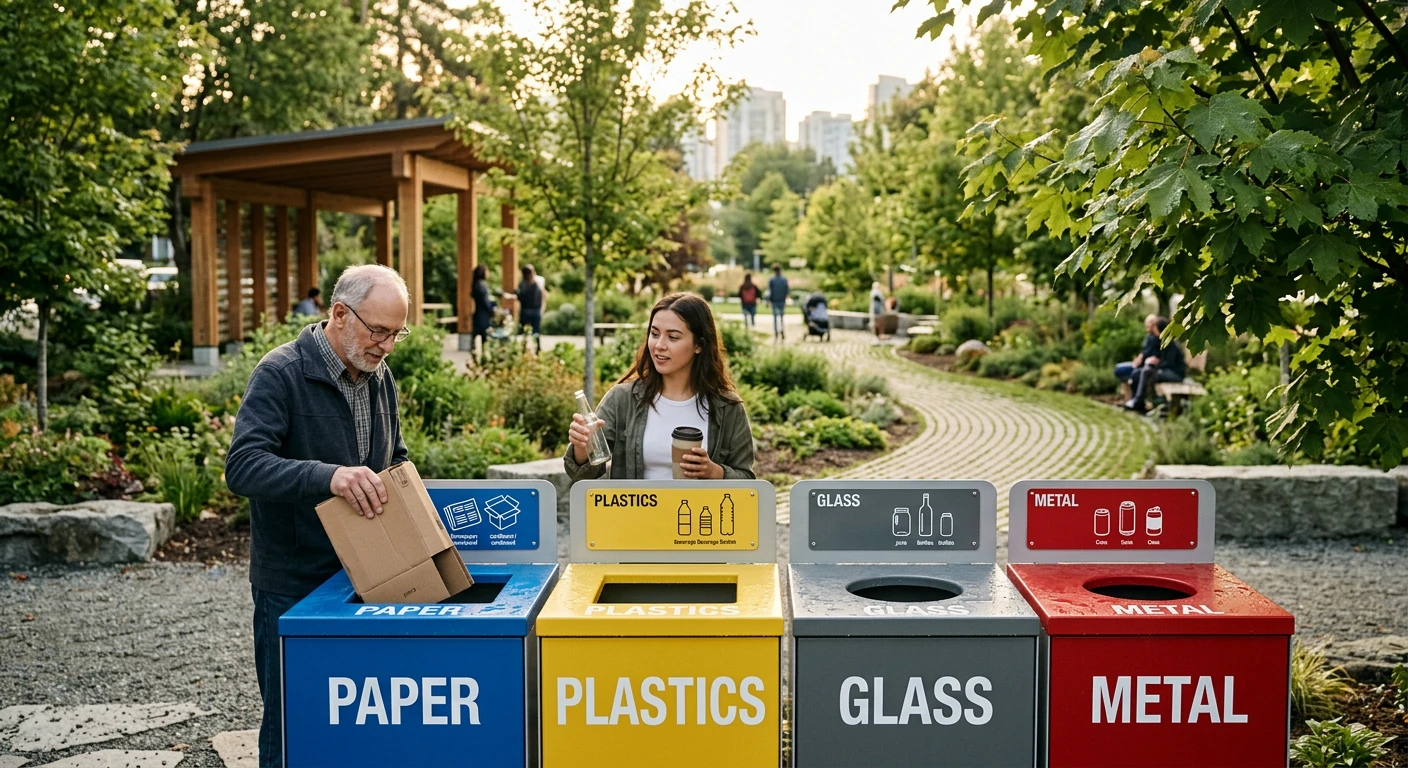
Waste management is rarely the first thing businesses think about when considering their carbon footprint. Energy, transport, and supply chains tend to dominate the conversation. But waste contributes significantly to greenhouse gas emissions, and for many Melbourne businesses, it represents one of the most actionable areas for carbon reduction.
Australia's waste sector accounts for approximately 3 per cent of national greenhouse gas emissions. That may sound small, but it translates to roughly 13 million tonnes of CO2 equivalent per year. For individual businesses, waste-related emissions can be a meaningful portion of their overall carbon footprint, particularly when scope 3 emissions are considered.
How Landfill Generates Methane
The primary climate impact of waste comes from landfill. When organic materials, such as food scraps, paper, cardboard, timber, and textiles, decompose in landfill, they do so in anaerobic conditions (without oxygen). This anaerobic decomposition produces methane, a greenhouse gas with a global warming potential approximately 25 times that of carbon dioxide over a 100-year period.
A single tonne of food waste sent to landfill generates roughly 0.9 tonnes of CO2 equivalent emissions over its decomposition lifetime. For a Melbourne restaurant generating 10 tonnes of food waste per year, that equates to approximately 9 tonnes of CO2 equivalent, comparable to driving a car 45,000 kilometres.
Modern landfills in Victoria are required to capture a proportion of the methane they generate, either flaring it or using it for energy generation. However, capture rates vary significantly between sites. Even well-managed landfills typically capture only 60 to 75 per cent of methane produced. The remainder escapes into the atmosphere as a potent greenhouse gas.
Transport Emissions from Waste Collection
Every waste bin collected involves a diesel truck driving a route, and that route generates emissions. For most Melbourne businesses, transport-related waste emissions are smaller than landfill methane, but they are not negligible.
The emissions from waste transport depend on:
- Collection frequency - more frequent collections mean more truck movements. Right-sizing your bins to reduce collection frequency cuts transport emissions proportionally
- Distance to disposal facility - waste travelling to outer suburban or regional landfills generates more transport emissions than waste processed at closer facilities
- Vehicle efficiency - newer collection vehicles are more fuel-efficient and some operators are transitioning to electric or compressed natural gas trucks
Reducing your total number of bin lifts through waste reduction and right-sizing reduces both your costs and your transport-related emissions.
Emissions from Waste Processing
Waste processing facilities, including Materials Recovery Facilities (MRFs), composting operations, and waste-to-energy plants, also generate emissions. However, these are generally much lower than the emissions from landfilling the same material.
The processing emissions from recycling a tonne of mixed materials are typically 80 to 95 per cent lower than the combined extraction, manufacturing, and disposal emissions of producing the same materials from virgin resources. This "avoided emissions" benefit is one of the strongest environmental arguments for recycling.
How Recycling Reduces Embodied Energy
Every manufactured product contains embodied energy: the energy used to extract raw materials, process them, and manufacture the final product. When that product is recycled, a significant portion of its embodied energy is preserved because the recycled material requires less energy to reprocess than producing the same material from scratch.
The energy savings from recycling vary by material:
- Aluminium - recycling saves approximately 95 per cent of the energy needed to produce aluminium from bauxite ore. This is why aluminium recycling has such strong economic and environmental returns
- Steel - recycling saves around 74 per cent of the energy compared to production from iron ore
- Paper and cardboard - recycling saves approximately 60 per cent of the energy compared to production from virgin wood pulp
- Glass - recycling saves roughly 30 per cent of production energy
- Plastics - recycling saves between 50 and 80 per cent depending on the polymer type
For every tonne of cardboard your business recycles rather than landfills, you avoid approximately 1.3 tonnes of CO2 equivalent emissions when accounting for both avoided methane and reduced manufacturing energy.
Composting vs Landfill for Organics
The carbon benefit of diverting organic waste from landfill to composting is substantial. When food or garden waste is composted in aerobic conditions (with oxygen), it produces CO2 rather than methane. Since CO2 has 25 times less warming potential than methane, this shift alone dramatically reduces emissions.
Additionally, compost applied to soil sequesters carbon and reduces the need for synthetic fertilisers, which have their own emissions footprint. The Victorian Government's target to halve organic waste to landfill by 2030 is driven largely by this climate benefit.
For hospitality, food manufacturing, and retail businesses with significant organic waste streams, a dedicated organics collection is one of the single most effective carbon reduction actions available.
Waste-to-Energy in Australia
Waste-to-energy (WtE) facilities incinerate residual waste that cannot be recycled, generating electricity and heat. Australia has been slow to adopt WtE compared to Europe, where countries like Sweden and Denmark process over 50 per cent of non-recyclable waste through energy recovery.
Victoria's first large-scale WtE facility is in development, and the Victorian Government has established a policy framework that positions WtE below recycling but above landfill in the waste hierarchy. For businesses, this means that residual waste which genuinely cannot be recycled may eventually be processed for energy rather than buried in landfill, reducing methane emissions.
However, WtE is not a substitute for waste reduction and recycling. The waste hierarchy remains clear: avoid and reduce first, reuse second, recycle third, recover energy fourth, and landfill last.
Scope 3 Emissions and Waste
Under greenhouse gas accounting standards, emissions are categorised into three scopes. Scope 1 covers direct emissions from owned sources. Scope 2 covers indirect emissions from purchased electricity. Scope 3 covers all other indirect emissions in a company's value chain, including waste disposal.
For most businesses, waste falls under scope 3, category 5 (waste generated in operations). As more Australian companies commit to measuring and reporting scope 3 emissions, waste data becomes increasingly important. Accurate waste reporting requires knowing not just how much waste you generate, but what happens to it: how much goes to landfill, how much is recycled, and how much is composted or recovered.
Companies subject to the National Greenhouse and Energy Reporting (NGER) scheme may need to report waste-related emissions. Even for businesses below the NGER threshold, understanding waste emissions is becoming a standard part of corporate sustainability practice.
How Diversion Targets Reduce Carbon
Victoria's target of 80 per cent diversion from landfill by 2030 is fundamentally a climate policy as much as a waste policy. Every tonne diverted from landfill to recycling or composting reduces methane emissions. At scale, the impact is significant.
For your business, setting and tracking a diversion rate target is one of the simplest ways to align waste management with carbon reduction. Increasing your diversion rate from 30 per cent to 60 per cent will roughly halve your waste-related carbon emissions, assuming a typical waste composition.
Victorian Emissions Reduction Targets
Victoria has committed to net zero greenhouse gas emissions by 2045, with interim targets of 28 to 33 per cent reduction by 2025 and 45 to 50 per cent by 2030 (from 2005 levels). The waste sector is expected to contribute to these reductions through:
- Increased landfill gas capture and utilisation
- Higher diversion rates for organic waste
- Expansion of recycling infrastructure
- Introduction of waste-to-energy as an alternative to landfill for residual waste
- Rising landfill levies that make disposal progressively less economically attractive
Businesses that proactively reduce their waste-related emissions will be better positioned as these policies tighten and as customers, investors, and regulators increasingly expect demonstrated environmental performance.
Practical Steps to Lower Waste-Related Emissions
Reducing the carbon footprint of your waste does not require sophisticated carbon accounting. Start with these practical actions:
- Conduct a waste audit - understand your waste composition so you know where the biggest emission reduction opportunities are. Use our waste audit checklist to guide the process
- Divert organics from landfill - if you generate food waste, a separate organics collection delivers the largest per-tonne carbon reduction
- Maximise recycling - ensure cardboard, paper, metals, and plastics are separated and collected through recycling streams rather than going to general waste
- Right-size your collections - fewer bin lifts means fewer truck movements and lower transport emissions
- Track your diversion rate - monitor the percentage of your waste diverted from landfill and set improvement targets
- Ask your provider about destination - understand where your waste actually goes. Not all recycling providers achieve the same recovery rates
A waste partner like Bundle Waste can help you understand the carbon implications of your current waste arrangements and identify the most effective diversion strategies for your business.