
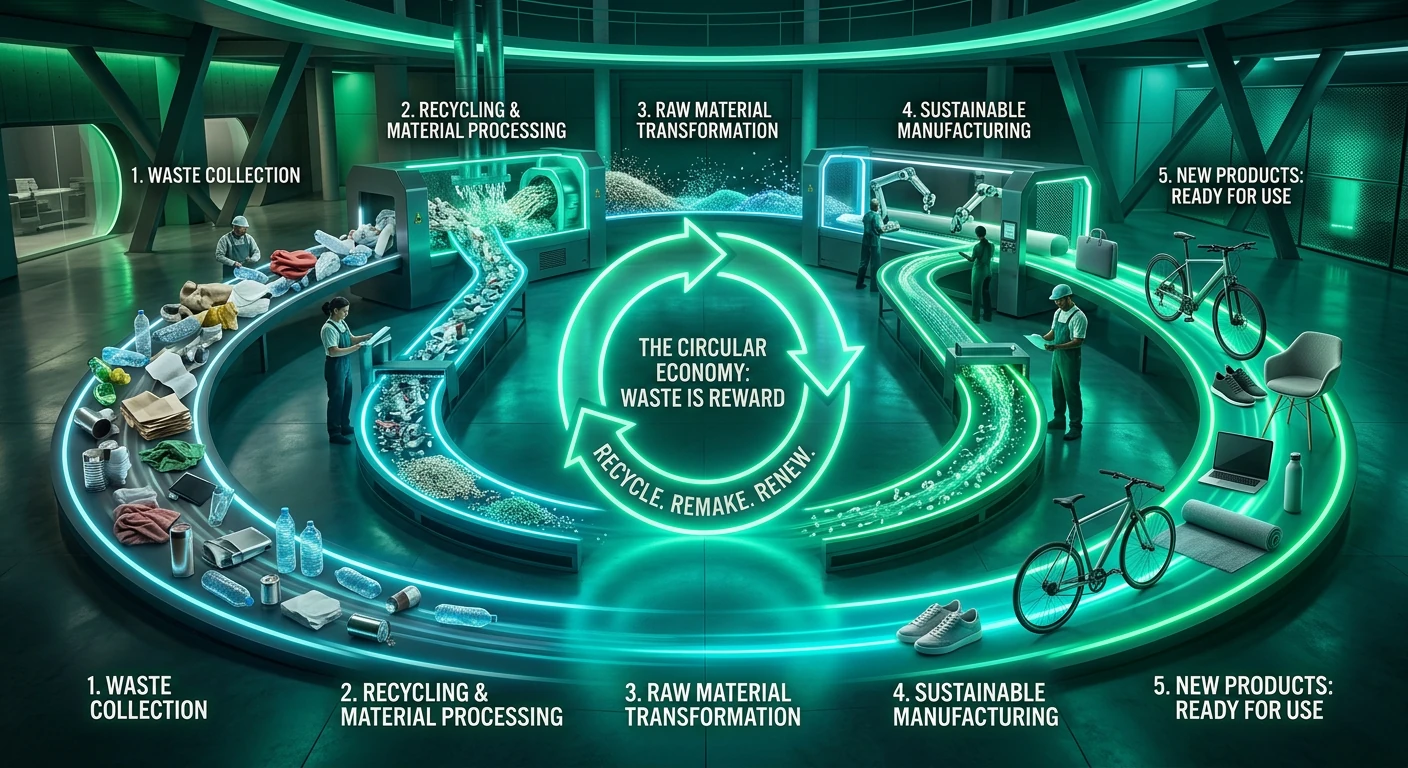
The phrase "circular economy" appears frequently in government policy documents and corporate sustainability reports, but what does it actually mean for a Melbourne business trying to manage its waste costs and environmental impact? This guide strips away the theory and focuses on practical actions that real businesses can take.
Linear vs Circular: What the Difference Means in Practice
The traditional business model is linear: take raw materials, make products, use them, and throw them away. This "take-make-waste" approach treats materials as disposable. Every item has a single life, and its endpoint is landfill.
A circular economy keeps materials in use for as long as possible. Products are designed for durability, components are repaired and reused, and materials are recovered and recycled back into production. Waste, in the circular model, is a design failure rather than an inevitable outcome.
For most businesses, the shift from linear to circular does not require a complete overhaul. It starts with examining your waste streams and asking a simple question: which of these materials could have a second life?
The Waste Hierarchy in Practice
Victoria's waste management framework is built around the waste hierarchy, which prioritises actions in this order:
- Avoid - prevent waste from being generated in the first place
- Reduce - minimise the volume and toxicity of waste produced
- Reuse - use items again for their original purpose or repurpose them
- Recycle - recover materials for reprocessing into new products
- Recover - extract energy or other value from waste
- Dispose - send to landfill only as a last resort
Most businesses focus almost exclusively on the bottom two levels: recycling and disposal. Circular economy thinking pushes effort towards the top of the hierarchy, where the greatest environmental and financial benefits sit. Avoiding a kilogram of waste saves more money and resources than recycling it, and recycling saves more than landfilling it.
Repair and Reuse Programmes
Before anything enters a waste stream, consider whether it can be repaired or reused. This applies across industries:
- Office furniture and equipment - broken chairs, desks, and monitors can often be repaired for a fraction of replacement cost. Melbourne has a growing network of commercial furniture refurbishers
- Pallets and crates - reusable pallets can circulate dozens of times before end of life. Pallet pooling services and repair companies extend the useful life of wooden and plastic pallets significantly
- Packaging materials - bubble wrap, packing peanuts, and cardboard inserts can be collected and reused internally or offered to other local businesses
- Textiles and uniforms - workwear with minor damage can be repaired. End-of-life uniforms can be donated, downcycled into cleaning rags, or processed through textile recycling
The financial case for reuse is often stronger than businesses expect. A Melbourne logistics company that switched from single-use cardboard packaging to returnable plastic crates for local deliveries saved over $40,000 per year in packaging costs alone, after accounting for the initial crate investment.
Closed-Loop Systems with Suppliers
A closed-loop system is one where materials circulate between your business and your suppliers rather than flowing in one direction to landfill. Common examples include:
- Packaging return - suppliers take back their packaging for reuse. This is standard in some industries (beverage kegs, gas cylinders) but underutilised in others
- Chemical and solvent recovery - used solvents and chemicals can often be returned to the supplier for reprocessing rather than disposed of as hazardous waste
- Manufacturing offcuts - production waste such as metal, timber, or plastic offcuts can be returned to the material supplier for reprocessing
Setting up a closed-loop arrangement typically requires a conversation with your supplier and a modest logistics adjustment. The cost savings from avoided waste disposal and reduced raw material purchasing usually justify the effort within months.
Industrial Symbiosis: One Business's Waste Is Another's Input
Industrial symbiosis is the practice of connecting businesses so that the waste output of one becomes the raw material input of another. While the concept sounds theoretical, it is already happening across Melbourne:
- Coffee grounds from hospitality businesses are collected by urban farms and composting operations for use as growing medium and soil amendment
- Food waste from supermarkets and restaurants is processed into animal feed or compost
- Construction demolition waste, particularly concrete, brick, and timber, is crushed and reused as road base, aggregate, or engineered wood products
- Cooking oil from restaurants is collected for biodiesel production
- Cardboard and paper waste is collected by paper mills as feedstock
The key to industrial symbiosis is knowing what you have and who needs it. Waste that costs your business money to dispose of may have genuine value to another business. Waste partners play a useful role here, connecting businesses with outlets for materials that would otherwise go to landfill.
Circular Economy vs Recycling
Recycling is part of the circular economy, but it is not the whole picture. In fact, over-reliance on recycling can become a barrier to circular thinking.
Recycling addresses waste after it has been created. It processes used materials into new raw materials, which requires energy, transport, and processing infrastructure. Some materials degrade with each recycling cycle (paper fibres shorten, some plastics lose quality), limiting the number of times they can be recycled.
Circular economy strategies address waste before it is created. They focus on keeping products and materials at their highest value for as long as possible. A repaired piece of equipment retains more value than one that is scrapped and recycled. A reused packaging container avoids the energy cost of recycling entirely.
For your waste reduction plan, this means prioritising avoidance and reuse before recycling, and treating landfill disposal as a genuine last resort.
Victorian Government Circular Economy Policy
The Victorian Government's Recycling Victoria policy, released as part of the Circular Economy Act 2021, sets ambitious targets that directly affect businesses:
- Divert 80 per cent of waste from landfill by 2030
- Cut total waste generation by 15 per cent per capita by 2030
- Halve the volume of organic waste going to landfill by 2030
- Ensure every Victorian household and business has access to food and garden organic waste recycling
The policy is backed by rising landfill levies, which make disposal progressively more expensive, and by investment in recycling infrastructure. For businesses, the direction is clear: waste disposal costs will continue to rise, and the financial incentive to adopt circular practices will only strengthen.
The compliance landscape is also evolving, with new obligations around waste reporting and management plans for larger generators.
Practical First Steps for SMEs
Small and medium enterprises often assume circular economy strategies are only for large corporations with dedicated sustainability teams. That is not the case. Here are practical starting points for any size of business:
- Audit your waste - before you can circulate materials, you need to know what you are throwing away. A waste audit is the foundation
- Talk to your suppliers - ask about packaging take-back, refillable containers, and reduced packaging options. Many suppliers offer these but customers do not ask
- Check for reuse before disposal - before putting something in a bin, ask whether it could be repaired, donated, sold, or given to another business
- Separate your waste streams properly - clean, well-separated recycling streams have higher recovery rates and lower costs than contaminated ones
- Connect with local networks - Melbourne has active business sustainability networks, industry associations, and waste exchange platforms that can connect you with circular economy opportunities
- Start small and scale - pick one waste stream where you can implement a circular approach, prove the value, and expand from there
How Waste Partners Support Circular Approaches
A waste partner sits between your business and the waste management industry, with visibility across providers, markets, and material flows. This position is useful for circular economy implementation because partners can identify outlets for materials that your current provider may send to landfill, negotiate better rates for separated streams, and connect you with specialist recyclers and reprocessors.
Bundle Waste works with Melbourne businesses to find the most cost-effective and environmentally sound destination for every waste stream. If you want to explore circular economy opportunities for your business, our free waste audit is a practical starting point.