
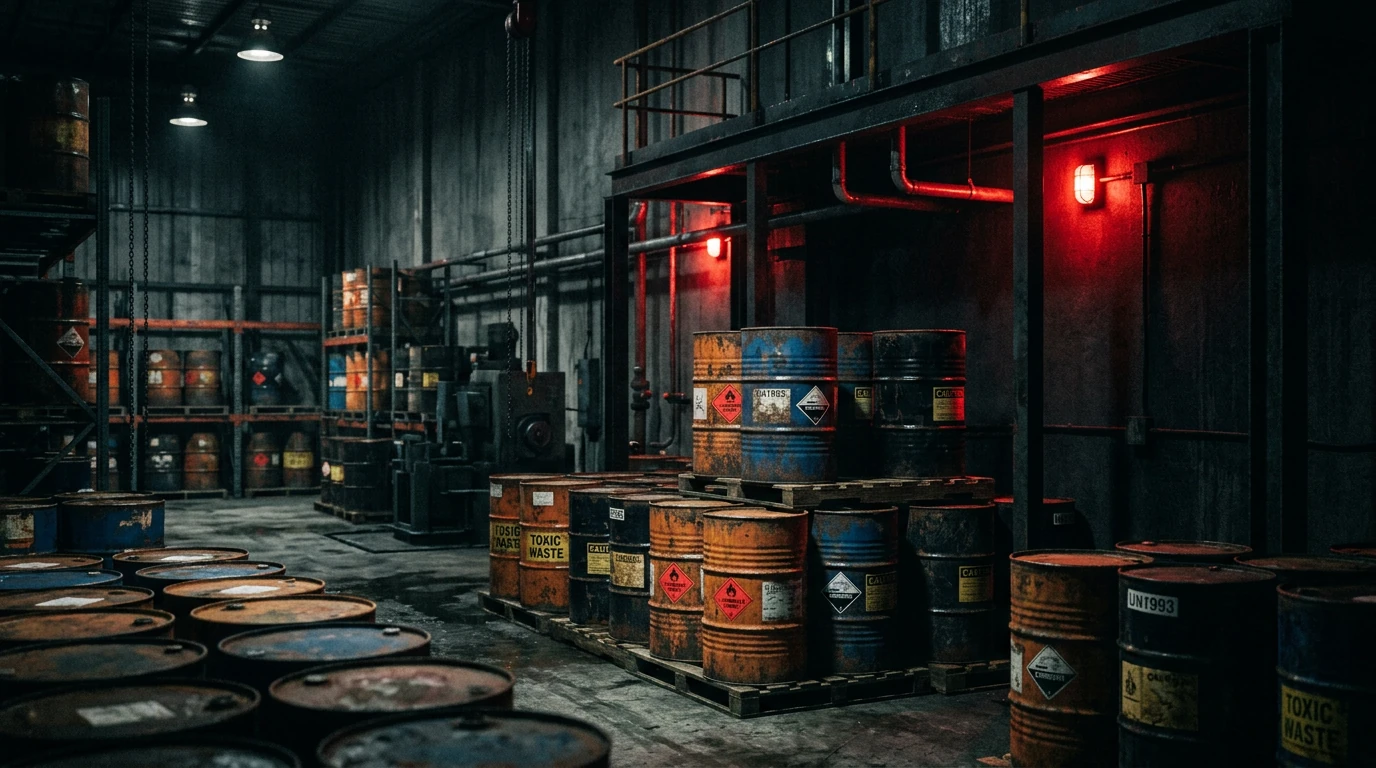
Prescribed industrial waste (PIW) is the regulatory term for waste that poses a risk to human health or the environment and requires special handling, transport, and disposal. In Victoria, PIW is regulated under the Environment Protection Act 2017 and the Environment Protection Regulations 2021, with EPA Victoria as the enforcing authority.
If your business produces any form of hazardous, chemical, clinical, or contaminated waste, there is a good chance it qualifies as prescribed industrial waste. Getting the classification wrong carries serious penalties, and ignorance is not accepted as a defence.
What Makes Waste "Prescribed" vs General Industrial
All waste from commercial and industrial activities is classified as industrial waste. The key distinction is between general industrial waste and prescribed industrial waste.
General industrial waste includes materials like cardboard, timber, plastics, scrap metal, and food waste from commercial operations. These materials can be collected by standard waste providers and taken to licenced landfills or recycling facilities without special handling requirements.
Prescribed industrial waste, by contrast, contains substances or has properties that make it potentially harmful. The determination is based on the waste's origin, composition, or characteristics as defined in the Environment Protection Regulations 2021. A waste becomes "prescribed" when it meets any of the criteria set out in Schedule 4 of the Regulations, which lists specific waste types by their source, chemical composition, or hazardous properties such as toxicity, flammability, corrosiveness, or reactivity.
If there is any doubt about whether your waste is prescribed, it must be tested and classified before disposal. Sending PIW to a facility that is not licenced to receive it is a serious offence.
PIW Categories: A, B, C, and D
Victoria classifies prescribed industrial waste into four risk-based categories. The category determines the level of control required for transport, storage, and disposal.
Category A: Highest Risk
Category A includes the most dangerous waste types. These are materials that pose an immediate or severe risk to human health and the environment. Examples include polychlorinated biphenyls (PCBs) at concentrations above 50 mg/kg, certain organochlorine pesticide wastes, highly toxic chemical residues, and some pharmaceutical manufacturing wastes. Category A waste requires the strictest controls and can only be received by facilities specifically licenced for this category.
Category B: High Risk
Category B covers a broad range of industrial chemical wastes. Common examples include strong acids and alkalis, heavy metal-bearing wastes (lead, mercury, cadmium, chromium), waste oils containing contaminants above threshold levels, plating and metal finishing wastes, and solvent-contaminated materials. Many manufacturing and automotive businesses generate Category B waste.
Category C: Moderate Risk
Category C includes lower-toxicity prescribed wastes. This category captures many types of contaminated soil (depending on contaminant levels), industrial sludges, waste paints and paint-related materials, some types of waste ink, and treated timber waste. Category C is often relevant to construction and demolition activities where contaminated soil is excavated.
Category D: Lowest Prescribed Category
Category D covers the lowest-risk prescribed wastes. The most common Category D waste is asbestos in bonded form (such as fibro sheeting). Low-contamination soils that exceed the general industrial waste thresholds but fall below Category C levels also fall here. While Category D carries the lightest prescribed waste requirements, it still requires transport certificates and disposal at appropriately licenced facilities.
Common PIW Types in Melbourne Businesses
Many businesses generate prescribed industrial waste without realising it. Common PIW types encountered across Melbourne include:
- Solvents and degreasers - used in manufacturing, printing, automotive, and cleaning operations
- Waste paints and coatings - from manufacturing, construction, and maintenance activities
- Acids and alkalis - from cleaning processes, laboratories, and metal treatment
- Asbestos - from building renovation and demolition, extremely common in pre-1990 buildings
- Contaminated soil - from excavation on sites with historical industrial use
- Clinical and pharmaceutical waste - from healthcare facilities, veterinary clinics, and pharmacies
- Batteries containing heavy metals - lead-acid batteries, nickel-cadmium batteries
- Fluorescent tubes and lamps - contain mercury, a prescribed substance
- Used oil filters - from automotive workshops and fleet maintenance
If your business handles any of these materials, you should verify whether your current waste arrangements meet PIW requirements.
Transport Certificate Requirements
Every movement of prescribed industrial waste in Victoria must be documented with an EPA transport certificate. This is a non-negotiable requirement under the Environment Protection Regulations 2021.
The transport certificate must include:
- Full details of the waste generator, including business name, address, and contact person
- Description of the waste, including its PIW category and any relevant classification codes
- Quantity of waste being transported (in tonnes or litres)
- Details of the waste transporter, including their EPA registration number
- The receiving facility's name, address, and EPA licence number
- Signatures from the generator, transporter, and receiver
Transport certificates can be managed electronically through EPA Victoria's online system. Your waste provider should initiate the certificate process, but as the waste generator, you are ultimately responsible for ensuring certificates are completed for every PIW collection. If EPA Victoria audits your records and finds missing transport certificates, you face penalties regardless of whether your provider failed to complete them.
Licenced vs Unlicenced Facilities
Prescribed industrial waste must be taken to a facility that holds an EPA licence specifically authorising it to receive that waste category. Not all waste facilities are licenced for PIW, and those that are may only be licenced for certain categories or waste types.
Sending PIW to an unlicenced facility is an offence for both the transporter and the waste generator. Your duty of care requires you to verify that the facility receiving your waste is appropriately licenced before any waste leaves your premises.
You can check facility licences on the EPA Victoria public register. Look for the specific waste types and categories covered by the licence, not just whether a licence exists. A facility licenced for Category D asbestos, for example, is not necessarily licenced to receive Category B chemical waste.
On-Site Storage Requirements
If your business stores PIW on its premises before collection, you must comply with storage requirements under the Environment Protection Regulations 2021. The requirements vary by waste type and quantity, but general principles apply to all PIW storage:
- Containment - PIW must be stored in containers that are compatible with the waste type and in good condition. Leaking or damaged containers must be replaced immediately.
- Bunding - liquid PIW storage areas should be bunded to contain spills. The bund must be capable of holding at least 110 per cent of the volume of the largest container.
- Segregation - incompatible waste types must be stored separately. Acids and alkalis, for example, must not be stored in the same bunded area.
- Labelling - all PIW containers must be clearly labelled with the waste type, hazard information, and the date storage commenced.
- Security - storage areas must be secured against unauthorised access, particularly for highly toxic Category A and B wastes.
- Time limits - PIW should not be stored indefinitely. While there is no universal time limit, prolonged storage may trigger additional EPA requirements or constitute a breach of the General Environmental Duty.
Record-Keeping Obligations
Victorian businesses that generate PIW must maintain records for a minimum of three years. The record-keeping requirements are more stringent than for general industrial waste and include:
- Copies of all transport certificates for PIW leaving your premises
- Waste classification reports and testing results
- Details of the licensed transporters and facilities you engage
- Quantities of PIW generated, stored, and dispatched, including dates
- Any incident reports related to PIW handling, spills, or contamination
- Training records for staff who handle PIW
These records must be available for inspection by EPA Victoria officers at any time. Digital record-keeping is acceptable, provided the records are accessible, searchable, and can be produced promptly on request.
How to Get Waste Classified and Tested
If you are unsure whether your waste qualifies as prescribed industrial waste, you need to have it classified. The process involves:
- Identify the waste source - determine the process or activity that generated the waste. Some wastes are prescribed based solely on their origin, regardless of test results.
- Check Schedule 4 - review the list of prescribed waste types in Schedule 4 of the Environment Protection Regulations 2021. If your waste matches a listed type, it is prescribed.
- Arrange testing - if classification is not clear from the source, engage a NATA-accredited laboratory to test the waste. Testing determines the presence and concentration of prescribed substances.
- Compare results to thresholds - the Regulations set concentration thresholds for various contaminants. Results above these thresholds classify the waste as prescribed and determine its category (A, B, C, or D).
- Document the classification - retain the classification report and test results as part of your record-keeping obligations.
Classification is not a one-time exercise. If your processes change, the raw materials you use change, or you generate a new waste stream, the classification should be reviewed. Bundle Waste can help you identify which of your waste streams may require classification and connect you with appropriate testing services as part of our free waste audit.
If in doubt, treat the waste as prescribed until testing confirms otherwise. The cost of proper classification is negligible compared to the penalties for getting it wrong.