
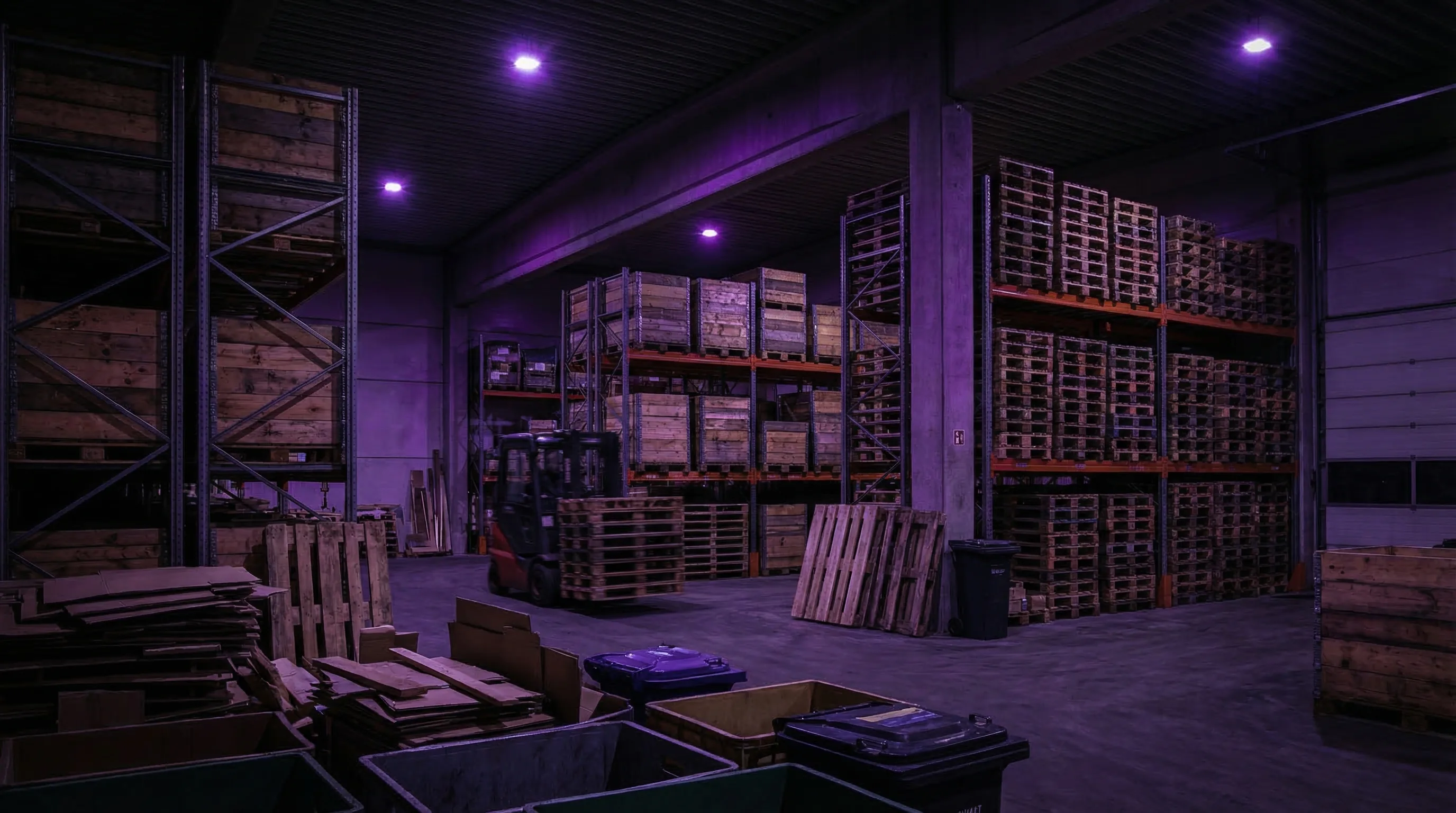
Warehouses and distribution centres in Melbourne's industrial corridors, from Laverton and Truganina in the west to Dandenong South and Hallam in the south-east, generate some of the highest waste volumes of any commercial operation. A mid-sized distribution centre processing 500 to 1,000 pallets per week can easily produce 2,000 to 5,000 kilograms of waste, predominantly cardboard, stretch wrap, pallets, and packaging materials.
The good news is that 80 to 90 per cent of warehouse waste is recyclable. The challenge is setting up systems that capture that value efficiently without creating bottlenecks in your operations.
The Main Warehouse Waste Streams
Pallets
Pallet management is one of the largest waste-related costs for warehouses. Standard CHEP and Loscam pallets operate on a hire and return system, but plain timber pallets accumulate quickly. A warehouse receiving 200 plain pallets per week faces a choice: pay for disposal, find a recycler, or let them pile up in the yard.
Pallet recycling options in Melbourne include:
- Pallet resellers: Companies that collect, repair, and resell reusable pallets. They may collect for free or pay a small amount per pallet if the quality is consistent.
- Pallet recyclers: Facilities that chip or shred pallets for mulch, animal bedding, or biomass fuel. Collection is typically free for volumes above 50 pallets.
- General waste disposal: The most expensive option. Sending pallets to landfill via skip bin costs $150 to $250 per tonne, and timber pallets are heavy.
The worst option is doing nothing. Pallet stockpiles create fire risk, attract pests, and take up valuable yard space. Council fire orders for pallet accumulation in Melbourne's western suburbs are not uncommon.
Stretch Wrap
Stretch wrap (pallet wrap) is the second-largest waste stream by volume in most warehouses. A distribution centre unwrapping 500 pallets per week generates 50 to 100 kilograms of stretch wrap. This material is 100 per cent recyclable through commercial soft plastic recycling programmes, but it must be collected separately from other waste.
Set up dedicated stretch wrap collection points at each unwrapping station. Large collection cages or bins work well. The key is keeping the material clean: stretch wrap contaminated with labels, tape residue, or food is rejected by recyclers and sent to landfill. Remove labels and tape before placing wrap in the collection point.
Several Melbourne recyclers offer free collection of clean stretch wrap in bulk quantities. Some will pay rebates for consistent, high-quality material. For a warehouse generating 400 kilograms or more per month, this is worth investigating.
Cardboard
Cardboard from outer cartons, slip sheets, layer pads, and packaging inserts is a constant stream in any warehouse. For high-volume operations, a cardboard baler is the most cost-effective handling method. A horizontal baler produces dense bales of 300 to 500 kilograms that can be collected by recycling companies, often at no cost or with a rebate.
Baler options for warehouses:
- Vertical balers: Compact footprint, suitable for smaller warehouses. Produce bales of 100 to 250 kilograms. Cost: $4,000 to $10,000 to purchase, or $150 to $300 per month to lease.
- Horizontal balers: Higher throughput, suitable for distribution centres. Produce bales of 300 to 600 kilograms. Cost: $15,000 to $40,000 to purchase, or $400 to $800 per month to lease.
- Auto-tie balers: Fully automated, feed cardboard in one end and bales come out the other. Suitable for very high-volume operations. Cost: $50,000 and up.
Without a baler, cardboard occupies enormous bin volume. A single 1,100-litre bin holds roughly 40 kilograms of loose cardboard but over 120 kilograms when baled. The difference in collection costs over a year is substantial.
Contaminated Packaging
Damaged goods, spills, and transit damage create contaminated packaging that cannot be recycled through standard streams. Cardboard soaked with chemicals, food residue, or oils must go into general waste. Packaging contaminated with hazardous materials requires separate collection through a licensed hazardous waste service.
Keeping contaminated packaging separate from clean recyclable material is essential. One contaminated box in a recycling bin can cause an entire load to be rejected. Train warehouse staff to direct damaged or soiled packaging to general waste immediately rather than mixing it with clean cardboard.
Hazardous Materials from Damaged Goods
Warehouses storing chemicals, paints, batteries, aerosols, or cleaning products face occasional spills and damaged goods that generate hazardous waste. Under EPA Victoria regulations, hazardous waste must be stored in bunded areas, handled by trained staff, and collected by licensed operators.
Having a spill response kit and clear procedures for damaged hazardous goods prevents small incidents from becoming expensive clean-up jobs. A standard spill kit for a warehouse costs $200 to $500 and should be positioned near storage areas for chemicals and hazardous goods.
Compactor Options for Warehouses
For warehouses with high general waste volumes, a compactor reduces both collection frequency and costs. The most common options are:
Stationary Compactors
A stationary compactor sits at your loading dock and feeds into a detachable hook-lift bin. When the bin is full, the waste provider swaps it for an empty one. Compaction ratios of 4:1 to 6:1 mean you get four to six times more waste into each bin before it needs swapping. For a warehouse currently swapping bins three times per week, a compactor can reduce this to once per week or less.
Lease costs for stationary compactors range from $500 to $1,200 per month. The net saving after lease costs typically runs $800 to $2,000 per month for operations spending $3,000 or more on waste collection.
Self-Contained Compactors
These units combine the compactor and container in one piece of equipment. They are particularly useful for wet waste or waste that might leak, as the sealed design prevents runoff. Self-contained compactors are common in food distribution warehouses and cold storage facilities.
Consolidating Multi-Stream Waste
Most warehouses end up with multiple waste providers: one for general waste, another for cardboard recycling, a third for pallet collection, and possibly a fourth for hazardous waste. This creates administrative complexity, multiple invoices, and eliminates any volume-based pricing leverage.
Consolidating waste services under one provider or through a waste partner simplifies management and typically reduces total costs by 10 to 20 per cent through bundled pricing. A single point of contact for all waste issues also means faster response times when bins are full, collections are missed, or problems arise.
Bundle Waste specialises in consolidating warehouse waste services across Melbourne. Our free waste audit covers all streams, benchmarks your current rates, and presents a consolidated service proposal with projected savings. For distribution companies operating multiple warehouses, we provide cross-site reporting and coordinated service management.
In a warehouse, waste management is a logistics problem. Treat it like one, and the costs come down.