
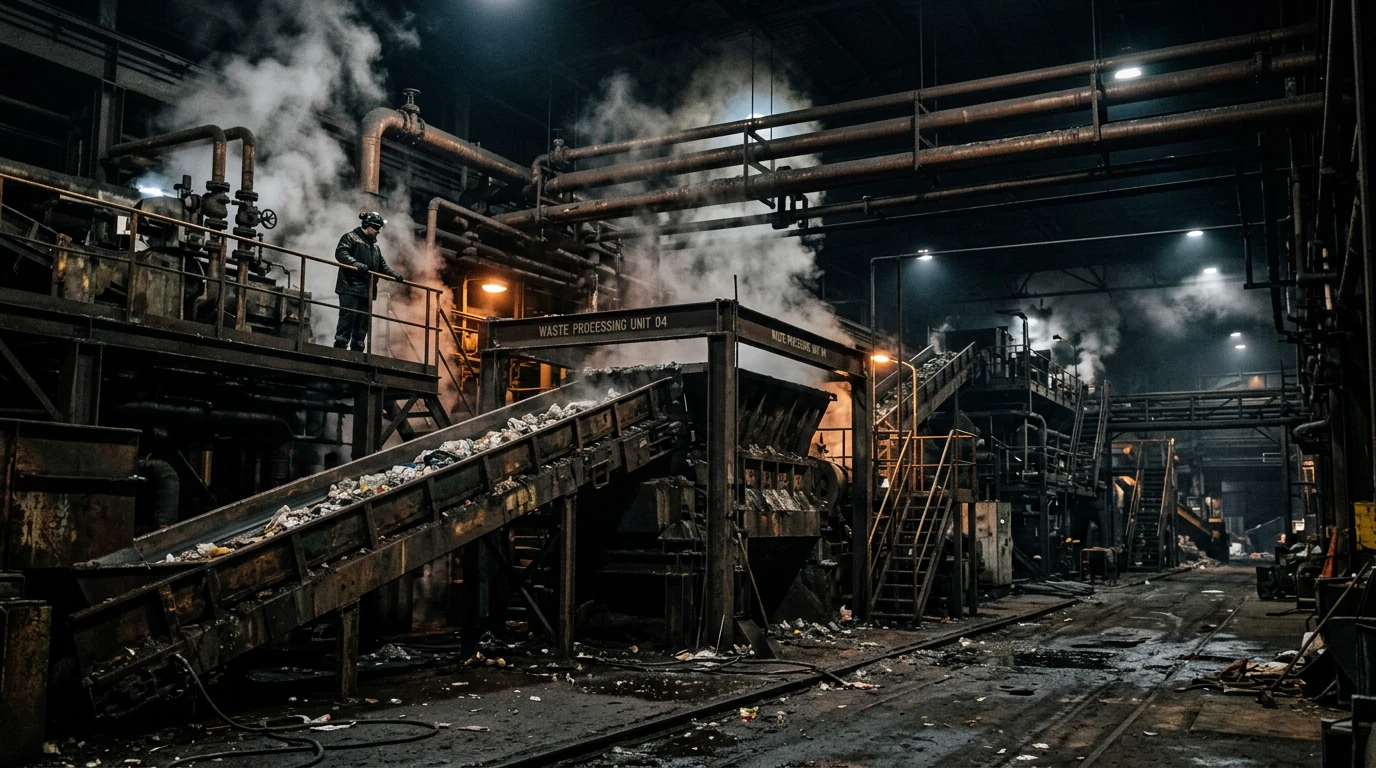
Waste-to-energy (WtE) is one of the most debated topics in Australian waste management. Proponents argue it diverts waste from landfill and generates renewable energy. Critics say it undermines recycling efforts and creates emissions. For business decision-makers, the relevant question is more practical: will waste-to-energy affect your costs, and should it change your waste management strategy?
The short answer is yes — not immediately, but within the next 3-5 years. Several large-scale WtE facilities are under construction or in planning across Australia, and their arrival will reshape how residual waste is priced and managed. Here is what you need to know.
How Waste-to-Energy Works
The most common form of waste-to-energy in Australia is thermal treatment — specifically, moving grate incineration. Residual waste (waste that cannot be economically recycled) is burned at high temperatures (typically above 850°C), generating steam that drives turbines to produce electricity. Modern facilities also include extensive emissions control systems — filters, scrubbers, and monitoring equipment — to meet strict air quality standards.
Other WtE technologies include gasification (converting waste to synthetic gas), pyrolysis (thermal decomposition without oxygen), and anaerobic digestion (biological breakdown of organic waste to produce biogas). Anaerobic digestion is already widely used in Australia for food and organic waste, while thermal WtE is still emerging.
Where WtE Facilities Are Operating or Planned
Australia's WtE sector is developing rapidly:
- Kwinana, WA (operational): Australia's first large-scale WtE facility, operated by Avertas Energy. Processes 400,000 tonnes of residual waste per year, generating 36MW of baseload electricity
- East Rockingham, WA (under construction): A second WA facility by Veolia, targeting 300,000 tonnes per year
- Maryvale, VIC (approved): Opal Australian Paper's proposed facility would process 325,000 tonnes of residual waste annually. If built, it would be Victoria's first large-scale thermal WtE plant
- Western Sydney (proposed): Several facilities have been proposed for the Western Sydney area, though NSW has implemented a temporary moratorium on new thermal WtE approvals while developing its policy framework
Victoria's Position on Waste-to-Energy
Victoria has taken a cautious approach to WtE. The state's waste-to-energy framework, released in 2021, establishes a clear waste hierarchy: avoidance first, then reuse, recycling, recovery (including energy recovery), and lastly disposal. WtE is positioned as preferable to landfill but subordinate to recycling.
For Victorian businesses, the key policy positions are:
- WtE facilities must demonstrate they are only processing genuinely residual waste — material that cannot be economically recycled
- Facilities must meet strict EPA Victoria emissions standards
- The landfill levy does not apply to waste sent to WtE facilities, creating a growing cost advantage over landfill as levies increase
- Gate fees at WtE facilities are expected to be competitive with or slightly below landfill gate fees once levy is factored in
What This Means for Business Waste Costs
The economic equation is straightforward. As landfill levies continue to rise (Victoria's metropolitan levy has increased from $65.90 per tonne in 2019 to $106.19 in 2025), the cost of sending residual waste to landfill increases year on year. WtE facilities, which are exempt from the levy, become increasingly cost-competitive.
Once Victoria has operational WtE capacity, businesses can expect:
- Stable or lower residual waste costs: WtE gate fees are expected to be $120-$170 per tonne, competitive with current landfill costs (gate fee + levy) and insulated from annual levy increases
- Increased pressure to sort properly: WtE facilities need consistent feedstock. Waste providers will have stronger incentives to help clients separate recyclables, which should improve your contamination rates and recycling outcomes
- New sustainability reporting options: Sending residual waste to WtE rather than landfill can be reported as energy recovery in your sustainability reports, improving your landfill diversion metrics
Should You Change Your Waste Strategy Now?
Not dramatically — but you should be aware of the direction and plan accordingly:
Keep prioritising waste reduction and recycling. WtE is not a substitute for reducing waste at source or improving recycling rates. The waste hierarchy still applies, and WtE is only suitable for genuinely residual waste. Businesses that minimise their residual waste through better separation and source reduction will always have the lowest costs.
Review long-term contracts. If you are about to sign a long-term waste contract (3+ years), ensure it includes flexibility for WtE options as they become available. You do not want to be locked into landfill-only disposal when a cheaper WtE alternative opens up mid-contract.
Track your residual waste volumes. Understanding exactly how much of your waste is genuinely non-recyclable residual material positions you to take advantage of WtE pricing when it becomes available. If you are currently sending recyclable material to landfill (which many businesses are), fixing that now will save money regardless of WtE developments.
The Broader Context
WtE is part of a broader transition in Australian waste management away from landfill dependency. Combined with rising landfill levies across all states, container deposit schemes, organic waste mandates, and circular economy policies, the direction is clear: landfill is becoming the last resort, and alternative disposal and recovery pathways are being built to replace it.
For businesses, this transition creates both risks (changing regulations, new compliance requirements) and opportunities (lower costs through better waste management, new revenue from recyclable materials). The businesses that benefit most will be those that stay informed and adapt their waste strategies proactively rather than reactively.
At Bundle Waste, we keep across these developments so you do not have to. Get in touch to discuss how your waste strategy should evolve.