Bundle Waste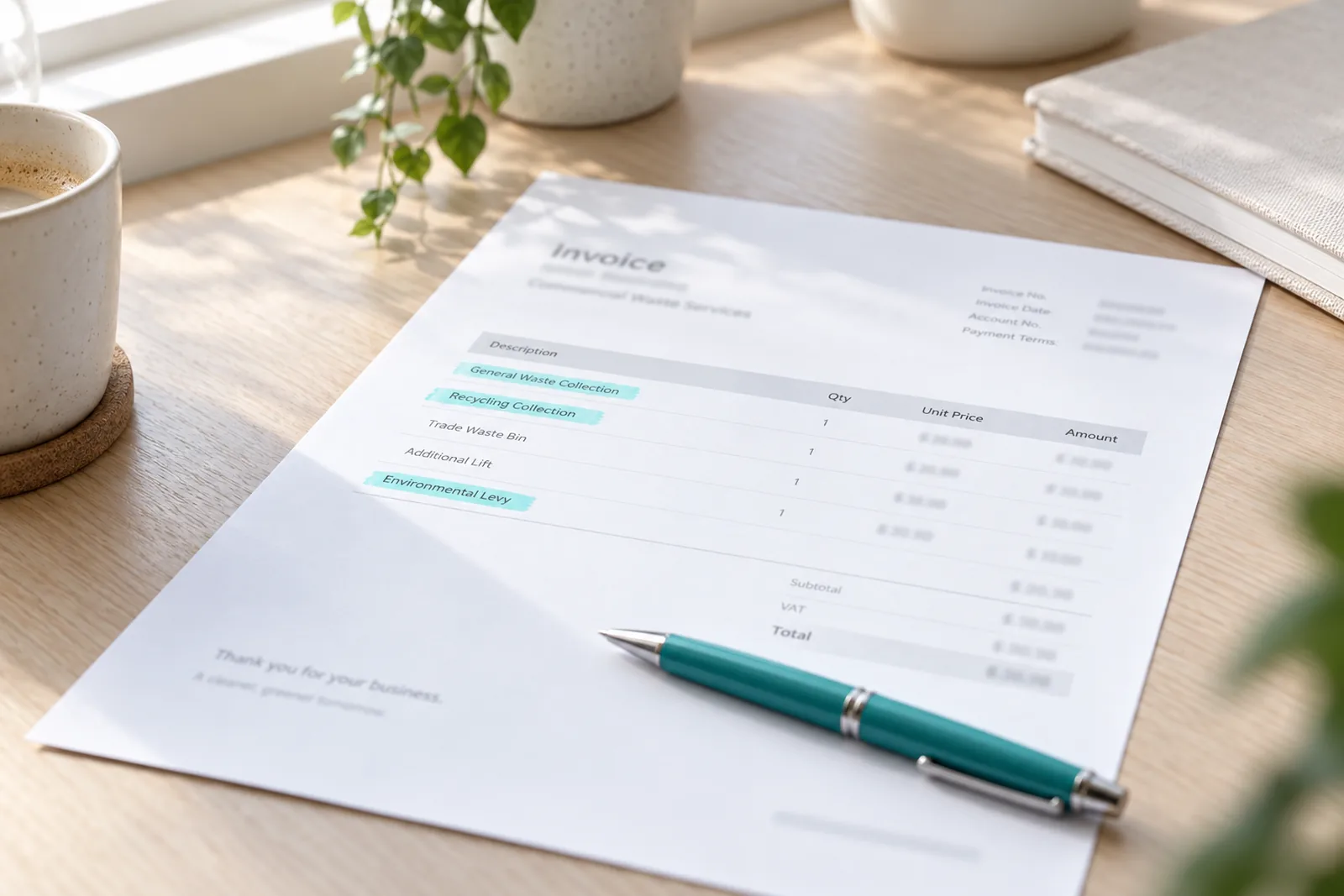
An EOFY waste cost review means auditing your waste invoices and contract before 30 June, because most Melbourne commercial waste agreements reprice or roll over from 1 July — the same day Victoria's landfill levy adjusts. Done now, a free waste audit typically finds up to 30% in savings before the new financial year's rates lock in.
Why 30 June matters for your waste bill
The Australian financial year ends on 30 June, and the waste industry's pricing calendar is built around it. Provider rate cards reset for the new financial year, contract anniversaries cluster on 1 July, and the Victorian landfill levy — the state charge on every tonne sent to landfill — adjusts on 1 July each year. Three separate pricing mechanisms move on the same day.
The catch is that most businesses only find out afterwards. Rate-rise letters typically land in July, often after the new rates have already taken effect, and by then the contract may have quietly rolled into another term. June is the one month when you still hold the cards: next year's budget isn't locked, notice windows are often still open, and a renegotiation done now settles before the new rates apply.
What actually changes on 1 July
Four things tend to move together at the start of the financial year — and because some are percentages applied on top of others, they compound:
| What moves on 1 July | What it does to your bill |
|---|---|
| Annual rate rise | Most contracts allow a yearly increase — frequently above CPI — applied from the new financial year without any renegotiation. |
| Victorian landfill levy | Adjusts on 1 July each year. The metropolitan rate is $169.79/tonne for 2025-26, and it is passed straight through to you. |
| Auto-renewal anniversaries | Contracts that anniversary on 1 July roll into a new term, resetting your exit window for another 12 months or more. |
| Pass-through recalculations | Fuel levies and environmental charges are re-set against the provider's new cost base — as percentages, they multiply the base rise. |
Several of those line items are negotiable or removable — the fuel levy, bin rental and admin fees in particular. We break down each one in hidden waste charges explained.
What Melbourne businesses pay right now
You can't judge a July price rise without knowing the market. These are typical Melbourne market rates as at June 2026 for weekly collection — they vary by zone, with the western suburbs cheapest and the CBD dearest:
| Bin size (weekly) | General waste | Commingled recycling |
|---|---|---|
| 240L | $40-75/month | $25-55/month |
| 660L | $75-145/month | $50-100/month |
| 1,100L | $110-200/month | $78-145/month |
| 3m³ front-lift | $230-450/month | $165-320/month |
| 4.5m³ front-lift | $320-580/month | — |
If your invoice already sits above these ranges before the July rise, you're funding someone else's margin. Zone-by-zone benchmarks live in the Melbourne Waste Cost Index, and the service pages for general waste and recycling cover what each stream should include.
Your EOFY waste review: five steps before 30 June
- Pull your last three invoices. Read line items, not totals — collection, fuel levy, environmental levy, bin rental, admin fees. Most increases hide in the pass-throughs, not the headline rate.
- Find your contract's dates. Anniversary, auto-renewal or rollover clause, and notice period. If notice is 60-90 days, you may already be inside the window that decides next year — note it either way.
- Benchmark every rate. Compare each line against the market ranges above. Anything sitting at or beyond the top of the range is your negotiation list.
- Right-size the service. Bins collected half-empty mean you're paying to move air. Adjusting bin size or collection frequency is the easiest saving of all — no provider change needed. The other usual suspects are covered in why is my commercial waste bill so high.
- Get the audit done before 30 June. Step one is a free waste audit — Bundle Waste reads every line, benchmarks it against a network of providers and comes back within 5 business days. No savings, no fee.
Why a June review beats a July reaction
Renegotiating in June means the new financial year starts on corrected rates; reacting in August means chasing a refund on rates you've already paid. The provider's price-rise letter usually arrives after the increase applies, so waiting to "see what happens" simply means paying the rise for a month or two first.
There's a budgeting payoff too: an audited waste number means your 2026-27 budget is built on what waste should cost, not last year's padded figure. And if your provider won't move, June gives you time to act on your exit terms — a waste broker handles the benchmarking and renegotiation for you, and switching providers is straightforward once you know your notice period.
Frequently asked questions
When do waste prices usually go up?
What happens to the landfill levy on 1 July?
Can I switch waste providers before EOFY?
Is a waste audit worth it before the new financial year?
Will my provider warn me before raising prices in July?
What should an EOFY waste cost review include?
Related guides
Get ahead of the 1 July rise
Send us one recent waste invoice before 30 June. We'll break down every charge, benchmark it against a network of providers, and finish the renegotiation before the new financial year's rates lock in — free, no obligation, no savings no fee.
Get Your Free EOFY Audit →