 Bundle Waste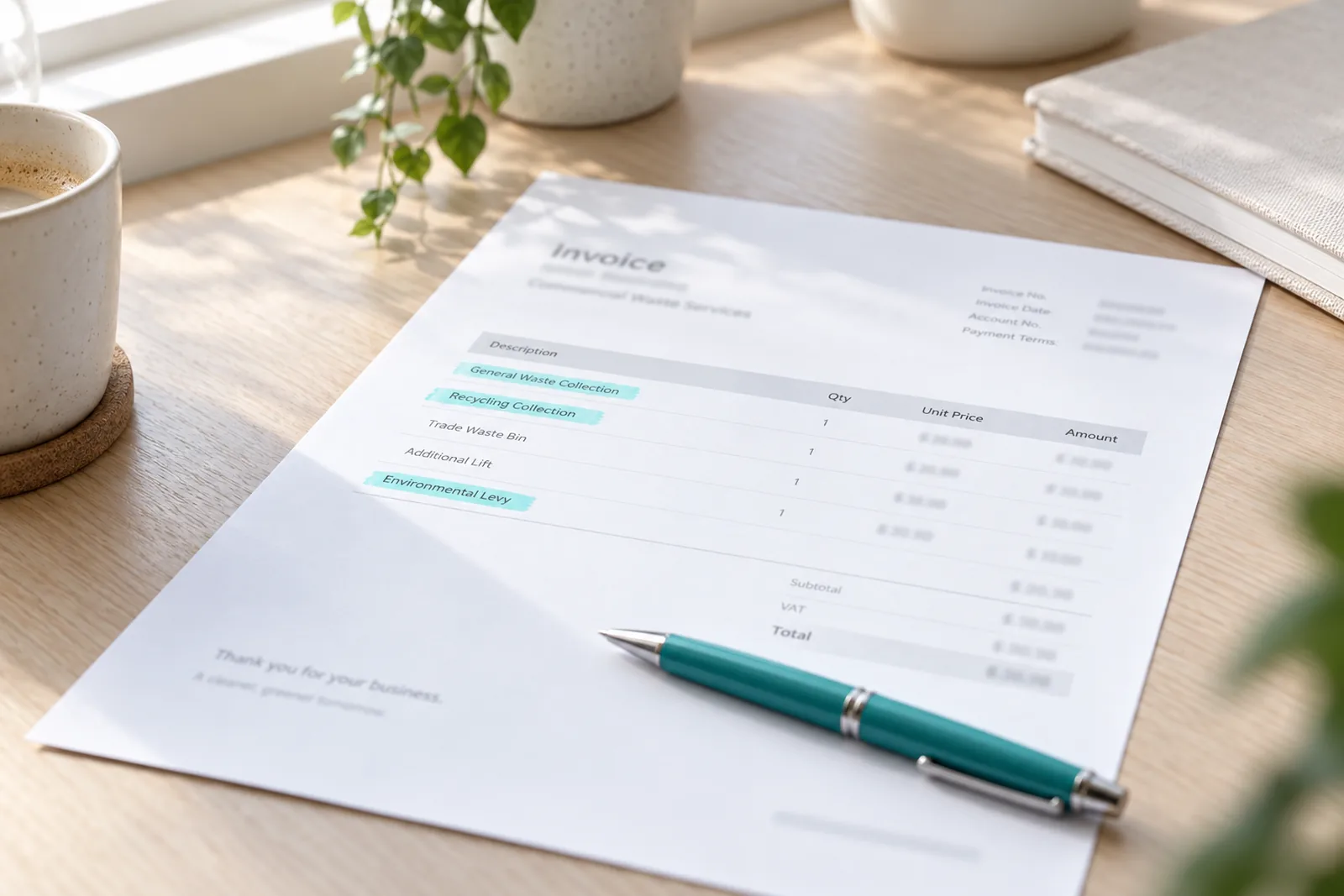
Use this checklist to compare commercial waste quotes for the same Melbourne site and service. We are not presenting an independently verified regional price index: a reliable benchmark needs a documented sample of comparable quotes.
What this page can do is show you how the number on a Melbourne waste quote is built, which parts of it are set by government and cannot move, and how to put two quotes on the same basis so the comparison means something.
Compare the same requirements in every quote
Start with your business address and collection point. Avoid assuming one Melbourne region is always cheaper than another. Ask each provider to price the same materials, containers, schedule and access conditions.
| Record | Include these details |
|---|---|
| Site | Suburb, postcode, loading access, clearance and collection hours |
| Waste stream | Materials accepted, excluded materials and contamination rules |
| Containers | Capacity, quantity, ownership and rental |
| Collections | Frequency, chargeable lifts, extra collections and holiday service |
| Price | Recurring fees, one-off charges, weight allowances and GST basis |
| Agreement | Quote expiry, term, price-review basis and notice requirements |
What actually moves the price
Two sites on the same street can be quoted differently, and the reasons are usually structural rather than negotiable:
- Distance and route. How far the truck travels to the receiving facility, and whether your site sits on an existing run, changes the cost of serving you.
- Access. Clearance, gate width, a laneway that needs a smaller truck, bins that have to be moved by hand, restricted collection hours in a CBD or a shared building.
- Container and lift profile. Bin size against collection frequency, and how the provider prices rental against each lift. Our bin size guide covers that trade-off.
- Weight allowance. What is included before an excess-weight charge applies, which matters most for dense streams.
- Disposal. What happens to the material at the end, including the statutory levy on anything landfilled.
Because these sit at site level, a regional average would not tell you what your own address should cost — which is the other reason this page does not publish one.
Keep recycling quotes separate
Ask what the provider accepts in each stream and whether the proposed service requires separate storage or handling. A recycling quote should not be treated as a general-waste price with a standard discount. Compare the actual service and charges for your site.
What to request for different services
- General waste: bin size, lift frequency, included weight and disposal charges.
- Recycling: accepted materials, sorting requirements and collection method.
- Food and organics: suitable containers, accepted inputs, collection frequency and cleaning arrangements.
- Pallet collection: pallet type, quantity, condition, ownership and loading access.
- Sanitary servicing: number of units, servicing schedule, rental and replacement terms.
The Victorian landfill levy
One component of a Melbourne waste bill is set by government and is the same whoever collects your bin. EPA Victoria's published table for 2026–27 puts municipal and industrial waste at metropolitan and provincial premises at $177.19 per tonne, up from $169.79 the year before. Rural premises are charged differently: $88.42 per tonne for municipal waste and $155.95 for industrial waste. EPA Victoria: Waste levy
It is a disposal levy, not a complete business bin price. Ask how your provider accounts for it and whether it is already included in the quoted total, or passed through and shown separately. It also only applies to material that is landfilled, which is why separating recyclable and organic material changes the disposal side of the bill as well as the collection side. Our Victorian landfill levy guide covers how it reaches an invoice.
What a defensible cost benchmark requires
Before reporting an average or range, a benchmark should disclose the observation dates, sample size, service definitions, geography, GST treatment, included fees and exclusions. It should distinguish quoted prices from invoiced charges and actual collections. An isolated supplier advertisement cannot establish what businesses across a region typically pay.
We have removed the earlier regional ranges because their underlying quote records are not available for verification. This page now provides a comparison method rather than presenting those figures as evidence.
Working out your own number instead
In the absence of a verified benchmark, the comparison that actually helps is against your own site rather than against a market average:
- Take your current invoice and separate it into recurring charges, per-lift charges, rental, levies and one-offs.
- Count the chargeable lifts over a full year, including holiday arrangements, and convert everything to the same period and GST basis.
- Check the fill level of each bin over several collections, so you know whether you are buying capacity you use.
- Ask two or three providers to price that exact service, using the table above so they are quoting the same thing.
- Where the totals differ, ask each provider to explain which line accounts for the difference before you choose.
Our Melbourne commercial waste cost guide works through the charge types in more detail.
Common comparison questions
How much does commercial waste collection cost in Melbourne?
Why do commercial waste prices vary across Melbourne?
Can I compare a monthly fee with a price per lift?
Does a lower quote mean my current provider is overcharging?
How much of my bill is the landfill levy?
What should I send for a review?
Review history
21 September 2026: restored the explanatory sections removed in the September rebuild and added the EPA Victoria levy figures for 2026–27. No regional price ranges were reinstated.
18 September 2026: replaced unverified regional price ranges and savings claims with a quote-comparison checklist. The existing URL is retained.
Sources
- EPA Victoria — Waste levy. Checked 21 September 2026; 2026–27 and 2025–26 rate tables by waste category and premises.
Calculate annual totals from your quotes · Read the Melbourne commercial waste cost guide · Ask us to review your invoice