Managing waste in the office buildings sector requires understanding specific waste streams, compliance requirements, and cost-effective disposal options. Office buildings generate significant paper and cardboard waste alongside general waste from kitchens and breakrooms. Multi-tenant buildings face challenges with waste attribution and shared bin areas. Confidential document destruction is essential for compliance. E-waste (computers, screens, printers) accumulates and requires specialist disposal. Kitchen and breakroom food waste is often the largest single stream. Recycling contamination from shared bins is a persistent issue. Bundle Waste specialises in helping office buildings businesses across Melbourne find the best waste management rates.
Office buildings generate significant paper and cardboard waste alongside general waste from kitchens and breakrooms. Multi-tenant buildings face challenges with waste attribution and shared bin areas. Confidential document destruction is essential for compliance. E-waste (computers, screens, printers) accumulates and requires specialist disposal. Kitchen and breakroom food waste is often the largest single stream. Recycling contamination from shared bins is a persistent issue.
How much does office waste management cost in Melbourne?+
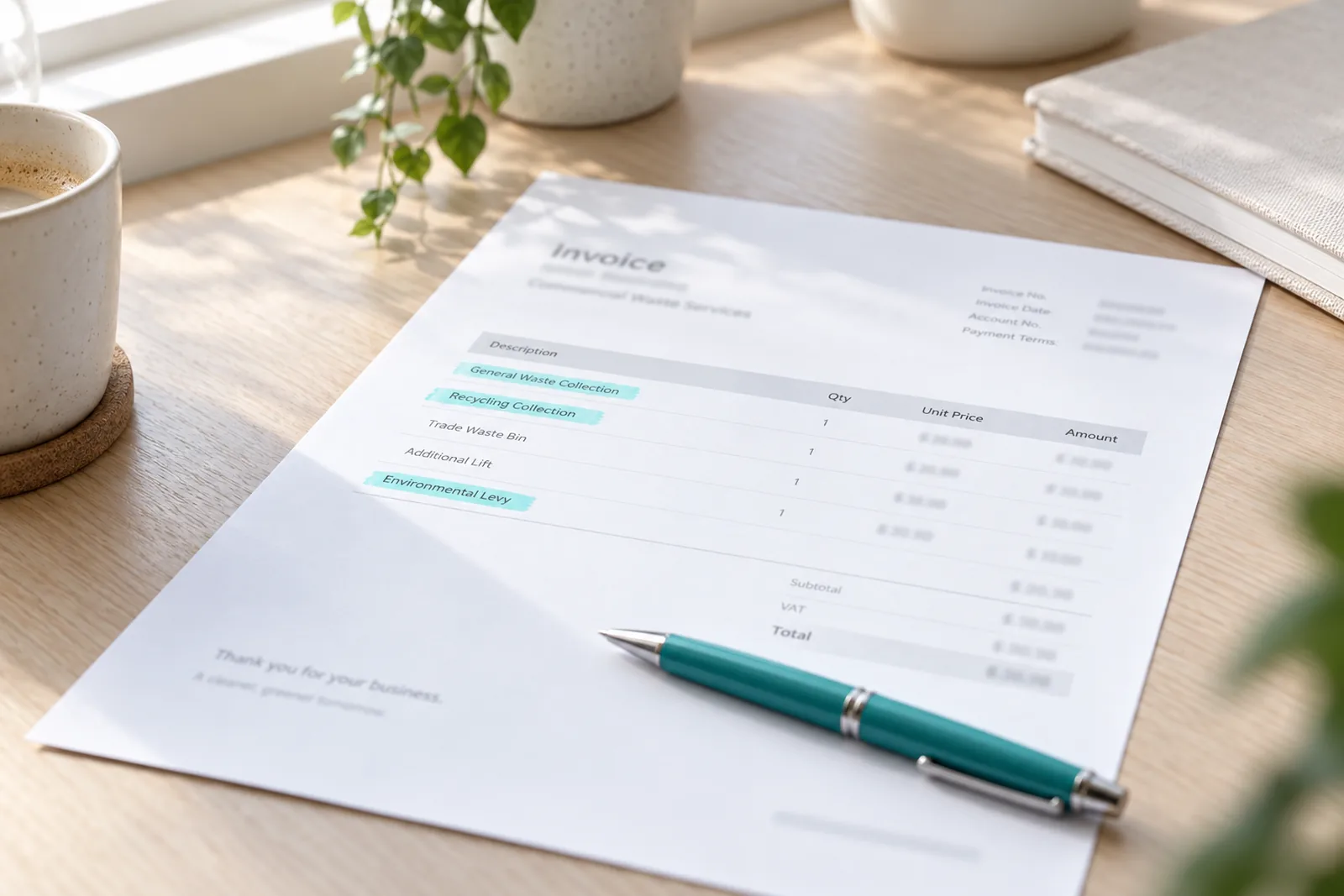
Office waste management in Melbourne typically costs $500-3,000 per month depending on office size and employee count. A small office (10-30 staff) pays $500-800/month, medium offices (50-100 staff) pay $800-1,500/month, and large offices (200+ staff) pay $1,500-3,000/month. General waste accounts for $200-800/month, recycling $100-400/month, confidential document destruction $100-300/month, food organics $50-200/month, and e-waste $50-200/quarter.
How should confidential documents be destroyed in an office?+
Under the Privacy Act 1988, offices handling personal information must securely destroy documents when no longer needed. Options: secure console bins ($30-60/month each, collected monthly or fortnightly), on-site shredding trucks ($120-200 per visit), or off-site shredding ($50-80 per 240L bin). Most offices need 1 console per 20-30 staff. Ensure your provider issues certificates of destruction and shreds to P-4 or P-5 security level. Cross-cut shredding is standard for commercial confidential waste.
What are the e-waste disposal rules for offices in Victoria?+
Since July 2019, Victoria has banned e-waste from landfill. Offices must dispose of computers, monitors, printers, phones, and other electronics through licensed e-waste recyclers. Penalties for putting e-waste in general waste are $9,000+ per offence. Many e-waste recyclers offer free collection for bulk quantities (10+ items). Data destruction should be performed before disposal — get a certificate of data destruction. Some providers offer combined e-waste recycling and data destruction services.
How can offices improve recycling rates?+
Key strategies: 1) Remove individual desk bins and use centralised waste stations (forces people to sort), 2) Pair every general waste bin with a recycling bin, 3) Use clear signage with images, 4) Place food organics bins in kitchens, 5) Make recycling bins larger than general waste bins, 6) Run quarterly waste awareness campaigns, 7) Appoint waste champions on each floor. Offices implementing centralised stations typically improve recycling rates from 20% to 50%+. The cost savings from reduced general waste often exceed the implementation cost.
What bins does an office building need?+
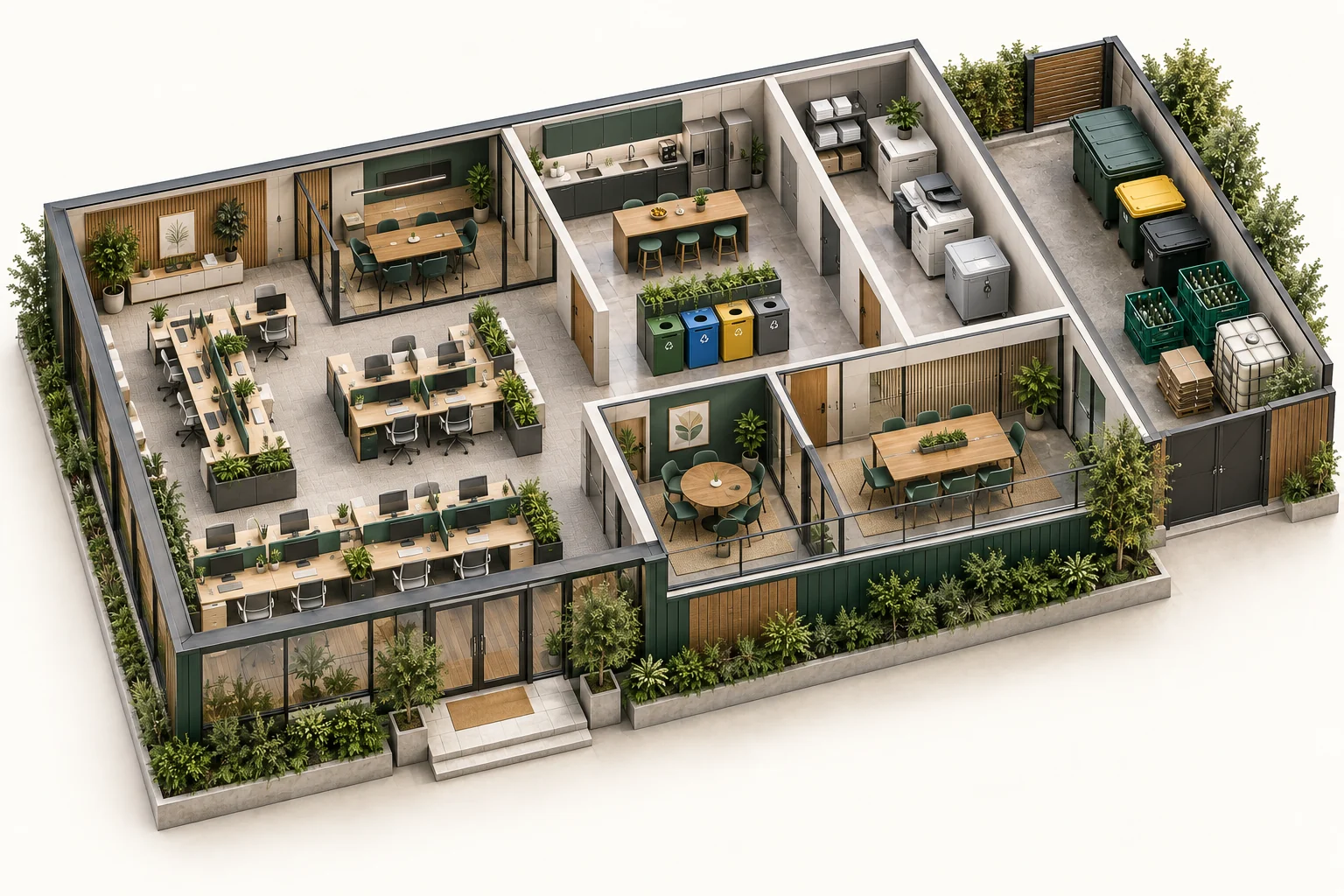
A typical Melbourne office needs: centralised waste stations with general waste, recycling, and organics bins on each floor (1 station per 30-50 staff), 660L-1100L external bins for general waste and recycling, secure document destruction consoles (1 per 20-30 staff), and an e-waste collection point. Kitchens need a food organics caddy plus general and recycling bins. The trend is toward removing under-desk bins entirely — this increases recycling rates significantly by forcing staff to use the centralised stations.
What are hazardous waste disposal costs in Melbourne?+
Hazardous waste disposal in Melbourne ranges from $2–15/kg depending on waste type. Chemical waste costs $3–8/kg, asbestos removal $50–80/m², and liquid chemical disposal $300–800 per 200L drum. All hazardous waste must be handled by EPA-licensed transporters under the Environment Protection Act 2017.
How much does clinical waste disposal cost in Melbourne?+
Clinical waste disposal in Melbourne costs $0.80–2.50/litre depending on waste category. Sharps containers (5L) cost $8–15 each, cytotoxic waste $4–8/kg, and anatomical waste $5–12/kg. Healthcare facilities typically spend $300–1,200/month. All clinical waste must comply with EPA Victoria Publication 1669.
What does document destruction cost for businesses in Melbourne?+
Secure document destruction in Melbourne costs $15–30 per 240L bin or $80–150 per 660L bin for scheduled collection. One-off purges cost $8–15 per archive box. Most providers include a certificate of destruction. Average offices spend $50–150/month.
How much does an office waste management program cost in Melbourne?+
Office waste management in Melbourne costs $120–400/month for a typical 50-person office. This includes general waste ($50–120), recycling ($40–80), paper/cardboard ($30–60), and organics ($30–60). Adding secure document destruction adds $50–150/month.
How much does grease trap servicing cost in Melbourne?+
Grease trap servicing in Melbourne costs $150–400 per service depending on trap size. A standard 1,000L trap costs $150–250, a 2,000L trap $250–400. Most food businesses need monthly or quarterly servicing. Failure to maintain grease traps can breach your trade-waste agreement, leading to penalties or suspension of your discharge consent by your water authority (such as South East Water or Yarra Valley Water).
 Bundle Waste