Bundle Waste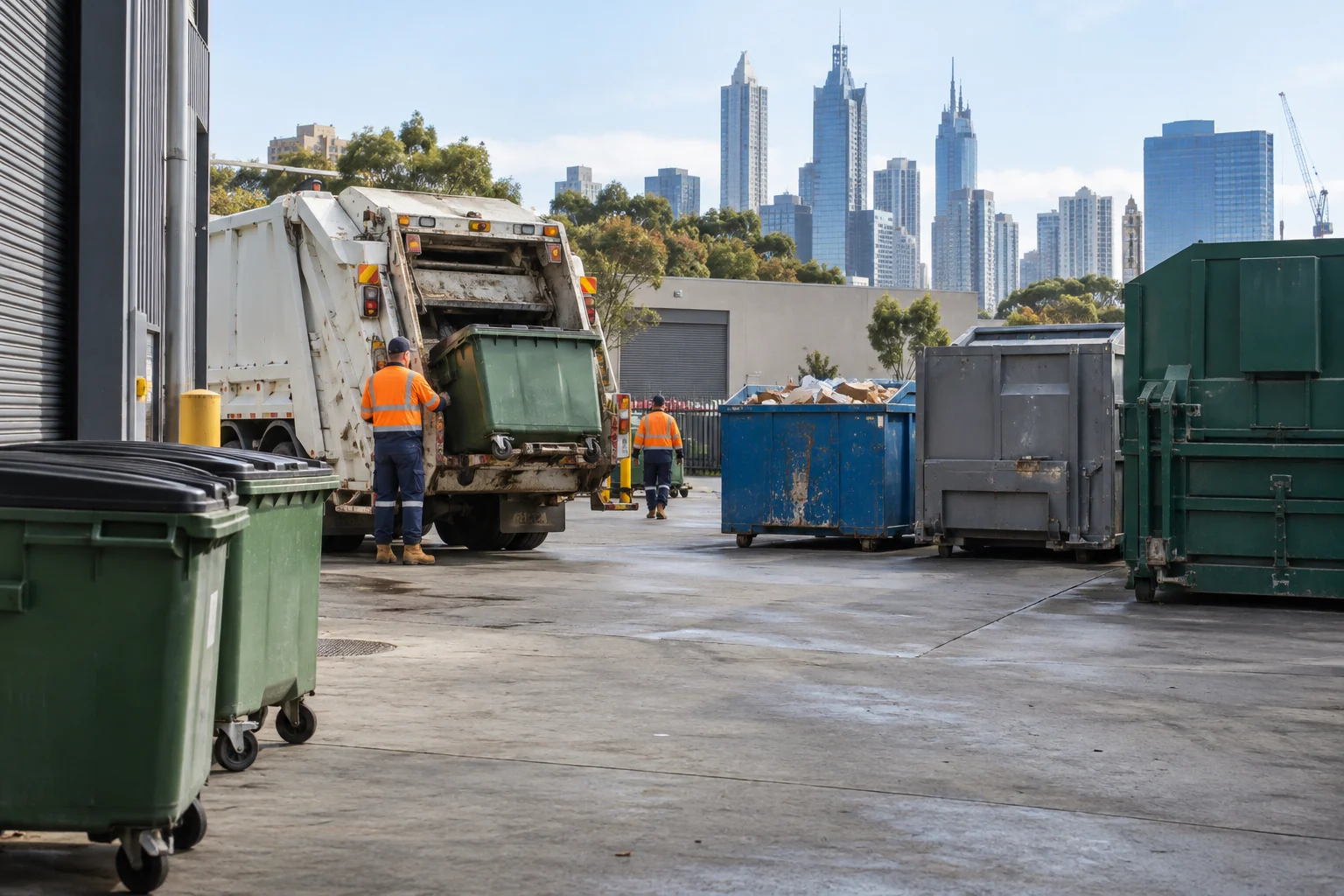
Commercial waste collection prices depend on the service quoted: the waste stream, bin size, number of collections, weight allowance and site access. Compare the full annual cost on the same GST basis, rather than treating a per-lift price as your total bill.
Bundle Waste helps Melbourne businesses review invoices, compare provider options and negotiate service arrangements. There is no universal price we can responsibly quote for every business. This guide shows you what to request and how to compare the answers.
What should a wheelie-bin quote include?
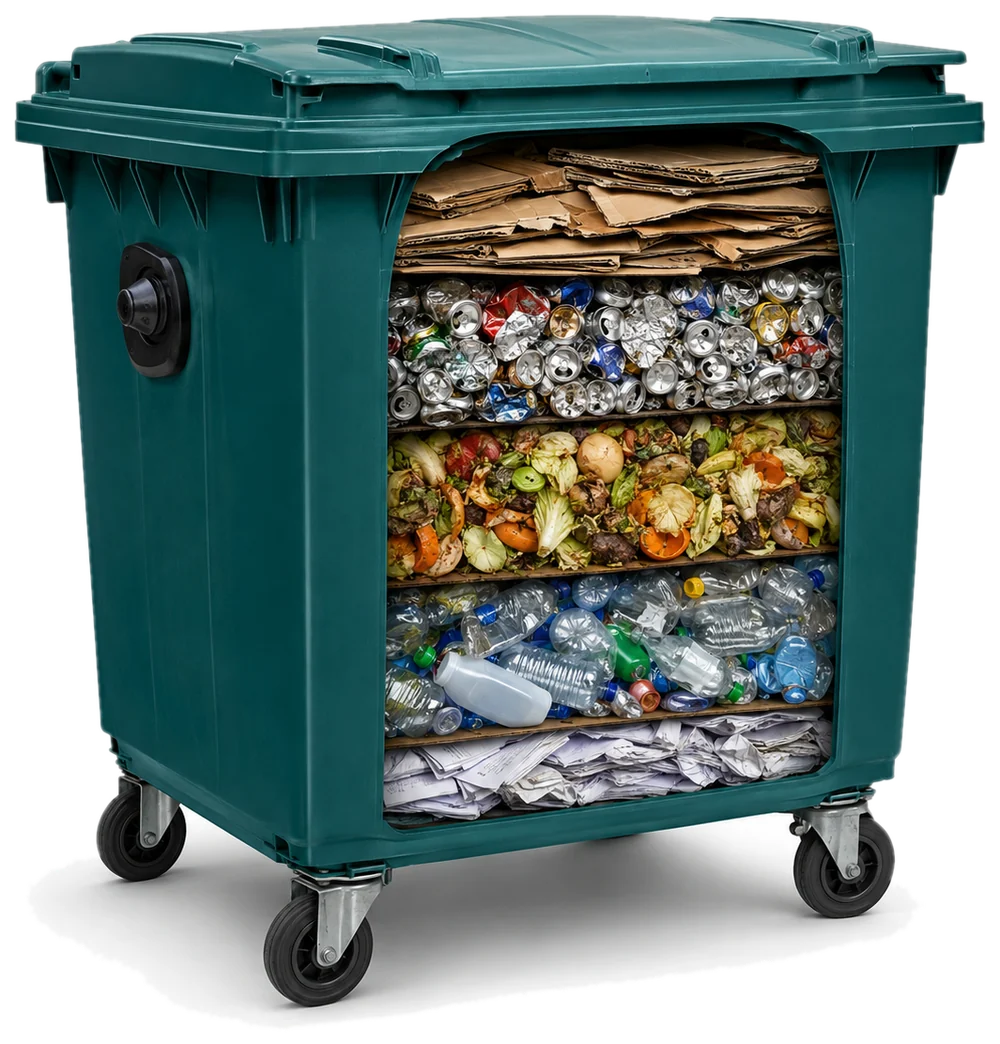
Ask for the waste stream, container capacity, number of bins and collection frequency in writing. A 240-litre bin collected weekly is a different service from an 1,100-litre bin collected several times a week. A monthly fee may include scheduled collections; a per-lift fee may not include rental or other charges.
| Quote item | What to confirm | Why it matters |
|---|---|---|
| Collections | Price per lift or included schedule; number of bins | Count chargeable lifts for the whole billing period. |
| Container charges | Rental, delivery, exchange and removal | A low collection rate can exclude these costs. |
| Weight and disposal | Included weight, excess-weight basis and levy treatment | Volume alone does not establish the disposal cost. |
| Additional fees | Fuel, administration, contamination and failed access | Ask when each fee applies and how it is calculated. |
| Contract | Term, renewal, price changes and notice requirements | The first quoted rate may not stay unchanged. |
For example, Australian Waste Management's general-waste page asks for location, bin size, frequency and quantity and separates annual and delivery charges. This is an example of a supplier's quote structure, not a Bundle Waste price or a market average.
Wheelie bins from 240 litres to 1,100 litres are emptied by a rear-lift truck: a hydraulic arm on the back of the vehicle lifts the bin and tips it into the hopper. That means the bin has to be at a kerbside or designated collection point the driver can reach on the scheduled day. Where staff have to wheel bins a long way, through a gate, or up a ramp, ask how that is charged and what happens on a day the bins are not out.
Capacity is only half the question. A bin collected while it is half full still costs a full lift, and a bin that is regularly overflowing usually signals the wrong size or the wrong frequency rather than a bad rate. Before comparing prices, work out how full your bins actually are on collection day for a normal week and a peak week.
Comparing larger bins and front-lift collection
Ask the provider to confirm the bin footprint, vehicle clearance, access route, maximum accepted weight and collection point. Compare configurations that handle your actual waste volume. A larger bin is not automatically cheaper when rental, access constraints and collection frequency are included.
Supply photographs and dimensions of the collection area with your quote request. Confirm whether staff must move bins and what happens if the vehicle cannot reach them.
Front-lift bins are the larger steel containers measured in cubic metres. They have sleeves on each side that the truck's forks slide into, so the bin is lifted over the cab and emptied from the front. They suit sites with consistent, higher volumes — hospitality, retail, manufacturing and multi-tenancy buildings — but they need clearance above and in front of the bin for the vehicle to work safely.
The trade-off to test is capacity against frequency. One larger bin collected less often and two smaller bins collected more often can move the same volume for very different totals, because rental, the number of chargeable lifts and the access arrangement all change with the configuration. Ask for both options priced on the same schedule rather than assuming the bigger bin is cheaper.
How skip-hire quotes differ
For a one-off clear-out, request a quote for the material type, bin capacity, hire period, weight allowance, delivery and collection. Ask which materials are excluded and how extra days or excess weight are charged. Confirm placement permission with the relevant council or property manager before booking.
Do not compare a one-off skip price with a recurring collection fee without accounting for the different service.
A skip is hired rather than serviced: the price covers delivery, a hire period, collection and disposal of one load, so it answers a different question from a recurring bin. Mixed heavy material, soil, concrete and anything classified as hazardous are handled differently again and can be excluded from a standard general-waste skip altogether, so confirm the accepted materials in writing before the bin arrives.
When to compare a compactor
Use your existing collection records to estimate the full operating cost. Request equipment rental or purchase costs, installation, electricity requirements, maintenance, collection charges and the provider's assessment of suitable materials. Avoid basing the decision only on a claimed compression ratio.
A compactor reduces the number of collections by compressing waste before it leaves site, which is why it is usually considered for cardboard, general commercial waste and other compressible materials at high volume. The saving, if there is one, comes from removing lifts — so the comparison to run is your current number of chargeable lifts against the number the compactor would leave you with, at the rate quoted for servicing it.
Set that against the whole cost of the machine: rental or purchase, installation, the power supply it needs, servicing, and the floor space it occupies. Ask the supplier to put the expected collection frequency in writing rather than inferring it from a compression ratio, and check what happens to the arrangement if your volumes drop.
The Victorian waste levy is not a bin collection price
EPA Victoria lists a levy of $177.19 per tonne for municipal and industrial waste received at prescribed municipal (metro) landfill premises from 1 July 2026 to 30 June 2027. Other categories and premises can have different rates.
That published landfill levy is not an all-inclusive collection fee. Ask your provider how disposal and levy charges are reflected in the quote and whether they are already included. Do not multiply bin capacity in litres by a levy per tonne: you need the relevant weight and charging basis.
The levy is charged on material that goes to landfill, which is why separating streams changes the bill and negotiating does not: recycling, cardboard and organics sent to a facility that genuinely processes them do not attract it. That is the mechanism behind most real reductions in a waste cost — less material in the general-waste stream, rather than a lower headline rate on the same volume.
On an invoice the levy can appear as its own line, be folded into the per-lift rate, or sit inside a charge with a name of the provider's choosing. Ask which statutory rate and waste category a levy-related line refers to, and on what weight or contractual allocation it was calculated. Our levy rates guide sets out the current published schedules by state.
How to compare surcharges
Request the formula, the charges it applies to and the review frequency for each surcharge. Check whether a percentage is applied only to collections or to other items too. Ask the provider to show the total for your proposed schedule, including GST treatment.
A fuel surcharge is normally expressed as a percentage, but the percentage on its own tells you very little. What matters is the base it applies to (collections only, or every line on the invoice), the index or price it is pegged to, how often it is reviewed, and whether it can fall as well as rise. A surcharge with no stated formula and no review date is a charge you cannot check.
Ask the same questions about administration fees, bin rental, contamination charges and failed-access charges: when each applies, how it is calculated, and what evidence you will be given when one is raised. Hidden fees on waste invoices covers the ones that most often go unnoticed.
What changes the price for your site?
- Materials: general waste, cardboard, food waste and regulated streams have different collection requirements.
- Location and access: the provider needs to assess your actual address and collection point.
- Schedule: specify normal collections, peak periods and public-holiday arrangements.
- Weight and contamination: confirm allowances and the conditions that trigger extra charges.
- Contract terms: read price-review and cancellation provisions alongside the starting price.
Compare written quotes, not an unsupported average
A price from a different suburb, waste stream or contract may not be comparable. We do not publish a verified market average without a documented sample of like-for-like quotes. Use the Melbourne waste cost comparison checklist to organise the information for your own site.
Commercial waste is not a published market. There is no regulated price schedule and no comparison register, so a figure quoted as "the market rate" is really one buyer's outcome on one specification, in one suburb, at one point in time. Two quotes can differ substantially and both be reasonable if the bin sizes, weight allowances, contract length or access conditions are not the same.
That is also why the number on someone else's invoice is a poor benchmark for yours. The comparison that holds up is between written quotes for your specification — same stream, same bin, same frequency, same inclusions, same GST treatment — which is what the checklist below is for.
Calculate the annual total
For a per-lift arrangement: annual collection cost = price per lift × chargeable lifts per week × service weeks. Add recurring fees and one-off charges separately. If collections are included in a fixed fee, do not count them again.
Illustrative arithmetic only: an assumed $20 per lift, one lift each week for 52 weeks and an assumed $10 monthly rental gives $1,160 before any other charges or GST adjustment. These are invented inputs to explain the calculation, not supplier rates or promised savings.
Compare annual totals using your own quote figures. Then check the scope and terms: the lowest arithmetic total is not necessarily the service that fits your business.
Benchmarking against a major provider
If your current agreement is with one of the national haulers, our independent breakdowns set out how each one structures its service and what to check before renewing:
Read them alongside how switching actually works, which covers notice periods, bin exchange and what to confirm before you sign anything new.
Common cost questions
How much does commercial waste collection cost in Melbourne?
Why is my commercial waste bill higher than I expected?
What is a per-lift charge?
What is the difference between rear-lift and front-lift collection?
Does the landfill levy show up on my invoice?
Can you give me a price without an invoice?
Will changing providers always save money?
Is recycling always cheaper?
Prepare your comparison
Sources checked 18 September 2026. Supplier pages describe their own services; availability and quotes must be confirmed directly. The EPA levy is a published statutory rate, not a Bundle Waste tariff.