 Bundle Waste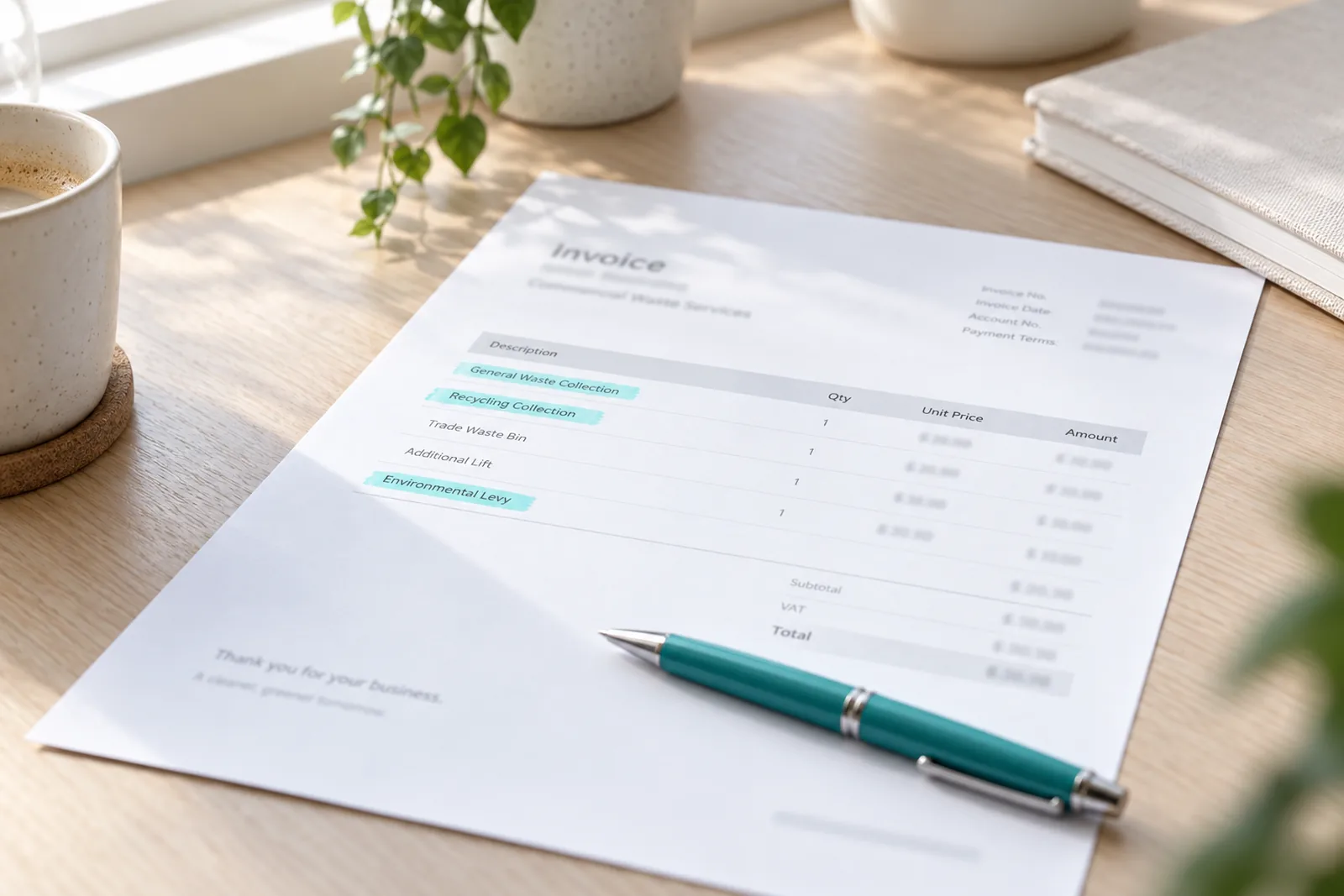
Victoria's waste levy is a state charge on waste received at landfill, set per tonne and paid by the landfill operator. It reaches your business through the disposal component of a waste invoice. It is not the entire collection price, and it is not a fixed charge determined by bin size.
The current rates
EPA Victoria publishes the rates by financial year and by premises category. These are the figures on its Table 1, checked 21 September 2026.
| Category | 2026-27 | 2025-26 (history) |
|---|---|---|
| Municipal waste, prescribed (metropolitan and provincial) premises | $177.19/tonne | $169.79/tonne |
| Industrial waste, prescribed (metropolitan and provincial) premises | $177.19/tonne | $169.79/tonne |
| Municipal waste, non-prescribed (rural) premises | $88.42/tonne | $84.78/tonne |
| Industrial waste, non-prescribed (rural) premises | $155.95/tonne | $149.33/tonne |
Prescribed municipal premises are those in the municipal districts listed under regulation 52 of the Regulations, so which rate applies depends on the landfill that receives the waste, not on where your business sits. Priority waste has its own separate categories. Source: EPA Victoria — Waste levy.
How the levy reaches your invoice
EPA Victoria states that a waste levy must be paid for all waste received at a landfill, and that landfill operators must submit a quarterly waste levy statement declaring the waste they received, which determines the amount payable. The levy is therefore charged by weight, in tonnes, at the landfill gate — not per bin and not per lift.
Your provider recovers that cost through the disposal component of your charges. Some show it as a separate line; others fold it into a per-lift rate, which makes it harder to identify. Because it is a per-tonne charge converted into whatever unit your contract uses, the same statutory rate can look very different on two invoices.
As an illustration of the arithmetic only: at the 2026-27 metropolitan and provincial rate of $177.19 per tonne, every 10 kg of general waste reaching landfill carries about $1.77 of levy. Your own invoice depends on the actual weight or the contractual allocation your provider applies, not on this example.
What to check on your own invoice
- Check financial year, landfill category and waste classification against EPA's current table.
- Ask how your provider calculates the invoice levy line: actual weight, allowance, lift or bundled rate.
- Separate levy, disposal, transport, rental and other contractual charges.
- Model the remaining general waste plus any new recovery service; diverted mass is not automatically an equal invoice saving.
Reducing what you send to landfill
The levy applies to waste received at landfill, so the only lever on the levy itself is sending less there. Material genuinely recycled, or organics sent to a licensed composting or anaerobic digestion facility, does not attract it.
- Separate the dry recyclables — cardboard, paper, plastics, metal and glass — before they reach the general waste bin.
- Divert food and organic waste, which for hospitality and food manufacturing is usually the heaviest single stream and therefore the one where a per-tonne charge bites hardest.
- Reduce at source, through purchasing and packaging decisions that change how much waste exists at all.
- Right-size the service. A part-empty bin still costs a lift, so matching bin size and frequency to real volumes lowers collection cost even where the levy is unchanged.
Weigh the whole arrangement rather than the levy alone: a new recovery service has its own cost, and the general waste service rarely shrinks in exact proportion. See how to reduce commercial waste costs for the full comparison.
Frequently asked questions
What is the Victorian landfill levy rate right now?
Who actually pays the levy?
Why does my invoice not show the published rate?
Does diverting waste reduce the levy I pay?
Can a waste broker get the levy reduced?
Related resources
More questions
Browse commercial waste questions
Sources
- EPA Victoria — Waste levy. How the waste levy is calculated; waste levy statements; Table 1, 1 July 2026 to 30 June 2027 with 2025-26 comparison. Checked 21 September 2026.
Discuss your waste requirements
Include your location, waste types and current collection arrangements in your enquiry.
Contact Bundle Waste