Bundle Waste
Victoria's landfill levy is not the full price of a business waste collection. The applicable levy depends on the waste category and receiving premises. Use the current EPA table and the provider's written pricing terms when checking an invoice.
What the landfill levy is and who pays it
The landfill levy is a government charge on every tonne of waste received at a licensed Victorian landfill. EPA Victoria states that a waste levy must be paid for all waste received at a landfill, whatever the waste type. Landfill operators pay it, and the charge then travels down the chain: the landfill charges the transporter, the transporter charges the waste company, and the waste company includes it in the invoice your business receives.
It matters for two reasons. It is one of the larger components of a commercial disposal charge, and it applies only to material that is actually landfilled, so the way a site separates its waste changes what it pays.
2026–27 levy rates
The following selected rates apply to the 2026–27 financial year. Amounts are AUD per tonne from EPA Victoria's published tables, checked 18 September 2026. EPA Victoria: Waste levy
| Waste and premises category | Levy per tonne |
|---|---|
| Municipal and industrial waste: metropolitan Melbourne and provincial cities premises | $177.19 |
| Municipal waste: rural premises | $88.42 |
| Industrial waste: rural premises | $155.95 |
| Category B priority waste | $296.18 |
| Category C priority waste | $177.19 |
| Category D soil | $177.19 |
| Asbestos-contaminated soil or packaged asbestos waste | $35.58 |
EPA lists Category A priority waste as prohibited from landfill. A listed rate is not permission to send a material to any landfill; acceptance and classification must be established separately.
Rates differ by the premises receiving the waste, so a rural site and a metropolitan site can be charged different amounts for the same waste category. Most Melbourne businesses use metropolitan landfills, which is why $177.19 per tonne is the figure that usually reaches their invoice.
How the rate has changed
EPA Victoria's published tables change on 1 July each year, in line with the Victorian financial year. On the current table the metropolitan and provincial rate for municipal and industrial waste is $177.19 per tonne, up from $169.79 in 2025–26. Rural municipal waste is $88.42, up from $84.78, and rural industrial waste is $155.95, up from $149.33.
That yearly step is what makes a multi-year waste contract worth re-reading. If the agreement passes the statutory rate through, the disposal component of the bill moves on 1 July whether or not your volumes or base rates change. Budget against the schedule published for the coming financial year rather than the rate you signed at.
How the levy reaches your invoice
On a commercial waste invoice, the levy may appear in one of three ways:
- A separate line, labelled "landfill levy" or "EPA levy".
- Part of a bundled disposal or tip fee.
- Built into the per-lift or per-tonne charge with no separate disclosure.
Transparency varies between providers. If your invoice does not identify the levy component, ask for a rate breakdown. Without that visibility you cannot tell whether a price rise reflects the statutory change or a margin increase. Our guide to hidden fees on waste invoices covers the other lines worth questioning.
Ask which waste category, receiving facility, billed weight and contractual calculation support a levy-related charge. A collector may price a service as a combined amount or show separate lines. Check whether a change affects the statutory component alone or other service charges as well. Request the GST treatment for the quoted commercial service.
Calculation example, not a service quote: 10 tonnes multiplied by $177.19 per tonne equals $1,771.90. That arithmetic excludes transport, facility charges and other costs. It does not establish the weight in a volume-priced bin or the charge due under your agreement.
How diversion reduces levy exposure
The levy applies only to waste deposited at landfill. Material diverted to recycling, composting or another recovery route does not attract it, which is the whole purpose of the charge.
As an arithmetic example only, not a saving we are offering: at the current metropolitan rate of $177.19 per tonne, 100 tonnes sent to landfill in a year carries $17,719 in levy. Moving 50 of those tonnes into a genuinely recycled stream removes $8,859.50 of that figure, before any difference in collection charges either way. Your own numbers depend on your actual weights, which the weighbridge or your provider's records establish, not this example.
Common diversion routes include:
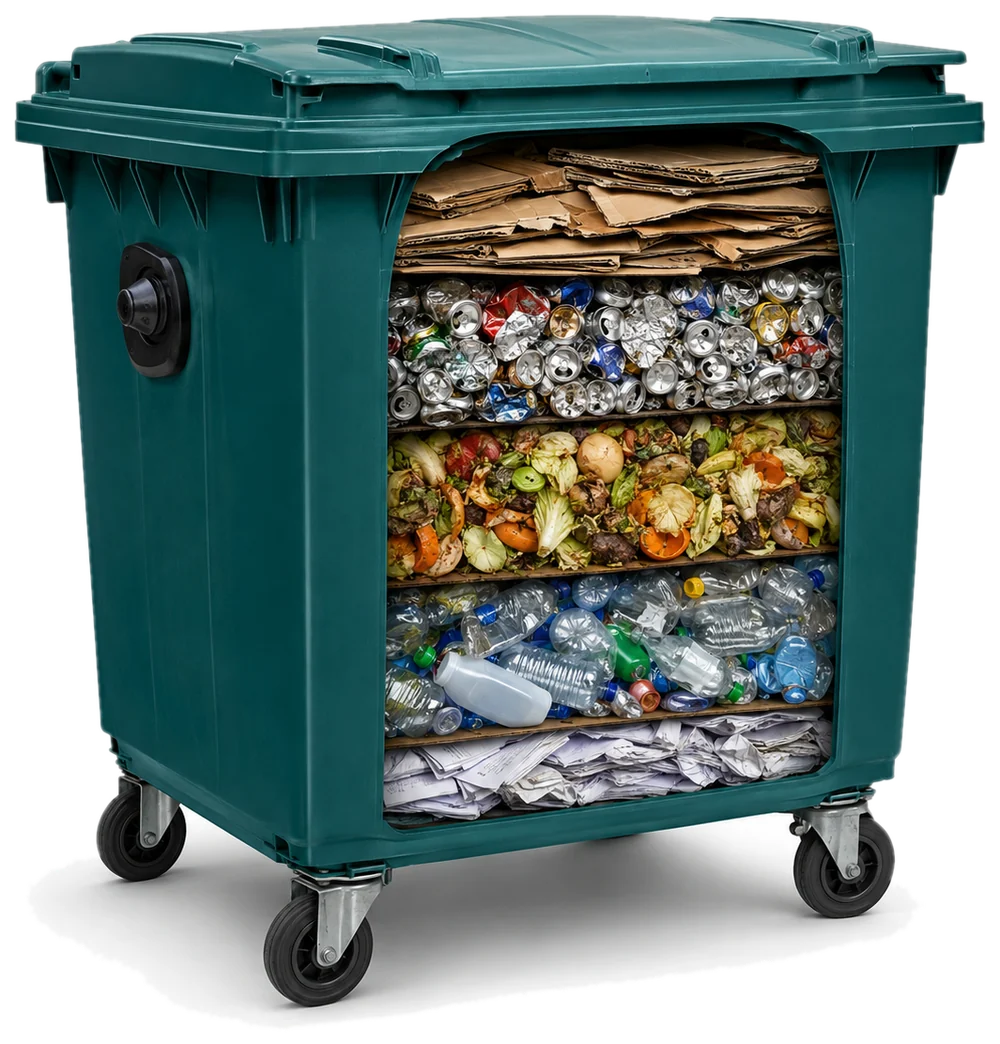
- Source separation — separating cardboard, paper, plastics, metals and organics where they are generated rather than sending a mixed bin to landfill.
- Commingled recycling — a mixed recycling bin for materials sorted at a materials recovery facility.
- Organic waste processing — food and organic waste to a licensed composting or anaerobic digestion facility.
- Construction waste recovery — separating timber, concrete, metals and soil on site.
- Product stewardship — returning packaging, pallets and containers to suppliers or a dedicated collection programme.
Contamination works the other way. A recycling load rejected for the wrong material can be redirected to landfill and pick up the full per-tonne levy.
Practical steps that reduce what you pay
- Audit the bins. Recyclable material is often sitting in general waste simply because nobody has looked. A waste audit shows what is actually in there.
- Right-size the general waste bin. An oversized bin gets filled. Reducing general waste capacity while adding recycling capacity shifts volume away from the levy-attracting stream. Our commercial bin size guide covers the trade-offs.
- Put the pass-through in writing. Ask that the contract state the levy is passed through at the statutory rate, and that it name the schedule and effective date it refers to.
- Review collection frequency. Bins consistently collected half empty still cost a lift.
- Train the people using the bins. Correct bin use is the cheapest contamination control there is.
- Consider compaction for high-volume sites. It reduces the number of collections; it does not change the per-tonne levy.
Investigate avoidable material, verified reuse routes and separately accepted recycling streams. Compare the complete proposed service cost and outcomes. Never dilute or relabel waste to obtain a lower rate; obtain qualified classification advice where needed.
Keep the applicable rate period in the contract review file and check EPA again when budgeting for a new financial year. See state levy comparison and cost-per-bin calculations.
How Victoria compares with other states
Victoria is not the only state that uses a levy to push material out of landfill; each state and territory sets its own schedule, its own categories and its own regional boundaries. For a business with sites in more than one state, that means the same waste can carry a different statutory charge in each one, and a metropolitan site can sit well above a regional site in the same state.
We do not reproduce other jurisdictions' rates here, because they are only meaningful alongside their own category definitions and effective dates. The state-by-state levy comparison sets each one against its official source.
Frequently asked questions
What is the Victorian landfill levy and who actually pays it?
How much is the Victorian landfill levy per tonne in 2026–27?
Is the landfill levy charged on recycling or only on landfill?
How can a Melbourne business reduce its landfill levy bill?
Can a waste broker check whether the levy on my invoice is correct?
Sources
- EPA Victoria — Waste levy. Checked 21 September 2026; Table 1 and Table 3, 1 July 2026 to 30 June 2027 and 1 July 2025 to 30 June 2026 rows.