Bundle Waste
Calculate cost per bin using your invoice and completed services, then compare quotes with the same bin, stream, schedule and inclusions. A nominal container size alone does not establish a fair market price.
Two calculations with different purposes
| Measure | Calculation | Use |
|---|---|---|
| Quoted collection rate | The agreed unit charge for a specified service | Check whether an invoice matches the contract |
| Effective cost per completed collection | All agreed costs allocated to the service in the period, divided by completed collections | Compare the overall service cost on a consistent basis |
Separate streams and bin types before calculating an average. State whether rental, extra charges and GST are included. If a monthly package is fixed, do not assume its nominal per-lift equivalent is the amount refunded for a missed collection.
Worked example using hypothetical figures
Suppose a service costs $400 for a period and records show 10 completed collections. Its effective cost is $40 per completed collection. These are invented inputs to demonstrate arithmetic, not Melbourne rates or a Bundle Waste quote. If costs or service counts change, recalculate both rather than comparing headline unit prices.
What moves the price of a single bin
Two sites can be quoted very differently for what looks like the same bin. The variables that do most of the work are:
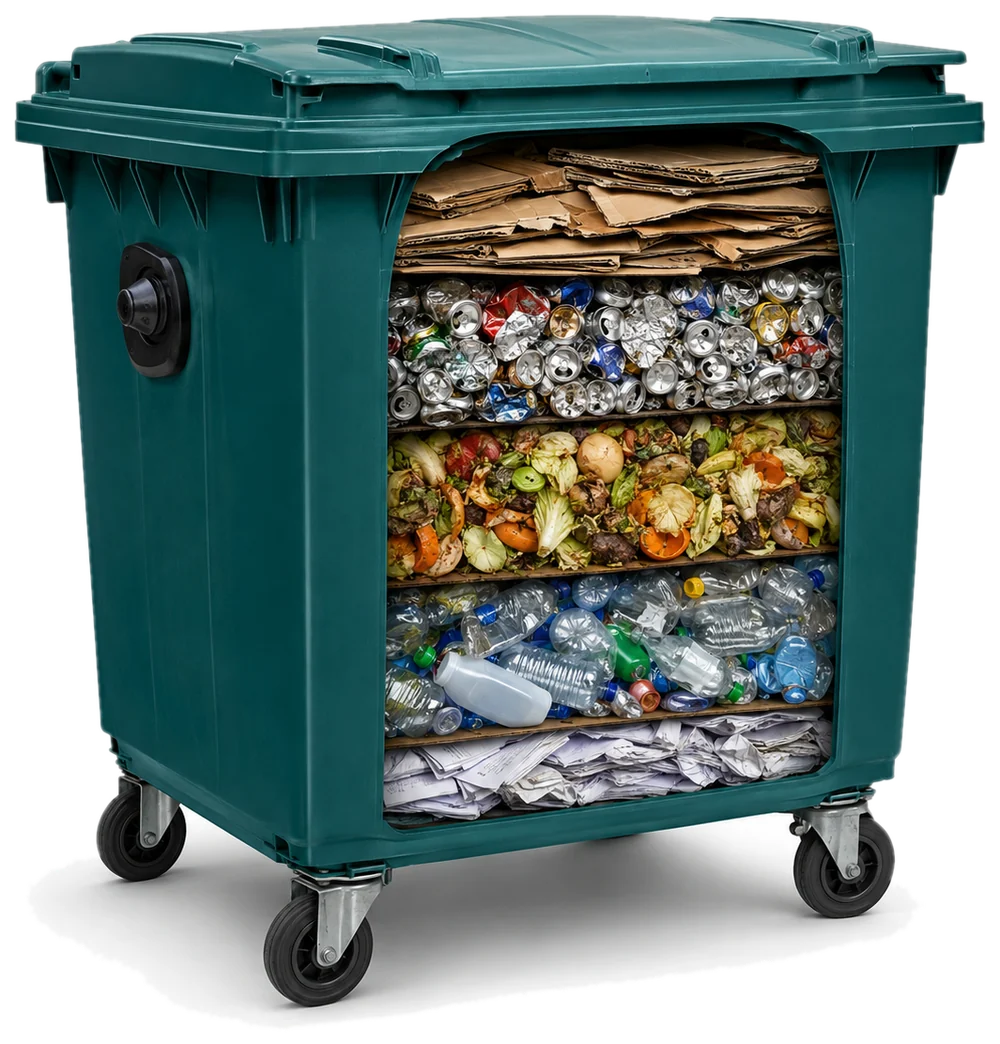
- The waste stream. General waste, commingled recycling, cardboard and organics are collected by different vehicles into different processing routes, and only material going to landfill carries the levy.
- Collection frequency. More collections usually lower the price of each one and raise the total. The number worth optimising is not the unit rate but the cost of moving your actual volume.
- Access. Distance from the collection point, gates, ramps, height restrictions and whether staff or the driver moves the bin all change the time a stop takes, and stop time is what the route is priced on.
- Weight. Some agreements include a weight allowance per lift or per period and charge above it. A dense stream can exceed an allowance in a bin that still looks half empty.
- Contamination. A recycling bin with the wrong material in it can be charged at a different rate or rejected, so the cheaper stream stops being cheaper.
- Contract terms. Length, renewal, the price-review formula and the notice required to leave all sit behind the opening rate, and the opening rate is the part that changes.
Ask which of these the quote assumes. A price given without an access assessment and a weight basis is a number, not a quote.
Information to request in every quote
- Waste specification, bin capacity, quantity and service frequency.
- Weight allowance or charging basis and the evidence used for excess charges.
- Rental, minimum commitments, delivery and removal charges.
- Access conditions, additional collections and missed-service arrangements.
- Price-adjustment formula, term, renewal and exit conditions.
- GST treatment and the period for which the quote remains valid.
How the stream changes the cost
General waste is normally the most expensive stream per kilogram because everything in it goes to landfill and attracts the levy. EPA Victoria lists $177.19 per tonne for municipal and industrial waste received at prescribed municipal (metropolitan) landfill premises from 1 July 2026 to 30 June 2027, up from $169.79 the year before. That is a statutory charge on landfilled tonnes, not a per-bin tariff, and it is why moving material out of general waste changes a bill in a way that renegotiating the same volume does not.
Commingled recycling avoids the levy on the material genuinely recovered, but it is not free: it still has collection, sorting and processing costs, and contamination can move a load back into the general-waste route.
Cardboard on its own is often handled differently again, because clean, dry, separated fibre is a recovered material rather than a disposal problem. Whether that produces a lower charge, no charge or a credit at your volume is a question for a written quote — do not assume it from the material alone.
Food and organic waste sent to a licensed composting or anaerobic digestion facility also avoids the levy. For kitchens and food manufacturers this is usually the largest single stream sitting in the general-waste bin, but it needs a collection setup that fits the operation: storage, separation and a frequency that keeps the material manageable.
Keep the landfill levy separate from the service price
EPA Victoria publishes statutory levy rates by waste and premises category. They are not a per-bin commercial collection tariff. A bin's capacity does not prove its weight or the facility receiving its contents. EPA Victoria: Waste levy
Use the audit checklist to establish the baseline and skip versus scheduled collection guide when comparing different service models.
Charges that sit outside the per-lift rate
A per-lift rate is one line of an invoice, not the cost of the service. The charges that most often make a comparison wrong are:
- Bin rental — charged per bin per period, or folded into the lift rate. Confirm which.
- Fuel or environmental surcharge — a percentage is meaningless without the base it applies to, the formula behind it and how often it is reviewed.
- Administration or account fees — a fixed charge per invoice or per period, easy to miss and easy to raise with the provider.
- Contamination charges — triggered by material that does not belong in the bin. Ask what evidence you will be given when one is applied.
- Excess weight — where the agreement sets an allowance, ask how the weight is established and what it is measured against.
- Failed access or missed collection — what happens, and who pays, when the truck cannot reach the bin.
- Delivery, exchange and removal — one-off charges at the start and end of a service that rarely appear in a headline comparison.
Hidden fees on waste invoices goes through each of these on a real invoice layout, and how to read a waste invoice covers the order the lines usually appear in.
Getting a price you can actually compare
- Write the specification once. Stream, bin capacity, number of bins, collection frequency, weight basis, access conditions and GST treatment. Send the same document to every provider so the quotes answer the same question.
- Ask for the whole cost, not the lift rate. Request rental, surcharges, administration and one-off charges itemised, then add them into an annual total.
- Check the bin is the right size first. A bin collected part-empty costs a full lift, and a bin that overflows generates extra charges. Right-sizing usually changes a bill more than a rate negotiation does.
- Separate the streams that are worth separating. Volume moved out of general waste avoids the levy on that material, which is the one saving that is structural rather than negotiated.
- Read the terms with the price. Term, renewal, the price-review formula and the exit notice decide what the rate will be in a year's time.
Use the waste audit checklist to establish the baseline before requesting anything, and the quote comparison tool to put the totals side by side. A review does not guarantee a lower price; keeping your current agreement is a legitimate outcome.
Frequently asked questions
What is a per-lift charge for a commercial bin?
How do I work out my real cost per bin?
Why is general waste more expensive than recycling per bin?
Is a bigger bin always cheaper?
Does the landfill levy appear as its own line on my invoice?
Can you tell me whether I am paying too much?
Sources
- EPA Victoria — Waste levy. Checked 18 September 2026; Table 1 and Table 3: 1 July 2026 to 30 June 2027.