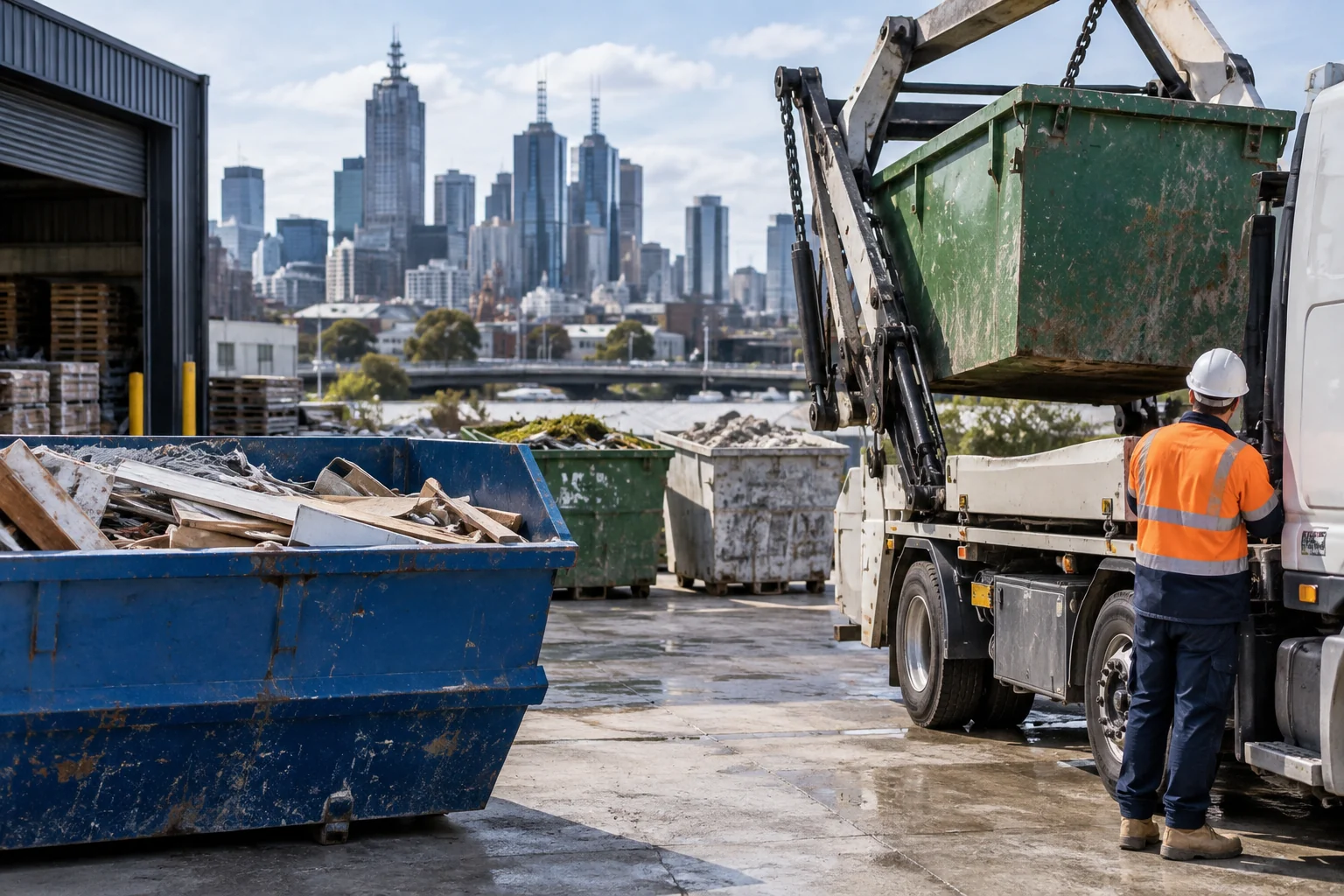
Whether you call them skips, front-lift bins or hook-lift bins, the container parked at the back of your premises is the single biggest line on most commercial waste invoices. Choosing the wrong size or lift type quietly inflates your bill for years. This guide breaks down the sizes (2–30m³), the three main lift methods, permit rules and the real cost drivers behind commercial bin hire in Melbourne—so you order what you actually need, not what a hauler wants to sell.
Skip and bin sizes: what 2–30m³ actually means
Commercial bins are measured in cubic metres (m³). The right size depends on volume per week, how compactible your waste is, and how much yard space you have. As a rough guide, a single office wheelie bin holds 0.24m³, so even a small 2m³ skip replaces roughly eight wheelie bins of capacity.
| Bin / skip size | Typical use | Approx. capacity |
|---|---|---|
| 2–3m³ mini skip | Small offices, cafes, one-off clear-outs | ~8–12 wheelie bins |
| 4–6m³ midi skip | Retail, mixed light commercial | ~17–25 wheelie bins |
| 1.5–4.5m³ front-lift bin | Ongoing general waste / recycling | Emptied on schedule, not removed |
| 9–12m³ hook-lift bin | Warehouses, manufacturing, bulky waste | ~38–50 wheelie bins |
| 15–30m³ bulk / open-top | Industrial, high-volume sites | Cardboard, timber, light bulky loads |
The most common mistake is over-sizing. A half-empty 6m³ skip costs the same to lift as a full one, so you are paying to cart air. The opposite error—an undersized bin that overflows—triggers extra pickups, side-waste charges and contamination. The aim is a bin that sits at roughly 80–90% full on collection day.
Front-lift vs rear-lift vs hook-lift
The lift method determines the truck, the access you need and, ultimately, the price per lift. Most ongoing commercial sites use one of three.
- Front-lift bins (1.5–4.5m³): The workhorse of commercial waste. A truck with front forks lifts the bin over the cab and empties it in seconds. Fast, cheap per lift and ideal for scheduled general waste or recycling. Needs overhead clearance and a clear approach for the truck.
- Rear-lift bins (240L–1100L wheelie bins): Smaller, lifted at the back of the truck. Best for tight sites, low volumes or where a front-lift truck cannot manoeuvre. More bins and more lifts usually means a higher cost per cubic metre.
- Hook-lift and skip bins (4–30m³): The whole container is hooked or craned onto a truck and driven away, then a replacement is dropped. Suited to bulky, heavy or project waste rather than steady daily volume. Each swap is a transport movement, so frequent swaps get expensive fast.
As a rule: steady weekly volume favours front-lift; bulky or heavy intermittent loads favour hook-lift or skip; constrained access favours rear-lift wheelie bins. For a deeper side-by-side, see our breakdown of skip bin hire vs ongoing collection.
Permits: when you need council approval
The rule across Melbourne councils is consistent even though the fees are not: a bin placed on your own land needs no permit, while a bin on public land—a road, footpath, nature strip or verge—requires a council permit. The City of Melbourne and surrounding municipalities each set their own fees and notice periods, with some accepting same-day applications and others requiring several days. If your business has no private yard and the bin sits on the street, factor the permit cost and lead time into every order.
Hire vs ongoing service
One-off skip hire and an ongoing bin service are priced very differently. A hired skip is a fixed fee covering delivery, a set hire period and one removal—clean for a clear-out or fit-out. An ongoing service is a scheduled lift (weekly, fortnightly, on-call) where the bin stays on site permanently. For any business generating waste week after week, ongoing service is almost always cheaper per cubic metre than repeat skip hire, because you are not paying delivery and removal every cycle.
The catch with ongoing contracts is the fine print: rise-and-fall clauses, fixed lift fees regardless of fill level, and bin rental charges that creep up. We cover the warning signs in our guide to general waste costs in Melbourne.
What actually drives the cost
Your invoice is built from more than the lift fee. The main drivers:
- The Victorian landfill levy. Metropolitan landfill is levied at $169.79 per tonne in 2025–26 (up from $129.27). Anything sent to landfill carries this—so heavy, wet or unsorted waste is expensive by design.
- Weight vs volume. Front-lift and wheelie bins are usually priced per lift; skips and hook-lifts are often weight-based. Heavy waste (soil, concrete, wet organics) in a volume-priced bin is a bargain; light bulky waste in a weight-priced bin is the same.
- Lift frequency. Each collection is a truck movement with a minimum charge. Right-sizing the bin so you can drop from weekly to fortnightly often saves more than negotiating the rate.
- Contamination. Putting the wrong material in a recycling or organics bin can downgrade the whole load to general waste at the higher levy rate.
- Bin rental, fuel levies and admin fees. The line items that rarely move on their own but add up across a year.
How an independent broker fits in
We are not a hauler—we don't own trucks or bins. We benchmark your current setup against a network of Melbourne providers, right-size the bins and lift schedule, and renegotiate the rate. You keep your existing collection if you want; we just stop you overpaying. We're paid only from the savings we find, so there's no fee if we can't beat your current deal. If your bin bill has crept up, start with our waste broker service or send us a recent invoice for a free benchmark.
Frequently asked questions
What size skip or bin does my business need?
What is the difference between front-lift, rear-lift and hook-lift bins?
Do I need a council permit for a commercial skip bin in Melbourne?
Is it cheaper to hire a skip or set up an ongoing bin service?
Why is my commercial waste bill so high?
How does Bundle Waste reduce skip and bin hire costs?
Related guides
See what you could save
Send us a recent waste invoice. We'll benchmark every charge against a network of Melbourne providers and show you the savings — free, no obligation, no win no fee.
Get Your Free Waste Audit →