Sustainability
3 min read
By Pedro Carreira
Updated 25 June 2026
Scope 3 emissions include all indirect emissions in your value chain — waste disposal falls under Scope 3 Category 5 (waste generated in operations).
For most businesses, waste accounts for 2-8% of total scope 3 emissions. Under Australia's new climate reporting requirements, large businesses must disclose scope 3 emissions from 2027-28.
Even if you are an SME, your corporate clients may ask for your waste data to calculate their own scope 3. Having audited data ready is a competitive advantage.
Key Numbers
- Waste share of scope 3: 2–8%
- Scope 3 category: Category 5 (waste in operations)
- Mandatory disclosure from: 2027–28
- Methane warming potential: 28× CO₂
What You Need to Know
Waste sits in Scope 3 Category 5 (waste generated in operations) — the indirect emissions in your value chain that you do not burn directly but are still accountable for. It typically accounts for 2–8% of a business's total scope 3 footprint, driven largely by landfilled organics releasing methane at about 28× the warming impact of CO₂. Two pressures make audited waste data worth having ready now:
- Mandatory reporting — large businesses must disclose scope 3 from 2027–28 under Australia's new climate rules.
- Client pull-through — even as an SME, your corporate clients may request your waste data to calculate their own scope 3.
- Competitive edge — having the numbers ready, verified and broken down, wins tenders that ask for them.
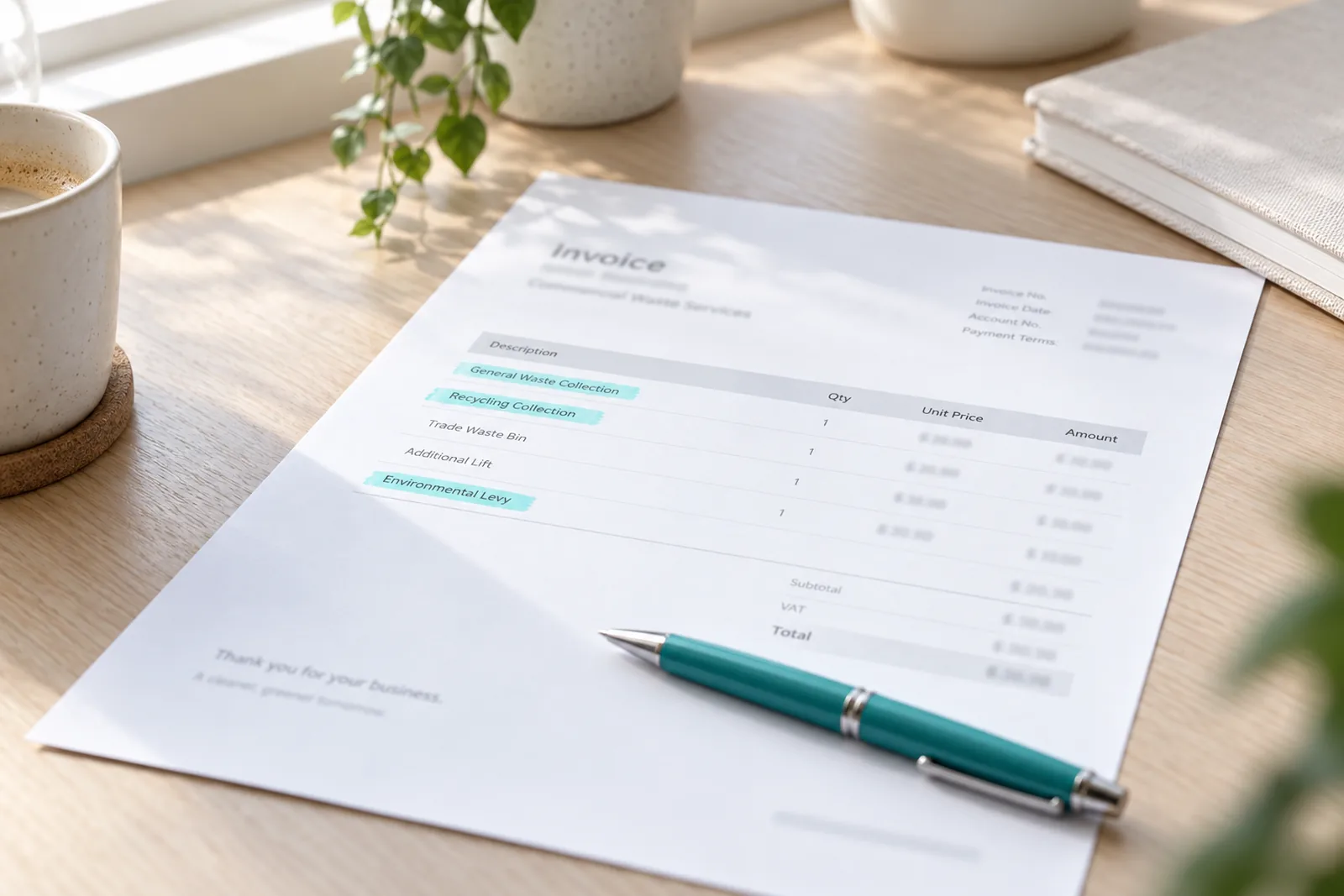
Cutting landfill in favour of diversion — the core aim of Recycling Victoria — A New Economy — lowers both your levy bill and your reported emissions. As an independent broker, Bundle Waste audits your invoice for free, compares a network of providers, and is paid only from the savings we find.
Related Resources
Related Questions
How does waste affect my business's carbon footprint?+
Waste sent to landfill generates methane — a greenhouse gas 28x more potent than CO2. Each tonne of general waste landfilled produces approximately 1.1-1.3 tonnes of CO2-equivalent emissions. Recycling 1 tonne of cardboard saves 1.4 tonnes CO2e; composting 1 tonne of food waste avoids 0.5 tonnes CO2e vs landfill. For a business generating 5 tonnes/month of waste, improving diversion from 20% to 60% can reduce carbon emissions by 2-3 tonnes CO2e per month.
What is sustainability reporting and do I need to do it?+
Sustainability reporting involves publicly disclosing your environmental impact, including waste data. It is mandatory for ASX-listed companies and large businesses under the Australian Sustainability Reporting Standards (from 2025-26 for Group 1 entities). SMEs are not yet required to report, but many clients and procurement processes now demand waste data from suppliers. Having accurate waste diversion data gives you a competitive edge in tenders and client retention.
Can my business get carbon credits for recycling waste?+
Not directly through the Australian Carbon Credit Unit (ACCU) scheme for most SMEs — the Emissions Reduction Fund projects require scale (typically 10,000+ tonnes/year). However, you can: (1) purchase ACCUs to offset your waste emissions ($30-50/tonne CO2e), (2) use certified waste diversion data in your sustainability reporting, (3) leverage waste reduction in B-Corp or Climate Active certification. Some large waste processors offer 'carbon-neutral waste' services at a 10-20% premium.
What sustainability certifications need waste data?+
Green Star (GBCA), NABERS Waste, ISO 14001, B Corp, Climate Active, GRI 306, and NGER all require: total waste generated, diversion rate, waste streams breakdown, and disposal methods. Bundle Waste provides data formatted for these certifications.
How does waste affect my carbon footprint?+
Waste accounts for 3–8% of a typical business carbon footprint. Key emissions: landfill methane, transport, embedded carbon in discarded materials. Reducing landfill waste 50% cuts total business emissions up to 4%.
See exactly what you are overpaying
Bundle Waste reviews your current waste invoices and benchmarks them against a network of Melbourne providers — free, with a written report in 5 business days. You will see what you pay now, where the hidden charges are, and the rate we can negotiate. You only pay from the savings we find: no savings, no fee.
Get my free waste audit →
Updated 25 June 2026