What waste management applies to businesses operating from home? What waste management applies to businesses operating from home?

What waste management applies to businesses operating from home?

Expert answer from Melbourne's waste management specialists

Home-based businesses typically use residential council waste services.

If waste volumes exceed residential allowances (typically 1x 240L general waste + 1x 240L recycling per week), you need commercial waste service. Check council by-laws — some prohibit commercial waste in residential bins.

Home-based food businesses need separate commercial food waste arrangements for volumes exceeding household levels.

Key Numbers

  • Residential general-waste allowance: 1x 240L per week
  • Residential recycling allowance: 1x 240L per week
  • Metro landfill levy (commercial loads): $169.79/tonne
  • GED max corporate fine: about $2.03 million

What You Need to Know

The line that trips up home-based operators is volume, not intent. A council kerbside service is sized for a household — roughly one 240L general bin and one 240L recycling bin a week. Cross that and you've moved from residential to commercial waste, which changes who is liable and how the load is charged.

SituationCorrect service
Within household volumesResidential council collection
Volume above the kerbside allowanceCommercial waste service
Home food business above household levelsSeparate commercial food-waste arrangement

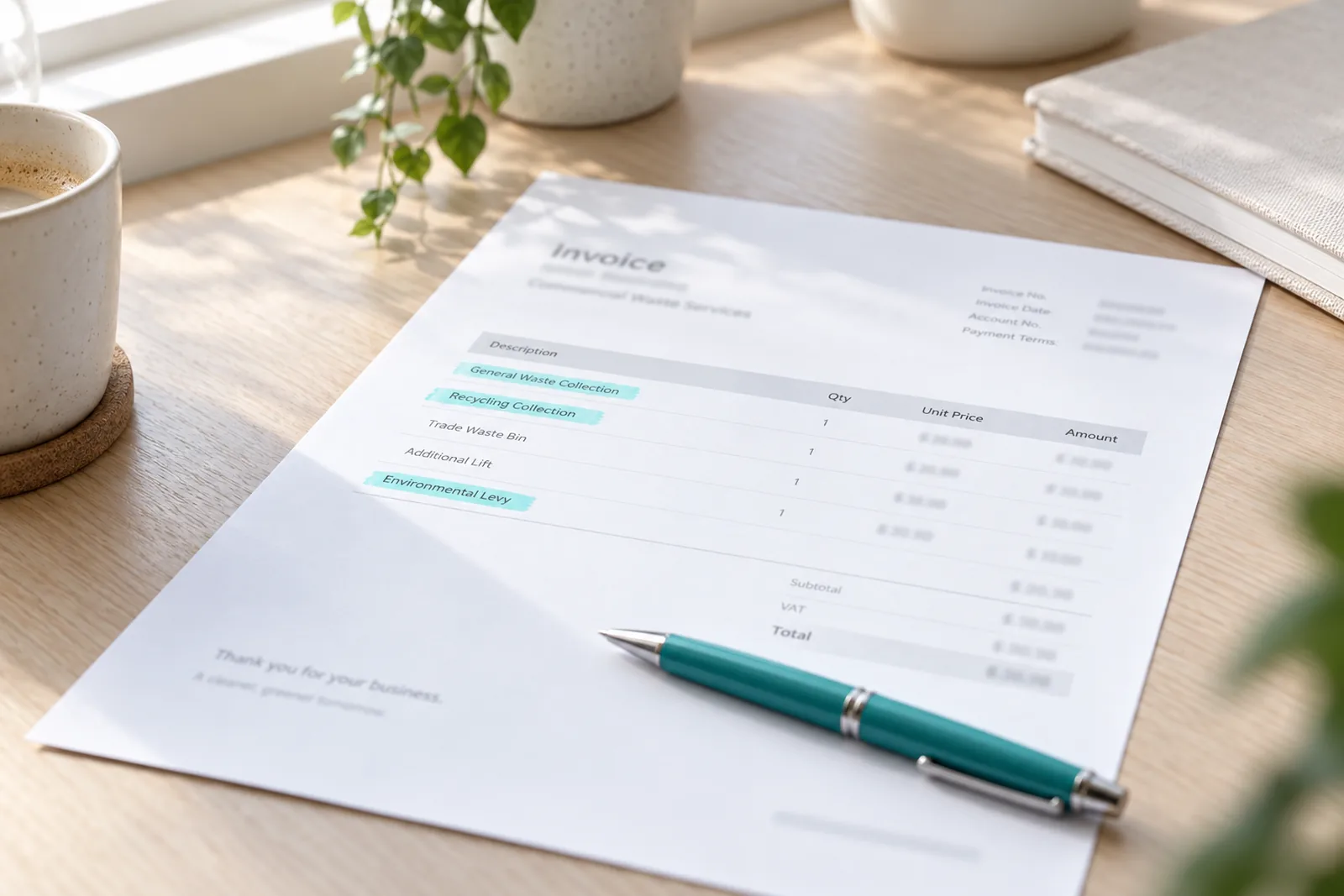
Some council by-laws prohibit commercial waste in residential bins outright, so check before you load. Either way the General Environmental Duty (GED) applies the moment you're running a business. Bundle Waste is an independent broker — our free invoice audit confirms whether you genuinely need a commercial bin and, if you do, compares a network of providers so you pay only what's fair, with our fee coming purely from the savings.

Related Resources

Related Questions

Do I need council approval for commercial waste bins?+
Council approval needed if bins are on footpaths or public land ($80–250/year permit). Private property storage does not need approval but must comply with planning scheme amenity requirements. Some councils restrict bin presentation times.
What waste rules apply near the Yarra River?+
Additional EPA scrutiny under the Yarra River Protection Act 2017. Waste storage must prevent leachate reaching waterways. Stormwater drains monitored regularly. Construction sites need sedimentation controls. Fines up to about $2.03 million.
What are hazardous waste disposal costs in Melbourne?+
Hazardous waste disposal in Melbourne ranges from $2–15/kg depending on waste type. Chemical waste costs $3–8/kg, asbestos removal $50–80/m², and liquid chemical disposal $300–800 per 200L drum. All hazardous waste must be handled by EPA-licensed transporters under the Environment Protection Act 2017.
How much does clinical waste disposal cost in Melbourne?+
Clinical waste disposal in Melbourne costs $0.80–2.50/litre depending on waste category. Sharps containers (5L) cost $8–15 each, cytotoxic waste $4–8/kg, and anatomical waste $5–12/kg. Healthcare facilities typically spend $300–1,200/month. All clinical waste must comply with EPA Victoria Publication 1669.
What are the main waste management laws in Victoria?+
Key legislation: Environment Protection Act 2017, Environment Protection Regulations 2021, Climate Change Act 2017, Circular Economy (Waste Reduction and Recycling) Act 2021. The EP Act 2017 introduced a general environmental duty (GED) requiring all businesses to minimise risks of harm from pollution and waste.

See exactly what you are overpaying

Bundle Waste reviews your current waste invoices and benchmarks them against a network of Melbourne providers — free, with a written report in 5 business days. You will see what you pay now, where the hidden charges are, and the rate we can negotiate. You only pay from the savings we find: no savings, no fee.

Get my free waste audit →

Updated 25 June 2026