What waste management does a high-rise office building need? What waste management does a high-rise office building need?

What waste management does a high-rise office building need?

Expert answer from Melbourne's waste management specialists

High-rise offices (20+ floors) need: centralised waste rooms on every 3–5 floors, a compactor in the basement loading dock, separate streams per floor (general, recycling, paper, organics), chute systems (if fitted), and regular tenant education.

Monthly waste for a 30-storey tower: $5,000–15,000. Building managers should negotiate single-provider contracts for all tenants to maximise volume discounts.

Key Numbers

  • Centralised waste rooms: every 3–5 floors
  • Monthly waste, 30-storey tower: $5,000–15,000
  • Recycling Victoria diversion target: 80% by 2030
  • Metro landfill levy (general waste): $169.79/tonne

What You Need to Know

A high-rise is really many small offices stacked vertically, so the waste system has to move material down efficiently or costs balloon. For a tower of 20+ floors the architecture matters more than the bin count.

  • Waste rooms every 3–5 floors so tenants never carry rubbish far.
  • A basement compactor in the loading dock to crush cardboard and cut lift frequency.
  • Separate streams per floor — general, recycling, paper, organics — feeding the building's diversion rate.
  • One provider for the whole building so volume is bundled, not fragmented tenant-by-tenant.

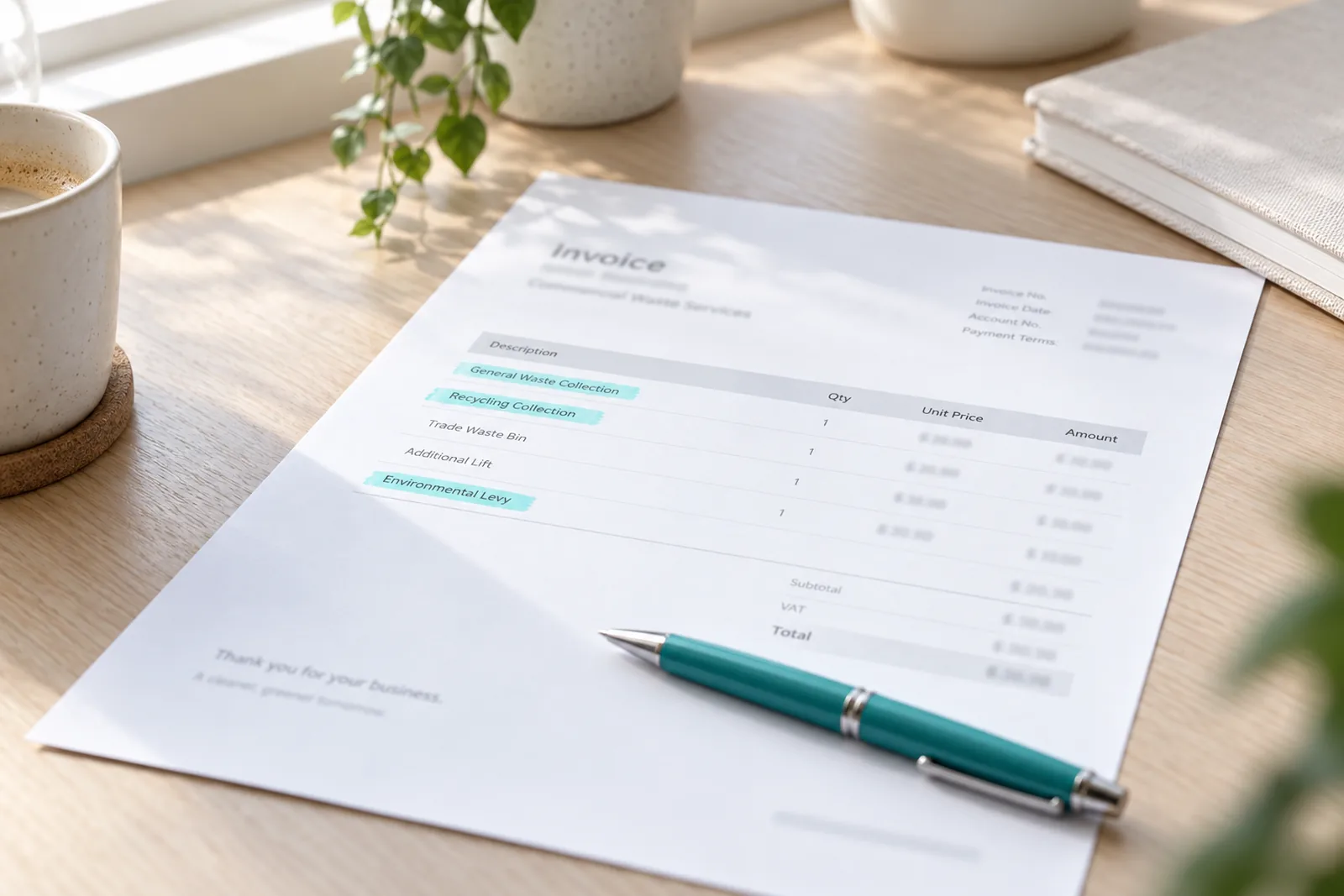
Four-stream separation is exactly what Recycling Victoria — A New Economy drives toward its 80%-by-2030 landfill-diversion target, and every tonne kept out of landfill avoids the $169.79/tonne levy. Bundle Waste is an independent broker: our free invoice audit reads a 30-storey tower's bill line by line, compares a network of providers, and is paid only from the savings — so building managers capture the volume discount instead of leaving it on the table.

Related Resources

Related Questions

What does e-waste recycling cost for businesses?+
E-waste recycling for businesses costs $0–5/kg depending on item type. Computers and monitors are often collected free under the National Television and Computer Recycling Scheme. Printers cost $5–15 each. Data destruction certificates cost $5–15 per hard drive.
How much does recycling collection cost compared to general waste?+
Recycling collection is typically 20–40% cheaper than general waste in Melbourne. A 240L recycling bin costs $25–45/month vs $35–65 for general waste. The difference is driven by the $169.79/tonne Victorian landfill levy applied to general waste but not recyclables. Businesses recycling over 50% of their waste can save $100–300/month.
What does document destruction cost for businesses in Melbourne?+
Secure document destruction in Melbourne costs $15–30 per 240L bin or $80–150 per 660L bin for scheduled collection. One-off purges cost $8–15 per archive box. Most providers include a certificate of destruction. Average offices spend $50–150/month.
How much does an office waste management program cost in Melbourne?+
Office waste management in Melbourne costs $120–400/month for a typical 50-person office. This includes general waste ($50–120), recycling ($40–80), paper/cardboard ($30–60), and organics ($30–60). Adding secure document destruction adds $50–150/month.
How much does pallet collection and recycling cost in Melbourne?+
Pallet collection in Melbourne typically costs $0–5 per CHEP pallet (returned through the CHEP system at no cost), while plain timber pallets cost $2–8 each for collection or earn $1–3 credit if in good condition. Businesses generating 20+ pallets/week should negotiate a scheduled collection at $50–120/pickup.

See exactly what you are overpaying

Bundle Waste reviews your current waste invoices and benchmarks them against a network of Melbourne providers — free, with a written report in 5 business days. You will see what you pay now, where the hidden charges are, and the rate we can negotiate. You only pay from the savings we find: no savings, no fee.

Get my free waste audit →

Updated 25 June 2026