Sharps & Clinical Waste Collection for Non-Hospital Businesses

Sharps & Clinical Waste Collection for Non-Hospital Businesses

Container sizes, sharps-container compliance and collection cadence for studios, clinics, vets and schools

You don't have to run a hospital to generate clinical waste. Tattoo and piercing studios, cosmetic and beauty clinics, veterinary practices, school first-aid rooms and NDIS providers all produce sharps that cannot legally go in a general waste bin. If your business uses needles, blades or lancets, you carry a duty of care to capture, store and dispose of them through a licensed clinical waste stream. Here is what that means in practice, and how to size and schedule it without overpaying.

What actually counts as sharps and clinical waste

"Sharps" is the category that catches most non-medical operators off guard. It covers any item capable of cutting or piercing skin once it has been used: hypodermic needles, tattoo and cosmetic-tattoo needles, piercing needles, scalpel and razor blades, lancets, ampoules, cannulae and even broken glass from a treatment area. "Clinical waste" is broader — it also includes items contaminated with blood or bodily fluids, such as used gauze, swabs, gloves and dressings from a procedure that drew blood.

The distinction matters because the two streams are often charged and collected differently. A solo tattoo artist may only fill a small sharps container, while a busy cosmetic clinic doing dermal needling and injectables will generate both sharps and contaminated soft waste. Putting either into your general waste bin breaches Victoria's general environmental duty and can expose your business to enforcement — penalty units for 2025-26 sit at $203.51 each, and serious duty breaches carry far heavier consequences.

Who generates it (and often doesn't realise)

  • Tattoo and piercing studios — used needles, blades, ink caps with blood residue, contaminated paper towel.
  • Beauty and cosmetic clinics — micro-needling cartridges, injectable needles, lancets, dermal roller heads.
  • Veterinary practices and groomers — animal sharps need the same AS/NZS 23907:2023-compliant containers; vaccination and surgical waste need the same handling.
  • Schools and workplaces — first-aid rooms, EpiPen and insulin disposal, plus diabetes-management sharps from staff or students.
  • NDIS and in-home care providers — community nursing, wound care and medication delivery all produce sharps off-site.

AS/NZS 23907:2023 — the sharps container standard you must meet

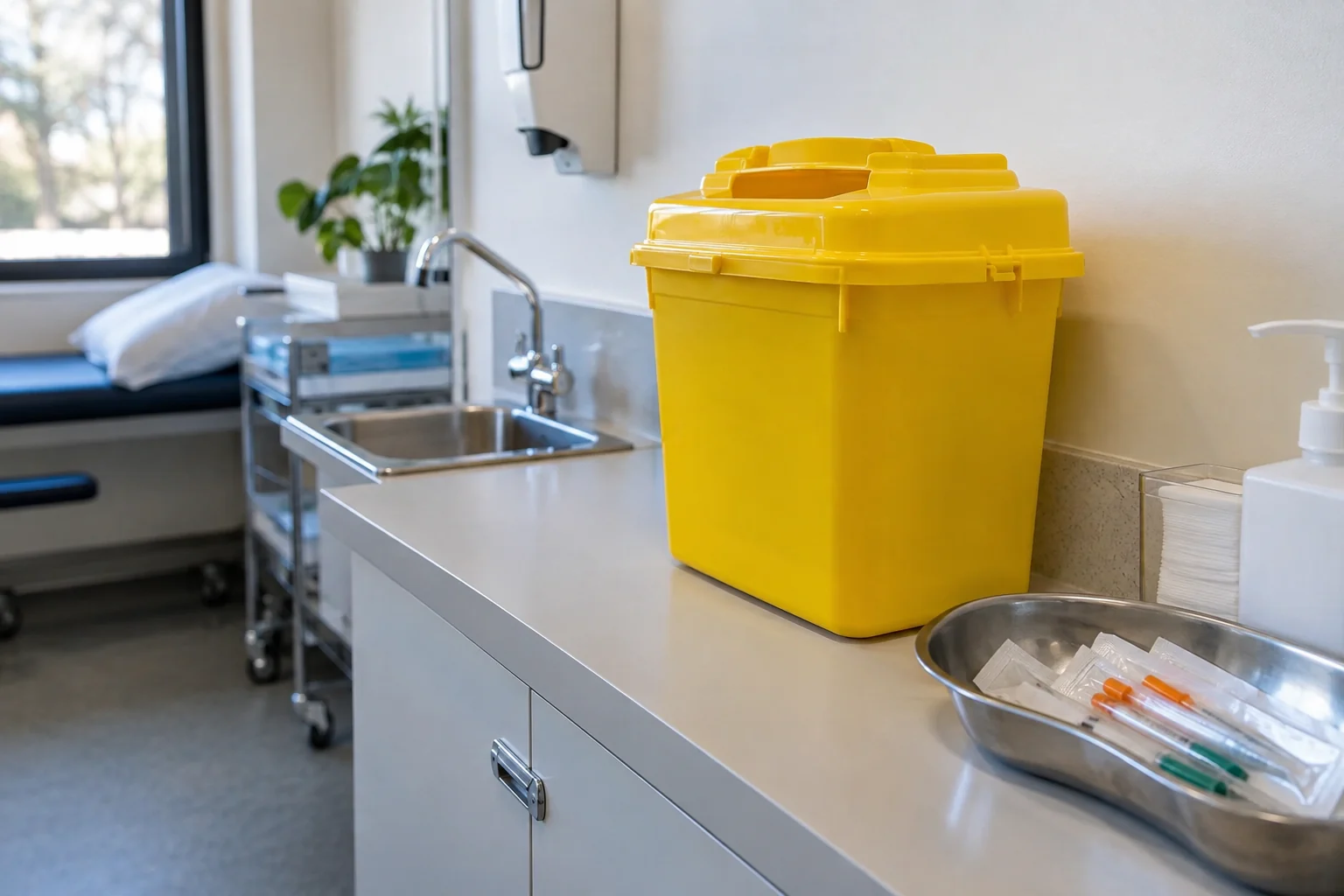
In Australia, sharps containers must comply with AS/NZS 23907:2023 (which superseded the older AS 4031:1992). The standard sets minimum requirements so a container survives real-world handling: it must be puncture-resistant, leak-proof, drop-tested, and fitted with a one-way aperture and a tamper-evident locking lid that cannot be reopened once sealed. Compliant containers are yellow, carry the biohazard symbol and a clearly marked fill line. Reusing a domestic bottle or an unrated tub is not compliant and will not pass a WorkSafe or EPA inspection. Anatomical and certain cytotoxic wastes sit under separate rules (often purple-lidded), which is why a quick stream review is worth doing before you commit to a contract.

Container sizes — match the box to the volume

Right-sizing is where most small businesses either overpay (oversized bins collected half-empty) or create risk (containers overfilled past the line). Sizes run from compact 1.4L units up to 23L bins. As a rough guide:

Container sizeBest suited toTypical fill time
1.4LSchool first-aid room, single-chair piercing, mobile NDIS kit6-12 weeks (low volume)
3-4LSolo tattoo artist, small beauty room, vet consult room3-6 weeks
7-8LMulti-station studio, busy cosmetic clinic, mid-size vet2-4 weeks
19-23LHigh-volume clinic or wall-mounted central point4-8 weeks (high volume)

Place a container within arm's reach of every point where sharps are generated — staff should never carry an uncapped needle across a room. Seal and replace any container once it reaches the fill line (three-quarters full), never higher.

Collection cadence and how it's priced

The rule of thumb across providers is collection when a container is three-quarters full; many services also replace them at least quarterly so containers don't sit indefinitely. Extended on-site storage is both a safety and a compliance issue, so cadence should follow your real fill rate, not a default the salesperson picked. Common schedules are monthly, fortnightly or on-demand swap-and-go, where a licensed contractor exchanges full containers for empty compliant units and provides a waste tracking record.

Pricing usually combines three components: the container itself, a per-collection service fee, and sometimes a minimum annual contract. This is exactly where independent benchmarking pays off — clinical waste contracts are notorious for auto-rolling rate rises, "environmental levies" and minimum-volume charges that bear little relation to what you actually generate. As an independent broker, Bundle Waste benchmarks your usage against a network of providers and renegotiates the contract; we're paid only from the savings, so there's no upside for us in oversizing you.

Getting compliant without overpaying

Start by mapping every place sharps appear in your premises, estimate weekly volume per point, then size containers to fill in 4-8 weeks rather than weeks of standing storage. Confirm your provider is licensed to transport clinical waste in Victoria and gives you collection documentation each visit. If you also generate contaminated soft clinical waste, keep that as a separate stream so you're not paying clinical rates on general rubbish — or general rates on regulated waste.

If you run a venue that's medical in nature, our medical and dental clinic waste guide covers category-by-category handling in more depth. For everyone else — studios, salons, vets, schools and care providers — our healthcare and clinical waste service sets up compliant collection and benchmarks the price. Not sure which stream you actually need? Send us your current invoice and we'll tell you in plain English whether you're compliant and whether you're overpaying.

Frequently asked questions

Does a tattoo or piercing studio legally need a clinical waste service?+
Yes. Used tattoo and piercing needles, blades and blood-contaminated items are sharps and clinical waste under Victorian rules. They cannot go in your general waste bin. You need compliant AS/NZS 23907:2023 sharps containers and collection by a licensed clinical waste transporter, with documentation of each pickup to satisfy your general environmental duty.
What standard must my sharps containers meet, and why?+
AS/NZS 23907:2023 (which superseded AS 4031:1992) is the Australian Standard for non-reusable sharps containers. It requires the container to be puncture-resistant, leak-proof, drop-tested, yellow, marked with the biohazard symbol and a fill line, and fitted with a tamper-evident lid that locks shut permanently. Non-compliant or improvised containers fail WorkSafe and EPA inspections and create needle-stick risk.
What size sharps container does a small business need?+
Match the size to your volume so it fills in roughly 4-8 weeks. A school first-aid room or solo piercer is usually fine with a 1.4L unit; a solo tattoo artist or small beauty room suits 3-4L; a busy multi-station studio or cosmetic clinic needs 7-8L; high-volume sites use 19-23L bins. Seal and replace any container at the three-quarter fill line.
How often must sharps containers be collected?+
Collect a container when it reaches three-quarters full; many services also replace them at least quarterly so containers don't sit indefinitely. Most providers offer monthly, fortnightly or on-demand swap-and-go collection where full compliant containers are exchanged for empty ones. Set the cadence to your real fill rate rather than a default schedule to avoid paying for half-empty collections.
Do veterinary practices follow the same sharps rules as human clinics?+
Yes. The current standard, AS/NZS 23907:2023 (which superseded the older AS 4031), covers sharps containers for both human and animal use, so vet practices, mobile vets and groomers that vaccinate or perform minor procedures must use compliant containers and licensed clinical waste collection. The container standard and collection requirements are the same.
Can Bundle Waste set up sharps collection if I'm not a medical clinic?+
Yes. We arrange compliant sharps containers and licensed collection for non-hospital businesses such as studios, beauty and cosmetic clinics, vets, schools and NDIS providers. As an independent broker we benchmark your usage against a network of providers and renegotiate the rate, and we're paid only from the savings we find.

Related guides

See what you could save

Send us a recent waste invoice. We'll benchmark every charge against a network of Melbourne providers and show you the savings — free, no obligation, no win no fee.

Get Your Free Waste Audit →