
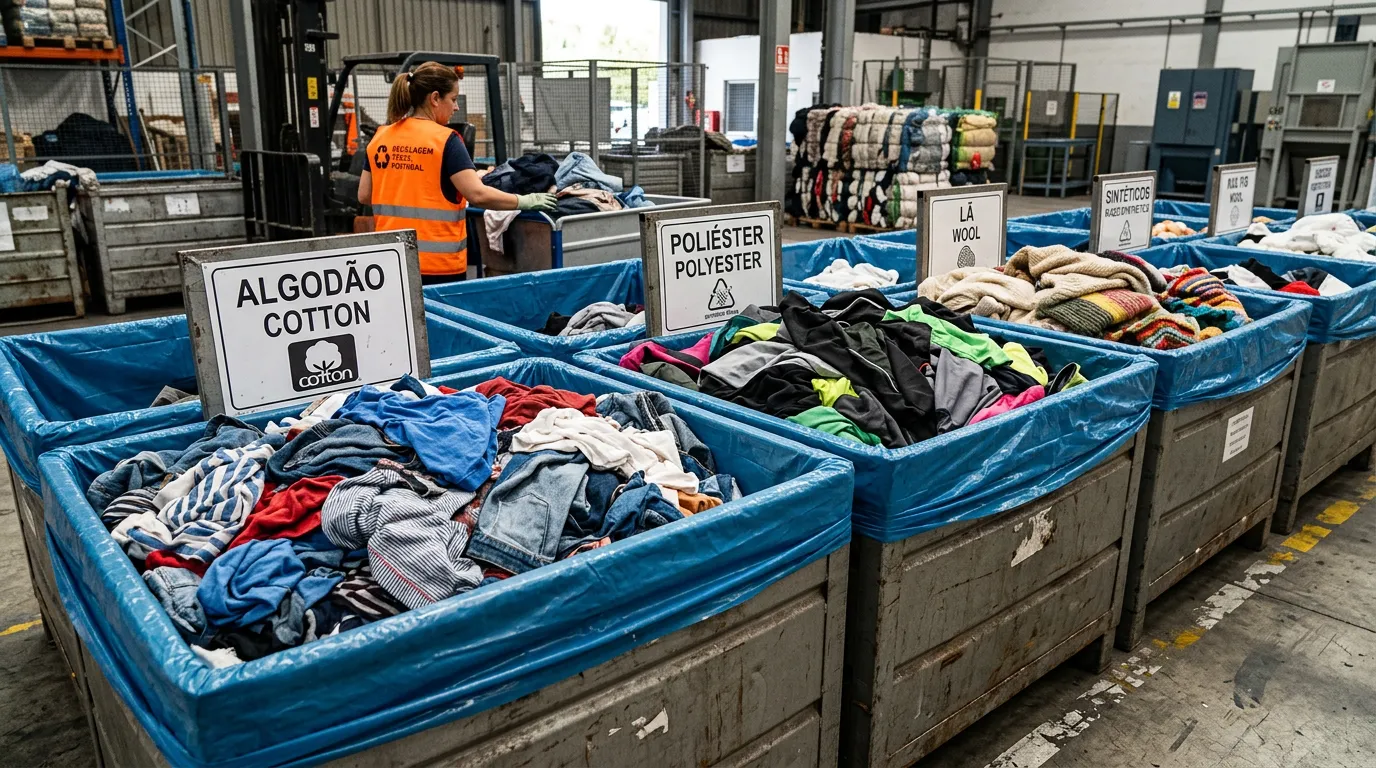
If your business runs a uniformed workforce or moves volumes of fabric, textiles are quietly one of your most wasteful and most overlooked streams. Australia sends roughly 800,000 tonnes of textiles to landfill every year and recovers only about 7% of it. For retail, hospitality and any organisation with branded workwear, that waste carries both a disposal cost and a brand-security risk. Here is how Australian businesses can divert textiles, dispose of uniforms securely, and start preparing for the Seamless product-stewardship scheme.
The scale of the problem
Australians are among the world's heaviest textile consumers. National data shows around 800,000 tonnes of leather, rubber and textiles discarded in a recent reporting year (2018-19 National Waste Report), with textiles the bulk of it and only about 7% recovered — more recent estimates put textile recovery even lower. The clothing slice alone runs to roughly 222,000 tonnes sent to landfill annually. For a business, that translates into general-waste bins filling with material that is light, bulky and entirely avoidable in the landfill stream.
In Victoria, every tonne that goes to landfill now attracts a metropolitan levy of $169.79 per tonne for 2025-26, up sharply from $129.27 the year before. Textiles are bulky relative to their weight, so they consume bin volume fast, which is what actually drives your lift charges. Diverting them protects both your levy exposure and your bin frequency.
Seamless: the textile product-stewardship scheme
Seamless is Australia's national clothing product-stewardship scheme, launched in 2023 and operational from 1 July 2024. It is funded by a small levy paid by member brands, typically four cents per garment, reduced to three cents for garments that meet eco-modulation (better design for recycling) criteria. The money funds collection, reuse and recycling infrastructure, with a roadmap to a circular clothing industry by 2030.
For most operating businesses, Seamless is not yet a direct compliance obligation, it is a voluntary scheme aimed at clothing brands and retailers. But the direction of travel is clear: textile stewardship is following the same path as packaging and e-waste, and procurement teams are already being asked about it. If you manufacture, import or retail apparel, joining or aligning with Seamless is becoming a credibility marker with corporate buyers.
Secure destruction versus recycling: which do you need?
This is the decision most businesses get wrong. There are two distinct outcomes for end-of-life uniforms, and they cost different amounts.
Secure destruction is for branded or identifying garments, anything carrying your logo, a security insignia, a healthcare or aged-care badge, or a high-vis livery. Old or rebranded uniforms in circulation are a genuine risk: they enable impersonation, unauthorised site access and identity fraud. Reputable providers shred the garments so they cannot be reconstructed, then feed the shredded fibre into recycling streams (insulation, padding, industrial wipes) and issue a Certificate of Destruction for your records. This is the same chain-of-custody logic as document destruction.
Standard textile recycling is for unbranded or generic textiles, plain workwear, offcuts, retail returns, linen, end-of-roll fabric, where there is no security exposure. These can go straight to a reuse or fibre-recovery partner at lower cost, because no shredding or certificate is required.
| Factor | Secure destruction | Standard recycling |
|---|---|---|
| Best for | Branded uniforms, hi-vis, healthcare/security workwear | Unbranded textiles, offcuts, linen, returns |
| Process | Witnessed/secure shred, then fibre recovery | Sort, reuse or fibre recycling |
| Proof provided | Certificate of Destruction | Recovery/diversion reporting |
| Relative cost | Higher (security premium) | Lower |
| Main driver | Brand and identity protection | Landfill diversion and levy saving |
Collection options for a uniformed workforce
How you collect textiles depends on your volume and how often it accrues:
- Scheduled bin or bag service — a dedicated textile container on a regular run, suited to retail chains, hotels and laundries with steady throughput.
- One-off project uplift — for a rebrand, fit-out clearance or a bulk uniform changeover, a single booked collection is usually the most economical.
- Take-back and consolidation — multi-site operators consolidate garments to a central point, then run a single secure-destruction collection to cut transport cost and tighten chain of custody.
- Reuse-first triage — wearable, unbranded items routed to charity or reuse partners before anything is shredded, which is both cheaper and a stronger sustainability story.
The right mix is rarely one option. A hospitality group, for example, might run a scheduled linen-recovery service, a reuse pathway for clean unbranded items, and a periodic secure-destruction uplift for logo'd front-of-house uniforms.
Where this fits in your wider waste plan
Textiles should be carved out of general waste as a named stream, the same way you would treat cardboard or organics. Once it is separated, the cost question is simply which partner gives you the best rate for your volume and security needs, and that is exactly the market we benchmark. As an independent broker we compare a network of providers, including textile and secure-destruction specialists, and we are paid only from the savings we find. There is no win, no fee.
If you are reviewing textiles, it is worth looking at the whole bin at the same time. Our clothing and textile recycling service sits alongside our work on general waste and commingled recycling, and many businesses find the biggest savings come from rebalancing all three together. For broader store-level tactics, see our guide to retail waste reduction.
To see what your current textile and general-waste contracts should actually cost, request a free, no-obligation review via our contact page or learn how our Melbourne waste broker service works.
Frequently asked questions
Is textile recycling mandatory for Australian businesses?
What is the Seamless scheme and does it cost my business money?
Should I shred old uniforms or just recycle them?
How much textile waste does Australia send to landfill?
What proof do I get that uniforms were destroyed and recycled?
Can a waste broker save money on textile and uniform disposal?
Related guides
See what you could save
Send us a recent waste invoice. We'll benchmark every charge against a network of Melbourne providers and show you the savings — free, no obligation, no win no fee.
Get Your Free Waste Audit →