 Bundle Waste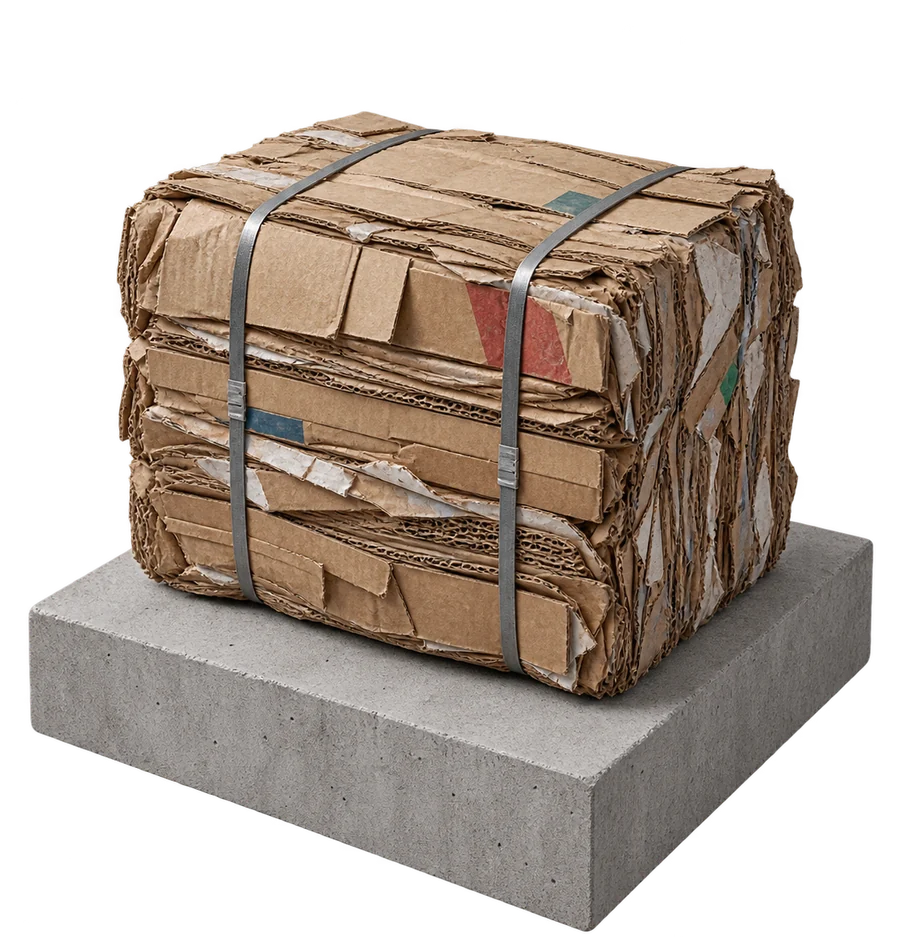
A baler decision needs a measured cardboard quantity, an accepted bale specification and a whole-of-life cost comparison. Do not buy equipment on an assumed rebate.
The facts behind the comparison
A baler is workplace plant. WorkSafe Victoria describes duties covering plant risks, guarding, maintenance, information and training. Source: WorkSafe Victoria — Plant and your legal duties.
What a baler does, and what it asks of your site
A vertical or horizontal baler compresses loose cardboard into dense, strapped bales. The effect is on volume rather than on weight: the same cardboard takes up far less room, so it is stored on a pallet footprint instead of filling bins, and it leaves site as a load rather than as a sequence of collections. For a site producing cardboard steadily, that is the whole argument — fewer chargeable collections of a material that is mostly air.
What the site has to provide in return is real: floor space for the machine and for finished bales, a suitable power supply, strapping consumables, servicing, and staff time on every bale. A baler is also workplace plant, so the duties WorkSafe Victoria sets out for plant apply — identifying hazards and controlling the risk, guarding, operator controls including emergency stop devices, installation and commissioning, maintenance and inspection, and information, instruction and training for the people who use it.
The revenue side is where a comparison most often goes wrong. Whether baled cardboard is bought, collected without charge, or charged for depends on the grade, the contamination level, the bale specification, the minimum load and the market at the time. Treat resale as income only where you hold a current written offer that identifies the deductions and says who pays freight.
What loose collection does, and where it falls short
Loose collection is the default arrangement: cardboard is flattened, put into a dedicated recycling bin and collected on a schedule. It needs no capital, no power supply, no operator training and no floor space beyond the bin itself, and it can be set up or changed quickly. For low or irregular quantities that is almost always the right answer.
Its weakness is volume. Cardboard is bulky, so a bin is full long before it is heavy, and a site producing a lot of it ends up paying for collections of empty space. Flattening every box is usually a contractual requirement rather than a courtesy; where it does not happen, bins overflow and contamination or excess charges follow. Ask your collector for its flattening and contamination requirements in writing, because they define what the service actually covers.
Stored cardboard is a fire consideration either way. EPA Victoria's guidance on the management and storage of combustible recyclable and waste materials describes pile height, length and width as key determinants of the severity, duration and intensity of a fire, and points to controls including limits on stockpile size, separation between stockpiles and the presence of firefighting equipment. That applies to loose stockpiles and to stacked bales alike, so whichever option you choose, the storage arrangement is part of the decision rather than an afterthought.
What to compare
| Decision | Baler proposal | Loose collection proposal |
|---|---|---|
| Material acceptance | Get the buyer’s bale size, grade, contamination and minimum-load specification. | Get the collector’s flattening and contamination requirements. |
| Site workflow | Allocate loading, tying, bale movement and storage tasks. | Allocate flattening and bin movement tasks. |
| Cost worksheet | Include hire or purchase, power, servicing, labour and freight. | Include bins, collections and applicable excess charges. |
| Revenue assumption | Use only a current written offer, with deductions and freight identified. | Confirm whether collection has a charge or credit; assume neither. |
Before you decide
- Measure cardboard produced during normal and peak weeks.
- Get written acceptance for your cardboard before selecting equipment.
- Ask the equipment supplier to assess layout, power, guarding and safe operating arrangements.
- Compare annual costs under low, expected and high quantities, without assuming resale income.
Which one suits your site
A baler is worth costing properly when cardboard arrives consistently rather than in bursts; you have measured the quantity across a normal week and a peak week; a recycler has confirmed in writing that it will accept the bale specification you would be producing; the space, power and labour exist; and the comparison still holds in your low-quantity case with no resale income assumed.
Loose collection is the better answer when quantities are low, seasonal or unpredictable; the site has no room or power for plant; nobody can be allocated to operate and maintain it; or no recycler has committed in writing to take your bales.
The reason this page gives no break-even tonnage is that every input which would produce one is yours: your measured quantity, your labour cost, the equipment quote you are actually holding, and a current written offer for your bales. Run the worksheet above on those four, at low, expected and high quantities, and the answer falls out of your own numbers rather than someone else's.
What this comparison cannot tell you
This comparison does not establish a universal break-even volume or payback period. A quotation for a machine is not evidence that a recycler will accept its output.
Frequently asked questions
How much cardboard does a business need before a baler makes sense?
Can I sell baled cardboard in Melbourne?
Does a baler reduce the waste bill?
What are my safety obligations if I install a baler?
Do I have to flatten cardboard for a loose collection service?
Is stockpiled cardboard a fire risk?
Related decisions
Explore the related comparison · Explore waste services
Discuss your waste setup with Bundle Waste.
Sources
- WorkSafe Victoria — Plant and your legal duties. Employers; Control of risk. Checked 18 September 2026.
- EPA Victoria — Management and storage of combustible recyclable and waste materials guidance. Stockpile dimensions and fire controls. Checked 21 September 2026.
- EPA Victoria — Waste levy. Table 1: 1 July 2026 to 30 June 2027. Checked 21 September 2026.