Retail
2 min read
By Pedro Carreira
Updated 25 June 2026
A large shopping centre (100–200 tenancies) requires: 15–30 bins across multiple waste rooms, daily general waste collection, multiple recycling streams, food court organics, cardboard compactor, grease trap servicing, hard waste coordination, and potentially clinical waste for medical tenants.
Annual waste cost: $80,000–200,000. A waste management plan is typically required as a planning condition.
Key Numbers
- Tenancies served: 100–200
- Bins across waste rooms: 15–30
- Annual waste cost: $80,000–200,000
- Metro landfill levy (2025–26): $169.79/tonne
What You Need to Know
At centre scale, the cost driver is not the bin count but how much of that 15–30 bin fleet is sent to landfill versus diverted. With the metro levy now $169.79/tonne, every tonne the food court and tenancies push into general waste instead of organics or cardboard carries the levy on top of the gate fee.
- Food court organics — the highest-volume, highest-contamination stream; segregating it cuts levy-bearing landfill tonnes.
- Cardboard compactor — densifies retail packaging into a rebated recyclate rather than a landfill cost.
- Grease trap servicing — a recurring scheduled cost easily over-serviced across multiple kitchens.
- Clinical waste — only the medical tenancies that genuinely need it, not centre-wide.
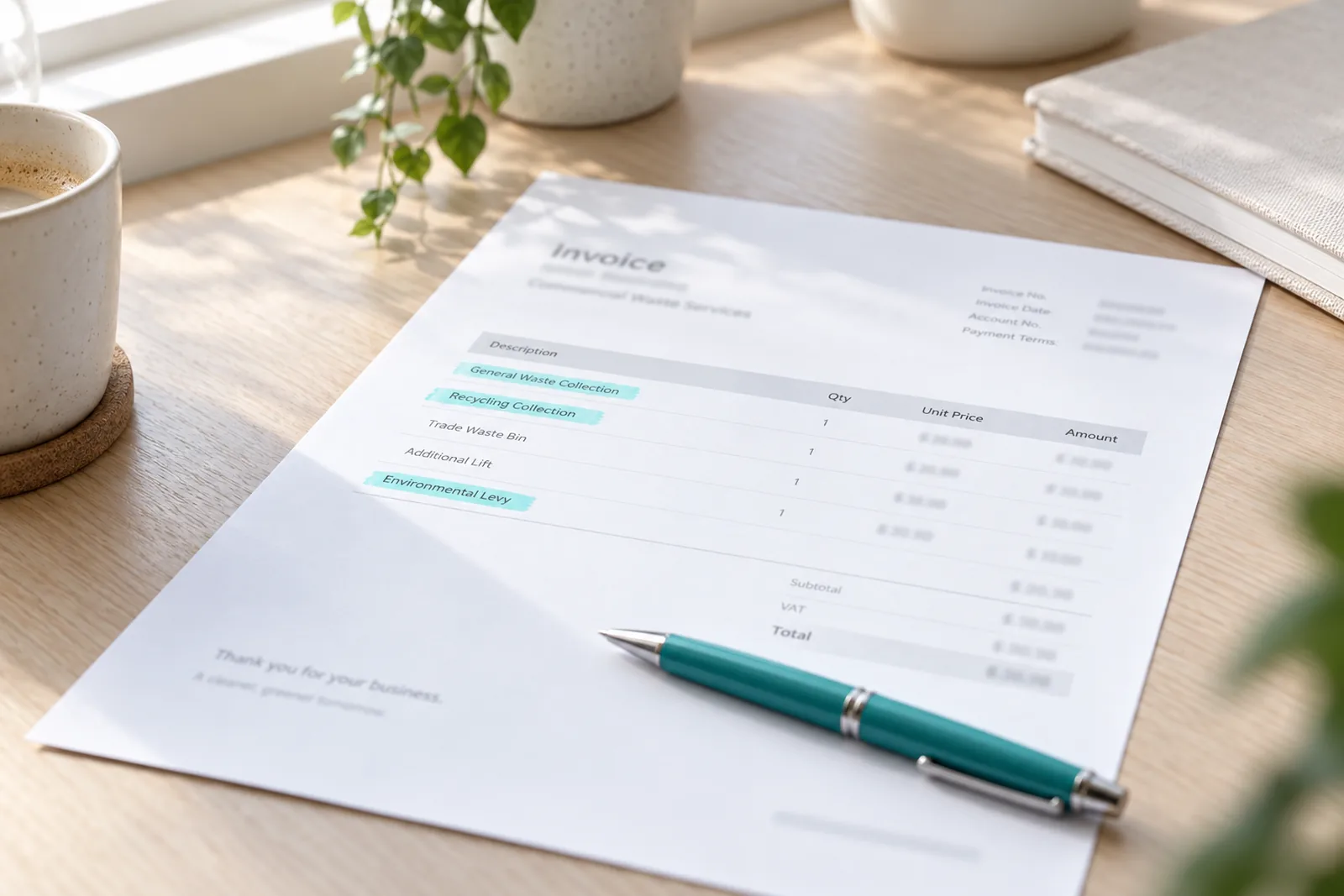
Diverting organics is also reinforced by the FOGO (Food Organics Garden Organics) Policy, which is steering commercial food waste out of landfill. As an independent broker, Bundle Waste runs a free invoice audit across every waste room, benchmarks each stream against a network of providers, and is paid only from the savings we find.
Related Resources
Related Questions
How should a Melbourne commercial bakery supplying supermarkets manage waste?+
Wholesale bakeries supplying supermarkets face additional waste from: returned unsold product (5–15% return rate), damaged packaging, high-volume ingredient packaging, and production waste. Returns represent lost revenue and disposal cost. Partner with food rescue for edible returns. Damaged product can go to animal feed. Monthly waste: $500–2,000. Returns management can save $1,000–5,000/year through food rescue donation tax deductions.
How much does food waste collection cost in Melbourne?+
Food waste (organics) collection in Melbourne costs $30–55/month for a 240L bin collected weekly and $50–90 for a 660L bin. This is typically 15–25% cheaper than general waste due to no landfill levy. Restaurants processing 200+ covers/day should budget $150–300/month.
What is the cost of waste management for restaurants in Melbourne?+
Melbourne restaurants typically spend $400–1,200/month on waste management: general waste $150–350, food organics $80–200, recycling $60–150, cooking oil $40–80, and grease trap servicing $150–400/quarter. High-volume venues (300+ covers/day) can exceed $1,500/month. Bundle Waste restaurant audits typically save up to 30%.
What are the waste costs for retail shops in Melbourne?+
Retail waste management in Melbourne costs $80–350/month depending on store size. A small boutique (under 100m²) spends $80–150/month, a mid-size store $150–250/month, and a large retail outlet $250–500/month. Cardboard recycling is the biggest stream; using a baler can reduce collection frequency by up to 70%.
What is the cost difference between front-lift and rear-lift bin collection?+
Front-lift bins (1.5m³–4.5m³) cost $120–350/month for weekly collection, while rear-lift bins (240L–1100L) cost $35–180/month. Front-lift is more cost-effective for high-volume generators producing over 3m³/week. The break-even point is typically 3–4 rear-lift 1100L bins.
See exactly what you are overpaying
Bundle Waste reviews your current waste invoices and benchmarks them against a network of Melbourne providers — free, with a written report in 5 business days. You will see what you pay now, where the hidden charges are, and the rate we can negotiate. You only pay from the savings we find: no savings, no fee.
Get my free waste audit →
Updated 25 June 2026