 Bundle Waste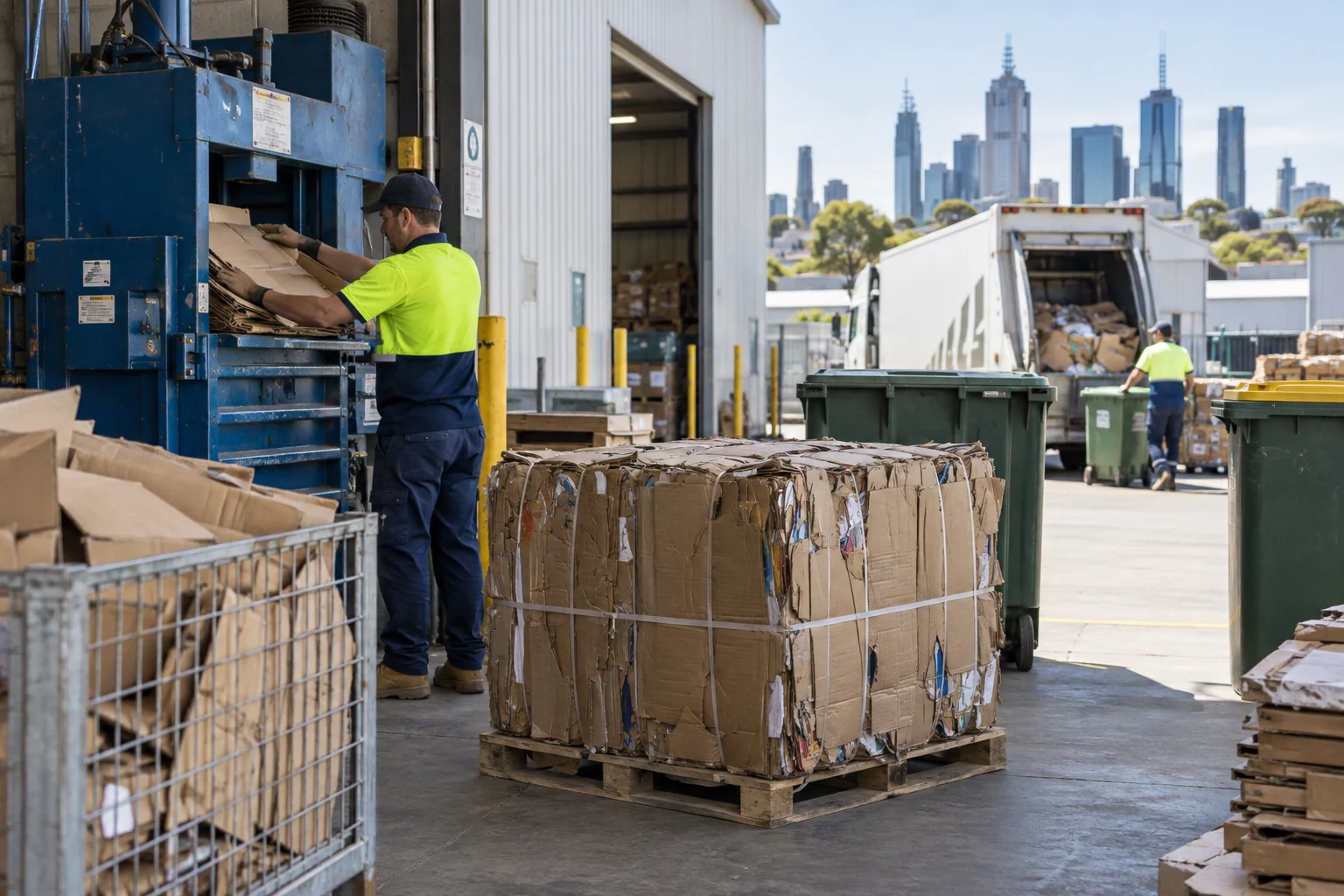
Choose a cardboard recycling arrangement by matching the material your Melbourne business produces to a collector's acceptance rules, your storage space and the full service cost. Separate collection, free pickup and paid rebates are different offers; confirm which one is actually being quoted.
Cardboard is also the one stream where the direction of the money can change. A retailer or warehouse that separates clean, dry boxes can move from paying a disposal rate to paying a lower collection rate, and at sufficient volume to being paid a rebate. This guide covers what decides which of those three you get.
Why cardboard should not go in general waste
Clean, dry cardboard — old corrugated cardboard, or OCC — is light, bulky and fully recoverable, which makes a general waste bin the most expensive place to put it. Waste sent to landfill carries the Victorian levy: $177.19 per tonne at metropolitan and provincial premises for 2026–27, up from $169.79 the year before, on EPA Victoria's published table. That sits on top of the gate fee and the transport.
Cardboard taken to a recycler does not attract that levy, and the material itself has a resale value. Those two facts are why a separated cardboard service is normally quoted below general waste for the same volume. How far below depends on your volumes, your collector and the OCC market, so get both priced rather than assuming a percentage. Our Victorian landfill levy guide explains how the charge reaches your invoice, and the business recycling guide covers the other streams worth splitting out.
Map how cardboard moves through your site
Record where deliveries are unpacked, how staff remove other packaging and where cardboard waits for collection. Check ordinary and peak delivery days. Photograph the actual material so providers can assess it rather than assuming every box belongs in the same service.
Keep the collection area accessible and protect stored material as required by the provider. Ask for a written list covering food-soiled, coated and wet cardboard, tape and packaging inserts. Do not infer acceptance from a recycling symbol alone.
Bin sizes: matching the bin to your volume
Commercial cardboard collection is built around the standard wheelie-bin sizes, with cages and front-lift bins above them. Right-sizing matters in both directions: an under-filled bin on a weekly lift pays for air, while an overflowing one creates contamination and side-waste charges.
| Option | Usually suits | Typical setting |
|---|---|---|
| 240L bin | Small offices, cafés, single retail tenancies | Low, steady box volume |
| 660L bin | Mid-size shops, clinic fit-outs | Daily deliveries, moderate unboxing |
| 1,100L bin | Larger retail, hospitality, light warehousing | High box throughput, frequent lifts |
| Cage or front-lift | Distribution, big-box retail, manufacturing | Bulk loose cardboard, before baling pays off |
Frequency matters as much as size, and the two trade against each other: fewer lifts of a larger or compacted container usually beats more lifts of a small one. Our commercial bin sizes guide sets out the capacity and access constraints for each.
Compare a bin, cage and baler
For loose collection, request the equipment dimensions, accepted load, lift schedule and access requirements. For cages, confirm who loads and moves them. For a baler, obtain the machine specification, training and maintenance requirements, as well as the buyer's bale specification.
Preserve safe movement and emergency access in the layout. Get the equipment supplier and collector to confirm the proposed arrangement before committing to a machine or building works.
A baler changes the arithmetic at high volume, because it compresses loose cardboard into dense bales, cuts the number of lifts and produces the baled material most rebate offers are written around. What it does not do is pay for itself at a predictable point — that depends on the machine, your actual weights and the rebate on offer, which is why the cost comparison below has to be built from your own numbers.
Build a complete cost comparison
List rental, collection, equipment, staff time, maintenance, delivery and removal. Show any rebate separately rather than hiding it inside a headline net figure. Compare equivalent periods and the same GST basis.
Use measured output and weight records where available. A bin count alone does not establish the weight of cardboard or the likely rebate. There is no verified universal baler price or payback period in this guide.
Rebates, free collection and the fine print
Free cardboard collection is a real offer, but a conditional one. A collector forgoes the fee, or pays a rebate, when the value of your material covers the truck and the processing. In practice that means:
- Large, clean, consistently baled volumes are the ones free or rebated collection is written for.
- Small or loose volumes normally carry a service charge, because the material value does not cover the trip.
- Haul distance counts. A site close to the receiving facility makes a marginal load viable where a distant one does not.
- OCC is a traded commodity and rebate rates move with it. Treat a quoted rebate as upside rather than a fixed income line, and check how and when the rate can change.
Our guide to cardboard bale prices covers how a rebate is actually calculated.
Contamination: the rule that voids a rebate
One rejected load can turn a recycling collection into a general waste charge and remove the rebate with it. Ask your collector for its written acceptance list; the categories that commonly appear on the excluded side are:
- Food-soiled boxes — greasy pizza boxes are the standing example.
- Wet or mouldy cardboard.
- Waxed or poly-coated cartons, including cool-room and produce boxes.
- Polystyrene, plastic wrap, foam inserts and packing tape left attached.
Flatten every box so the bin holds what it is meant to hold, and make stripping plastic and polystyrene part of the unpacking routine rather than a separate task nobody owns. Contamination is the most common reason a recycling service quietly bills at general waste rates.
Review the first collections
Check whether the equipment fills earlier or later than expected, whether other packaging enters the stream and whether invoices match the quote. Ask the collector to explain any rejected material with the date and applicable acceptance rule.
Retail and warehouse sites
Retail and warehousing generate the cleanest and highest-volume cardboard of any sector, which is why they are the usual candidates for rebated collection. The practical set-up is the same in both: one designated bale or cage point at the loading dock, lifts scheduled against the delivery cycle rather than against a default calendar, and a separation rule staff can follow without thinking about it.
Agree how the arrangement can change
Check the process for changing collection frequency, adjusting rebate rates and returning equipment. The ACCC contracts guidance provides context for reviewing service agreements. Keep the final specification with your quote and invoices.
Prepare your next step
Frequently asked questions
Is cardboard recycling cheaper than general waste in Melbourne?
Can I get free cardboard collection for my business?
What bin sizes are available for commercial cardboard recycling?
When does a cardboard baler make financial sense?
What contaminates a cardboard recycling load?
Do cardboard rebates stay the same over time?
How does a broker help with cardboard costs?
Sources
Checked 21 September 2026. These sources support the specific regulatory or contractual points identified above; the comparison checklists are practical guidance, not market-price research.
- Australian Competition and Consumer Commission — Contracts. Unfair contract terms; Next steps if there is a problem with a contract.
- EPA Victoria — Waste levy. Checked 21 September 2026; 2026–27 and 2025–26 rate tables.