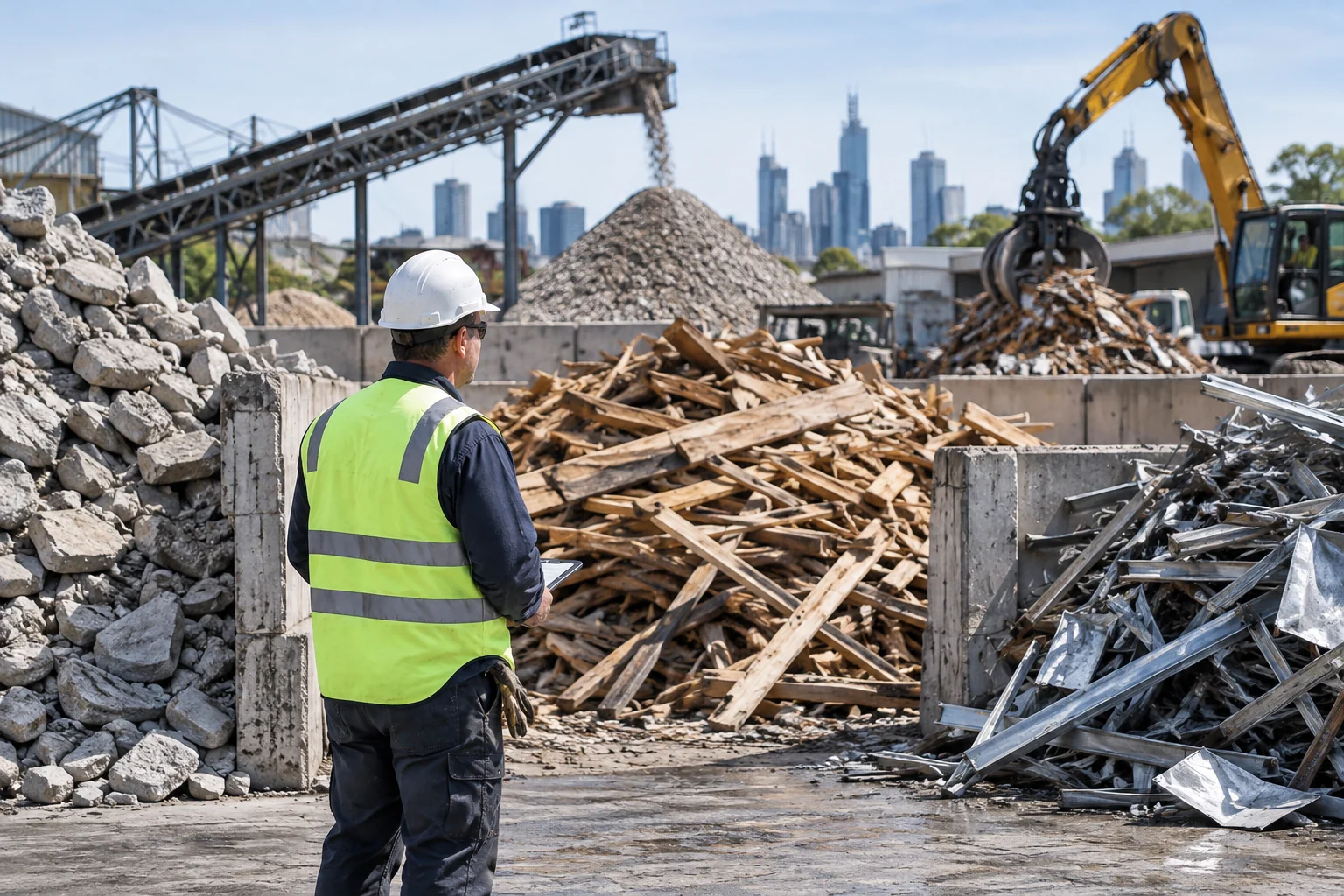
Construction & Demolition Waste Recycling in Australia: A Builder's Guide to Material Recovery

Construction & Demolition Waste Recycling in Australia: A Builder's Guide to Material Recovery

How to recover concrete, timber and metal on site, choose the right bin, and stop paying the full landfill levy on mixed loads.

Construction and demolition (C&D) waste makes up roughly 39% of everything Australia throws out — close to 29 million tonnes a year — yet it is also our best-recovered material stream, with building and demolition waste recovered at around 84% nationally. That gap between what's possible and what most sites actually achieve is where the money is. This guide is the operational side of C&D recycling: how to recover concrete, timber, metal and plasterboard on site, when to use a skip versus a hook-lift bin, and how to stop paying the full Victorian landfill levy on loads that didn't need to go to landfill at all.

Why C&D recycling is a cost decision, not just a compliance one

Most builders treat waste as a line item that "is what it is". It isn't. In metropolitan Victoria the landfill levy alone is $169.79 per tonne in 2025-26 — up sharply from $129.27 the year before — and that's before the gate fee and transport. A single mixed skip can carry a tonne or more of concrete and rubble that, if separated, would attract little or no levy and often has a positive recycling value. The recovery rate for building and demolition material sits around 84% nationally and roughly 80% in NSW, second only to metals. Sites that hit those numbers aren't doing anything exotic — they're just keeping heavy, recyclable material out of the bin that gets weighed at landfill.

The four streams that move the needle

C&D waste is dominated by a handful of materials, and a small amount of segregation captures most of the value. By weight, the recoverable streams are:

  • Concrete, brick and masonry — typically the largest fraction of a demolition load and the single biggest recycling win. Concrete and masonry make up the largest share of recovered C&D material; concrete is around 60% of recycled masonry. Clean rubble is crushed into road base and aggregate; recyclers often accept it at low or no cost, and a clean concrete-only bin avoids the levy almost entirely.
  • Metals — steel, copper, aluminium and offcuts. Metals are the highest-recovered stream of all (well above 80%) and have genuine scrap value. Never let metal ride in a mixed bin; a dedicated cage or a scrap-metal merchant usually pays you.
  • Timber — framing offcuts, formwork and pallets recover at roughly 40% nationally, mostly as mulch, animal bedding or engineered-wood feedstock. Treated and painted timber is restricted, so keep it separate from clean structural timber.
  • Plasterboard — uncontaminated offcuts are fully recyclable back into new board or gypsum soil conditioner, but only through specialist facilities. Plasterboard in a mixed bin is a contaminant; segregated, it's a recyclable.

Soil and fill are a separate question — they may need testing for contamination before they can be reused or disposed of, and contaminated material can fall into priority-waste categories with much higher levies. If you're planning streams formally for a permit, our construction waste management plan guide covers the documentation councils want to see.

Skip versus hook-lift: matching the bin to the job

The bin you choose largely determines whether segregation is even practical. The two workhorses on Australian sites are marrel (skip) bins and hook-lift bins, and they suit very different jobs.

FactorSkip / marrel binHook-lift bin
Typical size2–9 m³10–30 m³
Best forReno, fit-out, tight residential sitesDemolition, bulk concrete, large new builds
AccessFits driveways and lanewaysNeeds a clear, firm hardstand and truck access
SegregationRun two or three small skips per streamOne large bin per stream; high volume per lift
Cost driverPer-lift price plus levy on weightLower cost per m³, but you pay for the volume

The practical rule: if you can fit two or three skips for separate streams, you'll almost always beat a single mixed bin once the levy is factored in. On larger demolition jobs, a dedicated hook-lift for clean concrete plus a smaller bin for mixed residual is usually the cheapest configuration. We break the economics down further in our skip bin vs regular collection comparison.

How mixed C&D gets charged — and why it stings

When a bin is mixed, the whole load is generally treated as general waste and weighed at the landfill gate, so every tonne attracts the full $169.79/tonne metro levy plus the gate fee. Separate that same load into a clean concrete bin and a smaller mixed-residual bin, and only the residual portion carries the full charge. On a demolition where 60–70% of the weight is masonry, that's the difference between paying the levy on the whole job and paying it on a third of it.

ApproachWhat goes to landfillLevy exposure (per 10 t job)
One mixed bin~10 t treated as general waste~$1,698 levy + gate fees
Concrete separated, residual binned~3 t residual; 7 t concrete recovered~$509 levy + gate fees

Figures are indicative — actual savings depend on your material mix, recycler gate fees and haulage. The point holds at any scale: separation shrinks the weight you pay levy on.

Hitting diversion targets without slowing the job

Many Victorian councils require a minimum 70% diversion rate (by weight) for projects needing a waste management plan, and inner-Melbourne councils sometimes ask for more. You don't need a recycling expert on site to hit that — you need three things: enough bin positions for your main streams, clear signage, and a crew that knows concrete and metal never go in the general bin. Keep weighbridge dockets from your recycler; they're the proof of diversion councils and clients increasingly ask for, and they're also how you verify you're actually being charged correctly.

If you run multiple sites or pay different prices across builders and suburbs, that's exactly where an independent broker earns its keep. We benchmark a network of providers and renegotiate on a no-win, no-fee basis — see how the Melbourne waste broker model works or tell us about your sites and we'll show you where your C&D spend is leaking.

Frequently asked questions

What is the recycling rate for construction and demolition waste in Australia?+
Building and demolition materials are recovered at around 84% nationally according to the 2024 National Waste and Resource Recovery Report — one of the highest rates of any waste stream, second only to metals. NSW reports a stable C&D recycling rate of about 80%. The catch is that these are industry-wide averages driven by sites that separate their materials; a single mixed bin sent to landfill recovers almost nothing, which is why on-site segregation matters so much.
Does mixed C&D waste attract the full landfill levy in Victoria?+
Yes. When concrete, timber, metal and general rubbish are combined in one bin, the whole load is generally treated as general waste and weighed at the landfill gate, attracting the full metropolitan levy of $169.79 per tonne in 2025-26, plus gate fees. Separating clean concrete and metals out means only the residual fraction carries the full charge — often a third or less of the original weight.
Should I use a skip bin or a hook-lift bin for construction waste?+
Use skip (marrel) bins for renovations, fit-outs and tight residential sites where access is limited — they fit driveways and laneways and let you run two or three small bins for separate streams. Use hook-lift bins (10–30 m³) for demolition and large new builds with truck access, where high volume per lift lowers your cost. On big jobs, a dedicated hook-lift for clean concrete plus a smaller mixed-residual bin is usually the cheapest setup.
Which construction materials are worth separating for recycling?+
Concrete, brick and masonry give the biggest win because they're the heaviest fraction and recyclers accept clean rubble cheaply or for free. Metals have genuine scrap value and the highest recovery rate of any stream, so they should never sit in a mixed bin. Clean timber recovers as mulch or engineered-wood feedstock, and uncontaminated plasterboard is fully recyclable through specialist facilities. Keep treated, painted or contaminated material separate, as it has restrictions.
How do I prove I hit my project's waste diversion target?+
Keep the weighbridge dockets from your recycler and landfill for every load. They show the tonnage by stream and are the evidence Victorian councils and many head contractors ask for to confirm you met your diversion rate (commonly a minimum of 70% by weight). Dockets also let you check you're being billed for the actual weight tipped, which is a common source of overcharging.
Can recycled concrete actually be reused, or is it just diverted?+
It's genuinely reused. Clean demolition concrete is crushed into road base, aggregate and fill, and it makes up roughly two-thirds of all recovered C&D material in Australia. Crushed concrete even yields more volume per tonne than quarry rock, which is why recyclers want it. That demand is what makes a clean concrete-only bin so cost-effective — you're supplying a feedstock, not paying to dump waste.

Related guides

See what you could save

Send us a recent waste invoice. We'll benchmark every charge against a network of Melbourne providers and show you the savings — free, no obligation, no win no fee.

Get Your Free Waste Audit →