Bundle Waste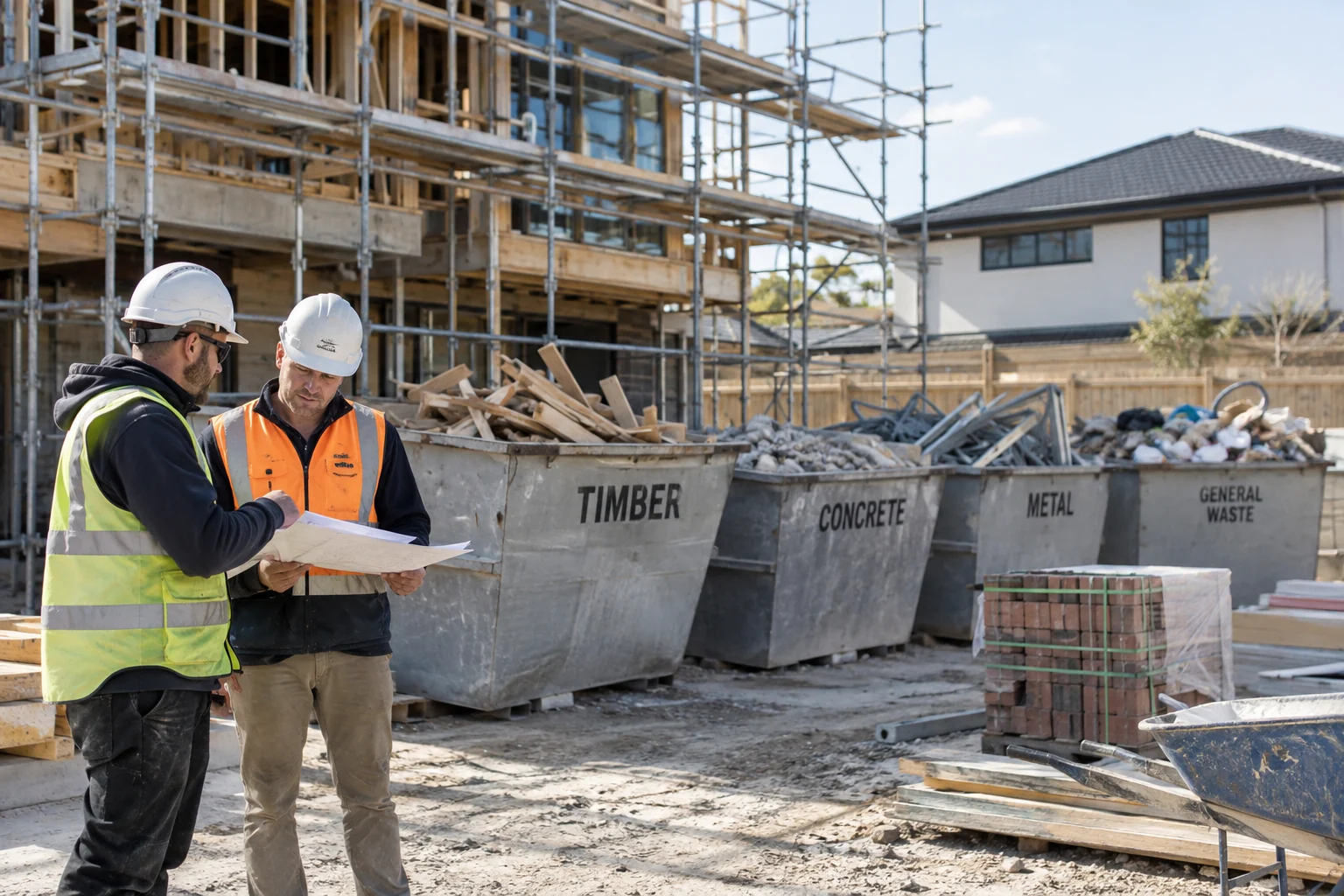
Build a construction waste management plan around the project's actual conditions, materials and receiving arrangements. Confirm planning and permit requirements with the responsible council; there is no universal project-value threshold in this guide.
A waste management plan earns its keep twice over. It satisfies a permit condition, and it forces the decisions — which streams, which bins, which receiving facility, whose job — to be made before the first skip arrives rather than improvised around it. This guide covers when a plan is called for, what it needs to contain, the main construction and demolition streams and how each is handled, and where the cost actually moves across a build.
Start with the project requirements
Collect the permit conditions, client requirements and relevant council guidance. Identify who must prepare, approve and update the plan. Do not assume a template from another municipality meets this project's requirements or establishes a fixed diversion target.
When a plan is required
The requirement is local, not statewide. Whether a waste management plan is needed, and what it has to contain, comes from the responsible council's planning scheme and from the conditions attached to your planning or building permit. Two adjacent municipalities can take different views of the same project, which is exactly why a template borrowed from a neighbouring council proves nothing about yours.
The situations that most often attract a requirement are demolition of an existing structure, multi-dwelling residential development, commercial and industrial builds, and significant renovation — but the council is the authority on that, and this page does not set a project value, floor area or dwelling count as a trigger. Ask before you assume, in either direction.
Where no plan is formally required, writing one is still worth the hour. The projects that overspend on waste are almost always the ones that never decided, in advance, how material would be separated and where each stream was going.
What the plan needs to cover
Whatever the council's format, a plan that is actually useful on site covers four things.
- Waste estimation. Types and quantities expected at each phase — demolition, excavation, structure, fit-out — with the estimation method recorded alongside each figure so a reader can see how firm it is.
- Targets. Where the responsible council sets a diversion target for the permit, state that target and how it will be measured. Where none is set, say so rather than importing one.
- On-site procedures. Bin placement, signage, contamination prevention, safe access, and who is responsible — including subcontractors, who generate much of the waste and rarely read the plan unless it reaches them.
- Destinations. The proposed receiving facility for each stream, with acceptance confirmed. A named facility that has agreed to take the material is evidence; "recycled where possible" is not.
Estimate by phase and material
Separate demolition, excavation, structure and fit-out. For each stream, record the estimation method, expected quantity, uncertainty and responsible contractor. Flag unknown contamination for investigation before deciding its route.
The C&D streams and how each is handled
Each stream has its own route, its own contamination sensitivity and its own reason to be kept separate.
Concrete, brick and masonry
Usually the heaviest stream on a demolition or construction site. Clean material can be crushed and reused as road base, drainage aggregate or fill. The operative word is clean: timber, plastic, plasterboard or soil mixed into a concrete load can turn a recoverable stream into a mixed one, so a dedicated area and a clear instruction to the crew matter more here than anywhere else.
Timber
Formwork, offcuts, pallets and demolition timber. Clean untreated timber can be mulched or reprocessed. Treated timber is a different matter: EPA Victoria names treated timber waste among its priority waste examples, which carry greater regulatory controls and their own duties (EPA Victoria — Understand your waste obligations and duties). Separating treated from untreated on site is straightforward with labelled bins and is far cheaper than discovering the mix at the gate.
Metals
Steel, aluminium and copper are the streams with genuine residual value, and they are also the easiest to lose into a mixed bin. A dedicated cage or skip for rebar, framing offcuts and pipe keeps that value where you can see it. Ask recyclers about collection arrangements and whether they pay for particular grades.
Soil and excavation material
Clean natural fill can often be reused on site or moved to another project. Material from a former industrial site, or near fuel storage, needs testing before anyone decides where it goes: EPA Victoria lists contaminated soil as a priority waste example. Test early. Soil classification discovered mid-excavation stops the job.
Plasterboard
Plasterboard is routinely kept as its own stream, because gypsum disposed of alongside biodegradable waste can generate odorous and toxic hydrogen sulphide. Acceptance rules differ between facilities, so confirm with the intended receiver whether it takes plasterboard, in what condition and with what contamination limits. A rejected load is redirected, re-transported and re-charged.
Hazardous material
Asbestos, lead paint, chemical residues and contaminated soil need identification before work starts, handling by appropriately permitted operators, and disposal at facilities that can lawfully receive them. Classify the waste first and then meet the duties that apply to that classification; the classification is what decides your obligations, not the container it ends up in.
Plan prevention and separation
Identify materials that can be ordered differently, retained, returned or reused after the necessary assessment. Draw proposed collection points and safe access. Specify signage and responsibilities so the plan describes how the site will operate, not merely which bins will be purchased.
Skip and hook-lift bin strategy
Construction waste is collected mostly in skips and hook-lift bins, and how they are set up has more effect on the bill than which supplier provides them.
- Separate rather than mix. A mixed construction and demolition load is charged as its worst component. Running separate bins for concrete, metals, clean timber and general residual gives each stream its own, usually better, rate — where the site has room for them.
- Match swaps to phases, not to the calendar. An excavation phase and a fit-out phase produce different materials at different rates, and a fixed weekly swap will be wrong for both.
- Do not overfill. Overloaded and overweight bins attract surcharges or are refused, which costs a second movement on top of the first.
- Place bins to avoid double handling. Waste that has to be carried across a site tends not to be, and ends up in whichever bin is nearest.
- Quote the project, not the swap. Ask for pricing across the whole build, with the bin size, accepted materials, weight allowance and excess terms written down.
Confirm destinations and records
Name the proposed receiver for each stream and obtain material acceptance. Use EPA Victoria — Understand your waste obligations and duties to identify the relevant checks. Record permissions and tracking requirements applicable to the actual waste, not a blanket statement that all providers are licensed.
Controlling cost across the project lifecycle
Waste cost on a build is not fixed at the start. It moves at three points.
Before work starts. A pre-demolition audit identifies what can be reused or salvaged before it is broken. Doors, windows, fixtures and heritage material have value that disappears the moment the demolition is indiscriminate, and every item retained is one that does not need transporting or disposing of.
During the build. Watch fill rates weekly and adjust bin sizes and swap frequency as the project moves between phases. The setup that suits a concrete-heavy excavation is the wrong one for a fit-out producing mostly cardboard and packaging.
At completion. Final clean-up generates a disproportionate volume — packaging, protective coverings, defect rectification — and it usually arrives when the budget is already spent. Plan a separate allowance for the final phase instead of absorbing it into general contingency.
Create a simple project register
Use columns for date, project phase, waste description, measured quantity or estimation basis, transporter, destination, docket reference and cost. Identify who reconciles the register with invoices and who handles rejected or changed material.
Review changes and close the project
Update the plan when materials, design, contractors or destinations change. At completion, compare estimated and actual quantities and explain missing records. Report recovery using the available evidence; a bin sent to a recycling facility is not by itself proof of a specific diversion percentage.
Frequently asked questions
When is a waste management plan required for construction in Victoria?
How much do construction skip bins cost in Melbourne?
What waste diversion rate do Victorian councils require?
What are the main categories of construction and demolition waste?
Related guides
Sources
Checked 21 September 2026. Operator sources describe their own services; these are not rankings, endorsements or universal acceptance rules.
- EPA Victoria — Understand your waste obligations and duties. Industrial waste; Priority waste; Reportable priority waste; the listed waste duties. Checked 21 September 2026.