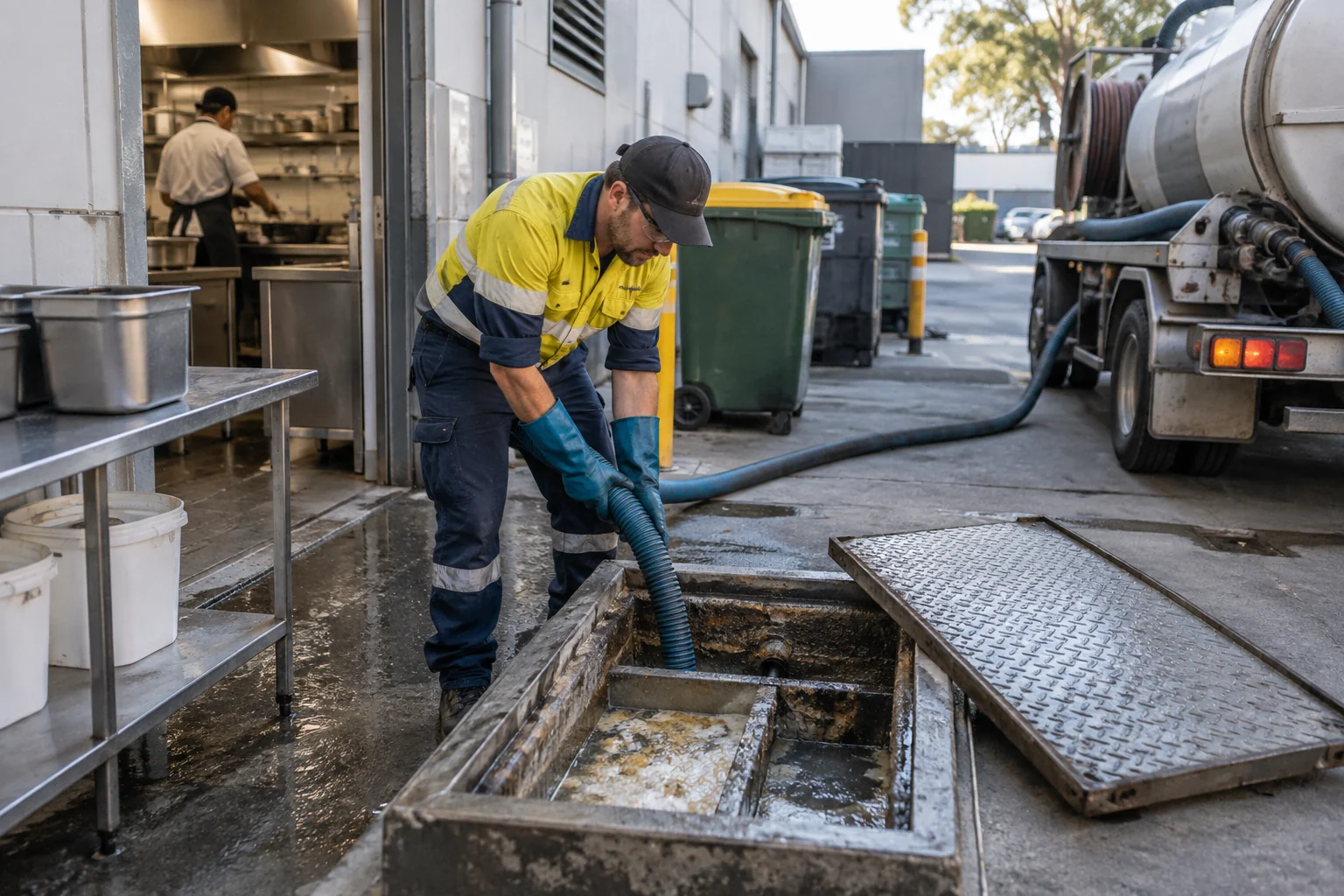
The honest answer to "how often should a grease trap be cleaned in Australia" is: as often as your trade waste agreement says, and never less often than the 25% rule allows. For most Melbourne food businesses that lands between every month and every three months — but the interval is not yours to set on a whim, and getting it wrong is a trade waste breach enforced by your water authority, not the EPA. Here is how the rules actually work, and how to make sure you are not pumping out more often than you need to.
The 25% rule: the standard every schedule comes back to
Across Australian water authorities, the governing principle for grease trap (food and oil interceptor) maintenance is the 25% rule. A trap must be pumped out before the combined depth of floating fats, oils and grease (FOG) plus the settled solids on the bottom reaches 25% of the trap's total liquid depth. Beyond that point the trap can no longer separate FOG effectively, grease begins passing through to the sewer, and you are in breach of your trade waste conditions.
The 25% rule is the ceiling. Your scheduled interval — monthly, two-monthly, quarterly — is simply the authority's estimate of how long your trap takes to reach that 25% threshold based on its size and your trade. If your kitchen gets busier, you hit 25% sooner and the interval must shorten, regardless of what the schedule says.
The standard interval: 1 to 3 months for most food businesses
For a typical Melbourne cafe, restaurant or takeaway, in-ground grease traps are serviced somewhere between every month and every three months. As a working guide:
| Trap type / size | Typical cleaning frequency | Who does it |
|---|---|---|
| Under-sink trap (40-100L) | Weekly to fortnightly | Staff |
| In-ground trap 1,000L (busy site) | Every 4-8 weeks | Licensed transporter |
| In-ground trap 1,000-2,000L (lower volume) | Every 8-13 weeks | Licensed transporter |
| Large interceptor 5,000L+ | Monthly (high volume) to quarterly | Licensed transporter |
These are typical intervals, not entitlements — the figure on your trade waste agreement is what binds you. South East Water, for example, commonly sets food and oil interceptors at a four-monthly default, then tightens it if monitoring shows the trap filling faster. The volume of FOG you generate, your trap's capacity and your trade all feed into the number.
Who sets your schedule — and why it is not the EPA
This is the point most operators get wrong. Discharging trade waste to the sewer is regulated by your retail water authority, not EPA Victoria. In metropolitan Melbourne that means Yarra Valley Water, South East Water or Greater Western Water. Your trade waste agreement with that authority is the document that dictates your pump-out interval, your pre-treatment, your monitoring and your record-keeping.
EPA Victoria sits one step downstream: it licenses the transporters who pump out and dispose of the waste, and it regulates where that waste ends up. So the EPA matters for who may legally empty your trap — only an EPA-registered liquid waste transporter can — but your cleaning frequency is a water-authority matter. If you are confused about who governs what, our liquid waste and grease trap guide maps the full framework.
Record-keeping: the part that gets businesses fined
Pumping out on time is only half of compliance. You must be able to prove it. Water authorities require you to keep your pump-out certificates, receipts and maintenance records and produce them on request or during an inspection — typically for at least two years. In South East Water's area, EPA-licensed transporters log every interceptor pump-out through South East Water's "Wastelog" system (run with the VWMA) in its service area, which it uses to monitor compliance; if your trap has no recent entry, you will hear about it.
Practical record-keeping discipline:
- Keep every pump-out certificate filed by date — digital copies are fine.
- Ask your transporter to record the FOG-and-solids depth at each visit, not just "serviced". That measurement is your evidence the 25% rule is being met, and your proof an interval could be extended.
- Confirm your transporter is EPA-registered and logs to your authority's system where one exists.
- Retain records for at least two years, or longer if your agreement specifies.
What non-compliance actually costs
Penalties for trade waste breaches run through the water authority and the Water Act, not EPA fines. Discharging trade waste without an agreement is an offence carrying up to 200 penalty units, with an additional 80 penalty units for each day a continuing offence persists. At Victoria's 2025-26 penalty unit value of $203.51, that headline figure is over $40,000 before the daily amounts compound. In practice, missing a scheduled pump-out usually starts with a non-compliance notice giving you a short window to fix it — but ignore those and the costs escalate fast, on top of the very real risk of a blocked sewer, an overflow and an emergency call-out at premium out-of-hours rates.
Are you cleaning too often? The overspend most businesses miss
Compliance failures get the attention, but the quieter problem is the opposite: pumping out far more often than the 25% rule requires, on a schedule a provider set years ago and never revisited. If your transporter's depth readings are consistently sitting at 10-15% when they arrive, you are paying for collections you do not yet need — and you can apply to your water authority to extend the interval, entirely within the rules.
You can also slow how fast the trap fills: collect cooking oil in drums for recycling rather than letting it reach the trap, scrape plates before washing, and keep under-sink traps clean so they do not overload the main one. Less FOG in means longer intervals out — and a smaller bill. We cover what those pump-outs should cost and how to test your rate against the market in our grease trap cleaning cost guide.
Where Bundle Waste fits
We do not clean traps or own tankers. As an independent broker, our job is to make sure your interval matches the 25% rule (not the provider's convenience), your rate is benchmarked against a network of providers, and your liquid waste is bundled with your other streams for leverage. Send us a recent invoice through our free audit — no savings, no fee.
Frequently asked questions
How often should a grease trap be cleaned in Australia?
What is the 25% rule for grease traps?
Who sets my grease trap cleaning schedule?
What are the penalties for not cleaning a grease trap on time in Victoria?
What records do I need to keep for grease trap cleaning?
Can I extend my grease trap cleaning interval to save money?
Does the EPA fine you for grease trap non-compliance?
Related guides
Related questions
See what you could save
Send us a recent waste invoice. We'll benchmark every charge against a network of Melbourne providers and show you the savings — free, no obligation, no win no fee.
Get Your Free Waste Audit →