
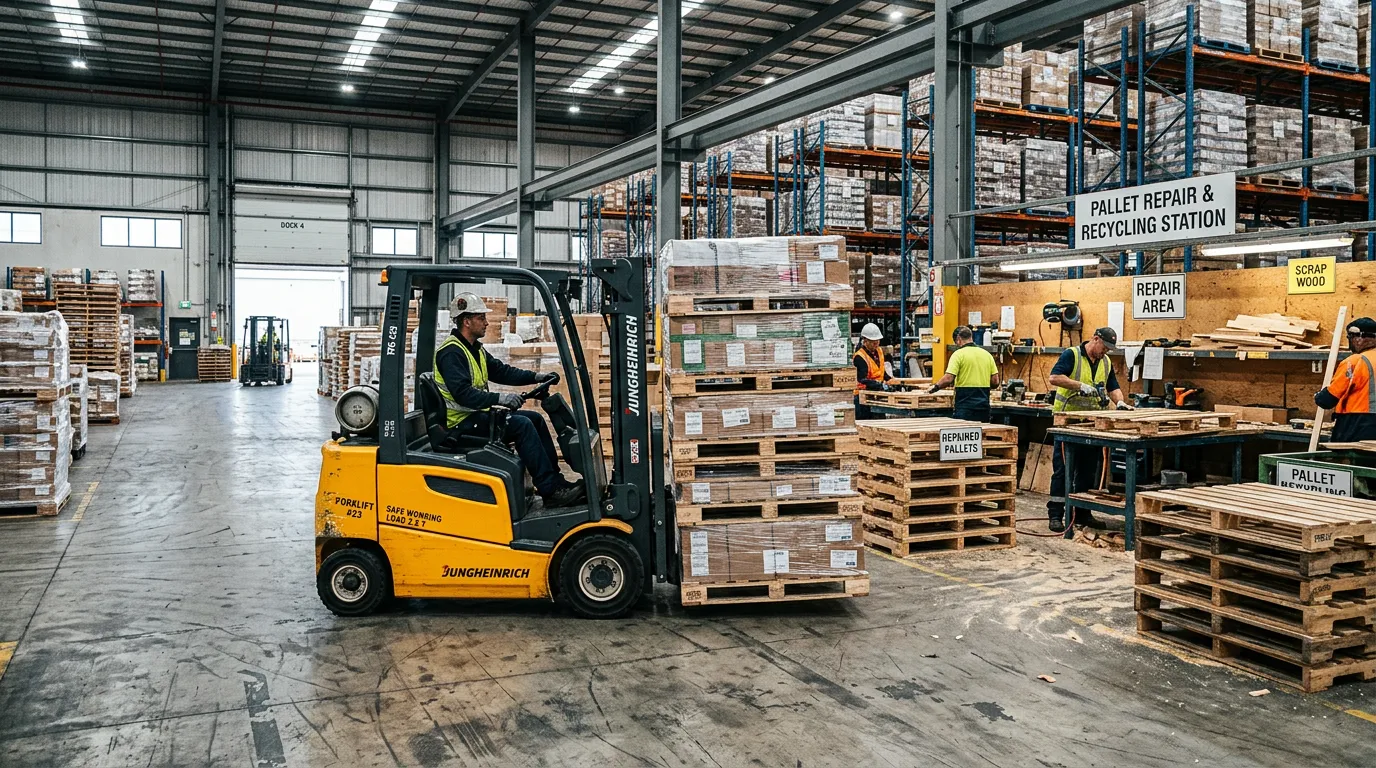
For most Melbourne warehouses, factories and distribution centres, pallets and timber offcuts are the single most voluminous waste stream on site — and one of the most expensive to handle badly. With the Victorian metropolitan landfill levy now at $169.79 per tonne, sending clean, recoverable timber to a general waste bin is paying premium prices to bury an asset that could be reused, bought back or recycled into mulch for free. This guide breaks down the real options.
Why pallets and timber are a costly waste stream
Timber is bulky and light. A general waste bin filled with broken pallets and offcuts hits its volume limit long before its weight limit, so you pay for air as much as material — and every tonne that does land in a metro Victorian tip now carries a $169.79 levy on top of gate and transport fees. That levy jumped roughly 31% from $129.27, with the new rate taking effect on 1 July 2025, and it is expected to keep rising. For a busy logistics site cycling through hundreds of pallets a month, this is rarely a rounding error on the invoice.
The good news: timber is one of the easiest streams to divert. Whole pallets in good condition have resale value, damaged units can be repaired or mulched, and clean offcuts have a ready market. The waste is only expensive if you treat it as waste.
The hierarchy: reuse before recycle
The cheapest pallet is the one you do not throw away. Before any disposal decision, work down this order:
- Reuse in-house. Standard pallets — the Australian Standard 1165×1165mm footprint in particular — circulate through supply chains. Sort sound pallets back into your own dispatch flow rather than buying replacements.
- Sell or hand back to a buy-back operator. Several Melbourne pallet companies pay cash for usable second-hand pallets (typically up to around $10 each for standard, sound units) and will collect them. A waste stream becomes a small revenue line.
- Repair and re-grade. Damaged pallets are often repairable for a fraction of replacement cost. Specialists collect, repair and re-sell — keeping timber in service longer.
- Recycle into mulch or chip. Pallets and offcuts beyond repair are shredded into landscaping mulch, animal bedding or biomass. Many operators offer free collection for clean, untreated timber because the recovered material has value.
- Landfill — last resort only. Reserve this for contaminated or treated timber that cannot be recovered, and price the levy into the decision.
Clean timber vs treated timber — the line that matters
This distinction drives both compliance and cost. Under EPA Victoria rules, treated timber is classified as priority waste. Only untreated timber can be applied to land as mulch or sawdust, so recyclers need clean feedstock — and they will reject or surcharge contaminated loads.
- Clean / untreated timber: raw pallets, packing crates, dunnage, plain offcuts. Fully recoverable — mulch, chip, repair or resale.
- Treated timber (water-based or light-organic preservative): some fencing, decking and structural timber. Can generally go to a municipal landfill but cannot be mulched.
- Oil-borne / creosote-treated timber: utility poles, sleepers, marine piles. Cannot go to standard landfill and needs specific assessment and disposal.
The practical takeaway: separate clean timber at the source. The moment recyclable pallets are mixed with treated timber, plastic wrap or general rubbish, the whole load is often downgraded to general waste and charged at the full levied rate. Source separation is the single highest-leverage habit on a timber-heavy site — the same principle covered in our guide to what contamination actually costs.
What the options cost
Indicative ranges for Melbourne metro — your real numbers depend on volume, condition, location and the quality of the deal negotiated:
| Option | Typical net cost to you | Best for |
|---|---|---|
| Buy-back (sound standard pallets) | Income, up to ~$10/pallet | High volumes of reusable standard pallets |
| Free recycling collection (clean timber) | $0 collection (subject to load/condition) | Clean, separated, full loads |
| Repair & re-grade service | Low per-unit fee, offsets replacement spend | Mixed-condition pallet pools |
| Booked timber/mixed collection | From ~$250+GST per service, typically | Damaged or mixed timber, scheduled pickup |
| General waste bin (timber in mixed) | Gate fee + $169.79/t levy + transport | Genuinely unrecoverable material only |
Setting up a pallet and timber programme that sticks
The operational wins are simple but easy to neglect:
- Designate a timber zone. A clear pallet stack and a clean-timber cage stop cross-contamination and make collections efficient.
- Match collection frequency to flow. Over-frequent pickups waste money; under-frequent pickups clog the yard and tempt staff to dump timber in the general bin.
- Track what leaves. Volumes and recovery rates feed reporting and help you renegotiate. The same discipline applies across a logistics site — see our warehouse waste management guide and the manufacturing waste guide for the wider picture.
- Benchmark, don't assume. Pallet pricing varies enormously between operators, and rates drift over time. Most businesses are on a contract that was competitive years ago and is not today.
Where Bundle Waste fits
We are not a pallet hauler or a tip — we are an independent broker. We benchmark your pallet and timber arrangements against a network of providers, line up the right mix of buy-back, recycling and collection, and renegotiate the deal. We are paid only from the savings we find, so if there is nothing to save, there is nothing to pay. If pallets and timber are a meaningful line on your invoice, see our pallet recycling service or request a no-obligation benchmark.
Frequently asked questions
Can clean timber and pallets avoid the Victorian landfill levy?
Do Melbourne companies actually pay cash for used pallets?
What is the difference between clean timber and treated timber for recycling?
Why does mixing timber with other waste cost more?
How often should a warehouse schedule pallet collection?
How can a broker reduce our pallet and timber waste costs?
Related guides
See what you could save
Send us a recent waste invoice. We'll benchmark every charge against a network of Melbourne providers and show you the savings — free, no obligation, no win no fee.
Get Your Free Waste Audit →