Car Dealership & Automotive Workshop Waste Management

Car Dealership & Automotive Workshop Waste Management

Eight waste streams, multiple regulators, one bill — here's how to handle automotive waste compliantly in Victoria.

A car dealership or automotive workshop is one of the most regulated waste generators a Melbourne business can be. Between the service bays, the panel shop, the parts department and the showroom, a single site can produce eight or more distinct waste streams — and several of them are classed as priority (prescribed industrial) waste under Victorian law. Get the classification, storage or paperwork wrong and you're not just paying landfill levy; you're exposed to EPA penalties. This guide breaks down every stream, what the rules actually say, and how consolidating them through a broker cuts both risk and cost.

Why automotive waste is different

Most businesses deal with general waste, recycling and maybe cardboard. An automotive site deals with all of that plus a list of materials that EPA Victoria treats as priority (prescribed industrial) waste — waste that can harm people or the environment and so requires classification, lawful transport and disposal only at an authorised place. The duty sits with you as the generator, not your contractor. That's the core reason dealership waste costs more to manage and carries more compliance risk than an office or a retail shop.

The waste streams a dealership generates

Waste oils & oily water

Used engine oil, transmission fluid, oil-water mixtures from wash bays and triple-interceptor (oil separator) waste are designated industrial wastes in Victoria. They cannot go to the drain or stormwater, and they can't go in a general bin. They must be collected by a licensed liquid-waste collector and taken to an authorised facility, with the movement tracked. Sending oily water to the sewer also breaches your water authority's trade-waste agreement.

Used tyres

Waste tyres are a reportable priority waste. Under EPA Victoria's rules, you need no permission to keep less than 5 cubic metres on site, but storing more than 5 m³ requires an EPA registration (and a licence above 40 tonnes / 5,000 equivalent passenger units). Tyres must be moved by a transporter to a lawful place — ideally a collector accredited under Tyre Stewardship Australia's scheme, so you can show your end-of-life tyres are recycled responsibly rather than dumped or stockpiled.

Lead-acid & lithium batteries

Vehicle lead-acid batteries and the lithium-ion packs from hybrids and EVs both go through B-cycle, Australia's ACCC-authorised battery stewardship scheme, via accredited drop-off and collection points. Damaged or swollen lithium packs are a fire risk and need specialist handling — never general waste.

Coolants, solvents & brake fluid

Coolants, degreasers, parts-washer solvents and brake fluid are typically priority industrial waste. They require classification, segregated storage, EPA waste tracking on collection and disposal at a licensed facility — the same regime covered in our hazardous waste service.

Oil filters & oily rags

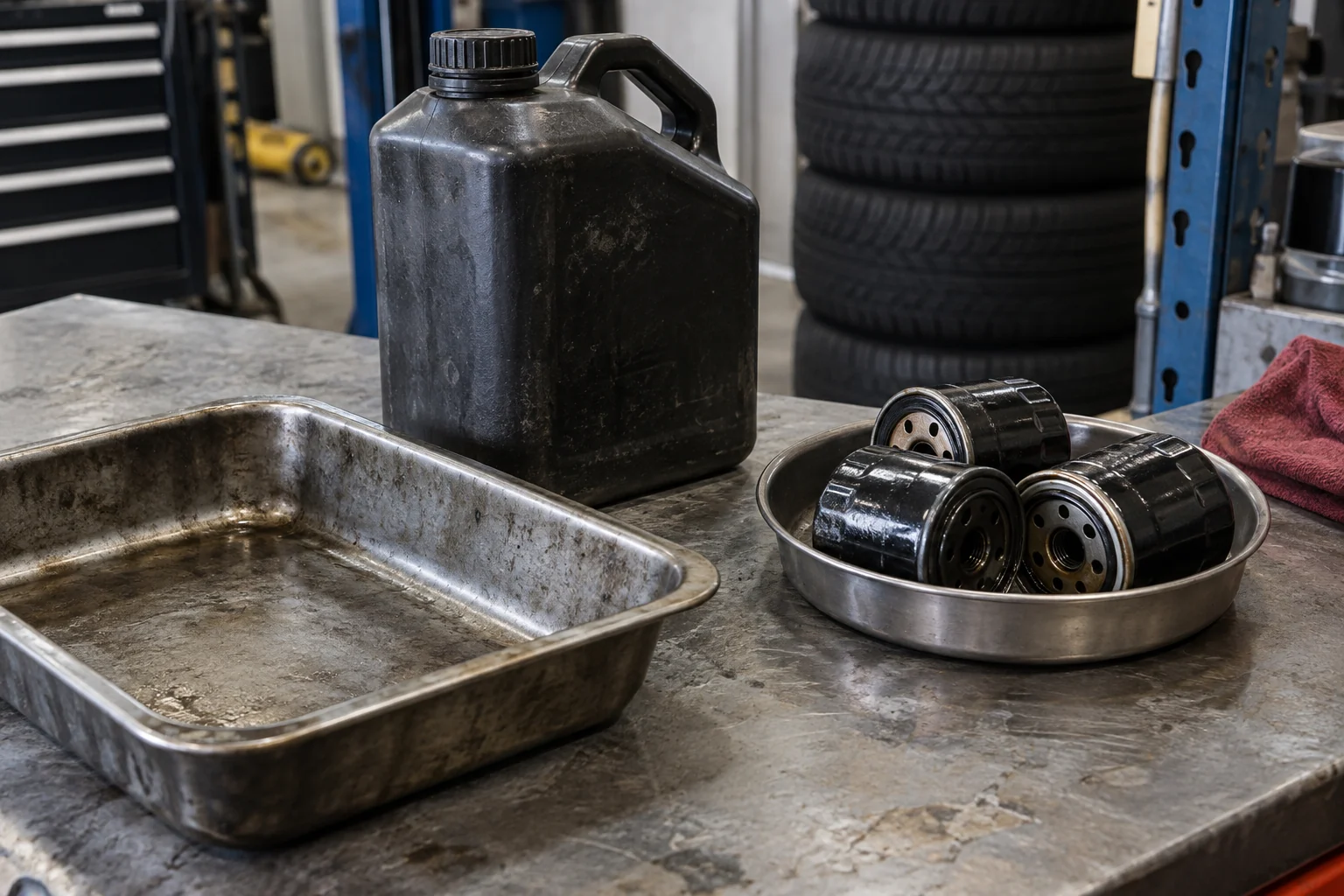
Used oil filters retain oil and are generally handled as industrial/priority waste; they should be drained and collected separately, not binned. Contaminated rags and absorbents follow the same logic.

Scrap metal & panels

Old panels, exhausts, brake rotors and offcuts are recyclable and carry genuine commodity value. Separated cleanly, scrap metal is a rebate, not a cost — but only if it isn't contaminated by the streams above.

E-waste from diagnostics & EV servicing

Diagnostic units, old screens, batteries and EV components are e-waste, which has been banned from Victorian landfill since 1 July 2019. It must go to an authorised e-waste collection point — see our guide to e-waste disposal for business.

General waste & cardboard

Showroom, office and parts-packaging waste is the straightforward part: general waste to landfill (attracting the levy) and clean cardboard to recycling.

The compliance and cost stakes

Two numbers frame why this matters. First, the 2025-26 Victorian metropolitan landfill levy is $169.79 per tonne — so anything you send to landfill that could have been recycled or diverted is paying full freight. Second, priority waste is charged differently: Category B priority waste carries a $288.29/tonne levy, Category C and D sit at $169.79/tonne, and Category A is banned from landfill entirely. Misclassifying a priority stream as general waste isn't just non-compliant — it can land it in the wrong (more expensive) bracket, or in a facility not licensed to receive it, which is an offence for both you and the transporter.

StreamClassificationWhere it must go
Waste oil / oily waterDesignated / priorityLicensed liquid-waste collector
Used tyresReportable priorityTSA-accredited collector
Batteries (lead-acid & Li-ion)PriorityB-cycle scheme
Coolant / solvent / brake fluidPriority industrialLicensed PIW facility
E-wasteLandfill-bannedAuthorised e-waste point
Scrap metalRecyclable (value)Metal recycler (rebate)
General / cardboardGeneral / recyclableLandfill / recycling

How a broker consolidates the chaos

The problem most dealerships have isn't any single stream — it's that they end up with four or five separate contractors, four or five invoices, and no single view of compliance. A broker fixes that. We map every stream on site, match each to a correctly licensed and accredited collector, and consolidate it into one coordinated service and one invoice. Because we tender your volumes across providers, you typically pay less for the same bins and the same service, while scrap-metal rebates offset the priority-waste costs.

Crucially, consolidation also tightens compliance: classification, EPA waste tracking and disposal records sit in one place, so an EPA audit doesn't become a scramble across multiple suppliers. For multi-franchise groups, that single-point model scales across every site. Explore our industrial waste service or see how the waste broker model works.

Where to start

A free site audit identifies every stream you generate, flags any that are being handled non-compliantly, and shows where you're overpaying. From there we build one consolidated, compliant arrangement. Book your free automotive waste audit to get started.

Frequently asked questions

Is car dealership waste classed as prescribed industrial waste in Victoria?+
Parts of it, yes. Waste oils, oily water, coolants, solvents, brake fluid, oil filters and batteries are typically priority (prescribed industrial) waste under Victorian regulations, requiring classification, EPA waste tracking and disposal at an authorised facility. General waste, cardboard and clean scrap metal are not — which is exactly why these streams must be separated rather than binned together.
Can a workshop pour used oil or oily water down the drain?+
No. Used oil, oil-water mixtures and triple-interceptor waste are designated industrial wastes and must never enter the drain or stormwater. They must be collected by a licensed liquid-waste collector and taken to an authorised facility. Discharging to sewer also breaches your trade-waste agreement with the water authority.
How many tyres can a Melbourne workshop store before needing an EPA permission?+
EPA Victoria sets the threshold by volume, not count. You need no permission to store less than 5 cubic metres of waste tyres at any time. Storing more than 5 m³ requires an EPA registration, and storing more than 40 tonnes (or 5,000 equivalent passenger units) requires an EPA licence. Tyres are a reportable priority waste, so movements off site must go to a lawful place.
Where do vehicle lead-acid and EV lithium batteries go?+
Both go through B-cycle, Australia's official ACCC-authorised battery stewardship scheme, via accredited drop-off and collection points. Lithium-ion packs from hybrids and EVs need careful handling — damaged or swollen batteries are a fire risk and must never go in general waste.
What does it cost to send dealership waste to landfill in Victoria?+
The 2025-26 metropolitan landfill levy is $169.79 per tonne for municipal and industrial waste. Priority waste is charged differently — Category B is $288.29/tonne, Categories C and D are $169.79/tonne, and Category A is banned from landfill entirely. Diverting recyclable streams such as scrap metal avoids the levy and can generate rebates.
How does a waste broker save a dealership money?+
A broker tenders your combined waste volumes across multiple licensed providers, consolidates four or five contractors into one coordinated service and one invoice, and offsets priority-waste costs with scrap-metal rebates. You keep the same bins and service while paying less, and your classification and EPA tracking records sit in one place for audits.

Related guides

See what you could save

Send us a recent waste invoice. We'll benchmark every charge against a network of Melbourne providers and show you the savings — free, no obligation, no win no fee.

Get Your Free Waste Audit →