Battery Recycling for Business in Australia: B-cycle, Lithium Fire Risk and EPA Compliance

Battery Recycling for Business in Australia: B-cycle, Lithium Fire Risk and EPA Compliance

Why a single hidden battery can torch a truck — and how to dispose of yours legally.

Batteries are the most dangerous item in your waste bin — and the easiest to get wrong. A single lithium cell crushed in a collection truck or sorting line can start a fire that destroys a facility, and Australian businesses are increasingly the source. This guide explains how commercial battery recycling actually works under B-cycle, what EPA Victoria classifies batteries as, and which batteries must never go in a general or mixed-recycling bin.

Why batteries are a business problem, not a household one

Most operators assume batteries are a kerbside issue. They aren't. Offices, workshops, warehouses, clinics and retailers generate a steady stream of dead batteries — power tools, laptops, UPS units, forklifts, e-bikes, vapes, exit lighting, smoke alarms and the loose AAs from every storeroom drawer. The national recycling rate for handheld batteries still sits around 15%, which means the rest are leaking value and, worse, hazard into general waste.

The hazard is real and growing. Industry data points to roughly 10,000 fires linked to batteries in the Australian waste and recycling sector in a single recent year, with hundreds of publicly reported incidents and dozens of catastrophic events causing damage from hundreds of thousands to tens of millions of dollars. Canberra's recycling plant was destroyed on Boxing Day 2022 in a fire believed to have started from batteries placed in household bins. Insurance premiums for battery-handling recyclers have jumped by as much as 200% in a year. When a battery you discarded causes that fire, the liability conversation gets uncomfortable fast.

The lithium fire risk in plain terms

Lithium-ion batteries store a lot of energy in a small space. When they're punctured, crushed or short-circuited — exactly what happens in a compactor truck or at a materials recovery facility (MRF) — they can enter "thermal runaway": a self-sustaining reaction that ignites instantly and is extremely hard to extinguish. The battery doesn't need to be charged or obviously dead; even flat lithium cells carry enough residual energy to ignite.

The highest-risk items are the ones people forget are batteries at all: disposable vapes, wireless earbuds, e-bike and e-scooter packs, power banks, and batteries embedded inside devices. At some e-waste facilities, embedded batteries are routinely found in incoming deliveries. That's why your staff bin policy matters as much as your contract.

How B-cycle works for businesses

B-cycle is Australia's official battery stewardship scheme, run by the Battery Stewardship Council and authorised by the ACCC (with B-cycle 2.0 enhancements progressing through 2025). It funds collection and recycling through a levy paid by battery importers, and there are more than 5,000 public drop-off points nationally.

For low volumes, B-cycle drop-off points accept handheld batteries — AA, AAA, C, D, 9V, button cells and removable rechargeables up to about 5kg. But there are important exclusions for business. B-cycle drop-offs generally do not accept:

  • Lead-acid batteries, including car, truck and forklift batteries (handled via ABRI collectors)
  • Mobile phone and laptop batteries, and batteries embedded in devices
  • Exit and emergency lighting batteries
  • Large industrial, EV or energy-storage packs

If you generate meaningful volume, or batteries fall outside the drop-off categories, you need a licensed collector — not the public drop-off network. To become an accredited collector yourself requires membership of the relevant industry body, but most businesses simply contract a compliant hazardous-waste provider. Our hazardous waste service arranges compliant battery collection alongside other regulated streams.

EPA Victoria: where batteries sit in the rules

In Victoria, batteries usually land in the priority waste and prescribed industrial waste framework. Used lead-acid batteries (ULABs) and nickel-cadmium batteries have historically been treated as reportable priority waste — the highest control tier — though small-volume transport and storage rules have been eased. Most business e-waste, including embedded batteries, is pre-classified as priority waste under the regulations. Separately, e-waste has been banned from Victorian landfill since 1 July 2019, and batteries fall squarely inside that ban.

The practical takeaway: batteries are not "general waste." Putting them in a general or commingled bin can breach the e-waste landfill ban and the priority-waste duties, and Victorian penalties are not trivial — the general environmental duty carries a maximum penalty around $2.03 million for a company (one penalty unit is $203.51 in 2025-26). For the full classification picture, see our guides on e-waste disposal for business and what contamination actually costs.

What your business must NOT bin

Print this and put it above the bins. None of the following belongs in general waste or mixed recycling:

Battery / itemBin it goes inCorrect route
AA/AAA/C/D, 9V, button cellsNEVER general or recyclingB-cycle drop-off or collector
Power tool, e-bike, e-scooter packsNEVER general or recyclingLicensed collector
Disposable vapes, power banks, earbudsNEVER general or recyclingLicensed collector (embedded lithium)
Laptop / phone batteries, devicesNEVER general or recyclingE-waste / hazardous collector
Lead-acid (car, forklift, UPS)NEVER general wasteABRI / lead-acid recycler

A simple, compliant battery routine

You don't need a complicated system — you need a consistent one:

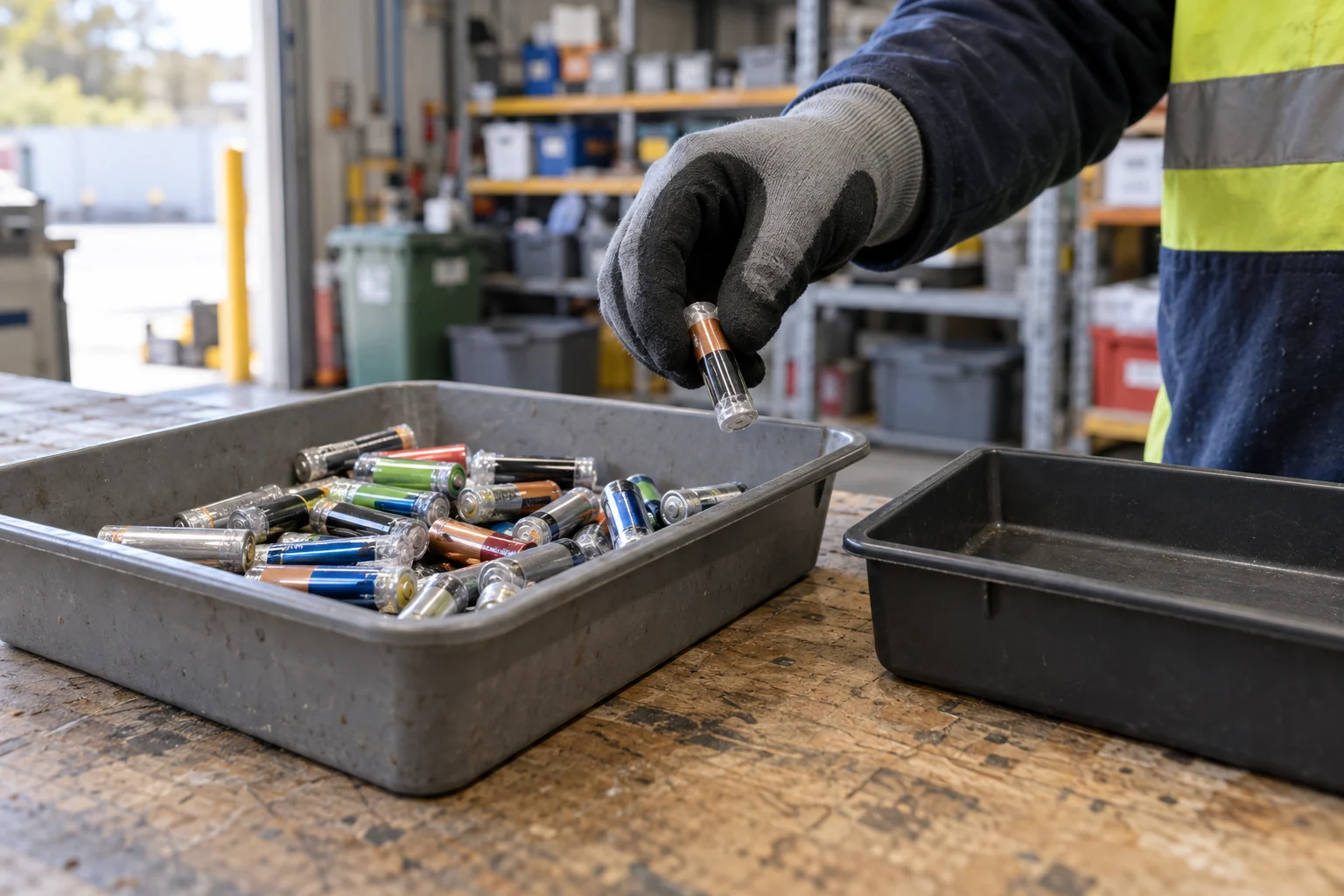
  • Segregate at source. A clearly labelled, non-metal battery container away from combustibles, kept under about half full.
  • Tape the terminals on lithium and 9V batteries (clear sticky tape over the contacts) to prevent short-circuits during storage and transport.
  • Store damaged or swollen lithium batteries separately in a non-combustible container, ideally in sand or vermiculite, and arrange prompt collection.
  • Match volume to route: occasional handhelds suit drop-off; regular or mixed volumes need a scheduled collection on a documented chain of custody.
  • Keep the paperwork. Compliant collectors provide waste transport and recycling records — your evidence of doing the right thing if EPA ever asks.

This is exactly the kind of low-volume, high-liability stream that gets overpriced or ignored in standard waste contracts. As an independent broker we benchmark battery and hazardous collection across a network of providers and only get paid from the savings — so you get a compliant route without paying a premium for it. See how the model works on our Melbourne waste broker page, or tell us what you're throwing out and we'll map the compliant, lowest-cost route.

Frequently asked questions

Can businesses put batteries in the general waste or recycling bin?+
No. Batteries are not general waste. In Victoria they fall under the e-waste landfill ban (in force since 1 July 2019) and the priority/prescribed industrial waste rules, so binning them can breach those duties. They are also a serious fire risk in trucks and sorting facilities. All batteries must go via a drop-off point or a licensed collector.
What is B-cycle and is it free for businesses?+
B-cycle is Australia's official battery stewardship scheme, funded by an import levy and authorised by the ACCC. There are around 5,500 public drop-off points that accept handheld batteries at no charge for low volumes. However, drop-offs exclude lead-acid, embedded device batteries, laptop/phone batteries and large packs, so businesses with regular or mixed volumes generally need a contracted licensed collector instead.
Why are lithium batteries such a fire hazard in the waste stream?+
Lithium-ion cells store dense energy and can enter thermal runaway — a self-sustaining fire — when punctured, crushed or short-circuited, which is exactly what happens in a compactor truck or MRF. Even flat batteries carry enough residual charge to ignite. Industry data links roughly 10,000 fires a year in Australia's waste and recycling sector to batteries in bins.
How should we store waste batteries safely before collection?+
Keep them in a labelled non-metal container away from combustibles and no more than about half full. Tape the terminals of lithium and 9V batteries to prevent short-circuits. Store any damaged, leaking or swollen lithium batteries separately in a non-combustible container (sand or vermiculite is ideal) and arrange prompt collection.
How are batteries classified under EPA Victoria rules?+
Most business battery waste is treated as priority waste, with used lead-acid and nickel-cadmium batteries historically classed as reportable priority waste (the highest control tier, though small-volume rules have been eased). Most e-waste including embedded batteries is pre-classified as priority waste, and e-waste is banned from Victorian landfill. The general environmental duty carries penalties up to about $2.03 million for a company.
What's the difference between battery recycling and e-waste disposal?+
E-waste covers electronic devices broadly — computers, screens, appliances — and centres on data security and material recovery. Battery recycling is a distinct, higher-risk stream focused on the fire hazard and chemistry of the cells themselves, governed by the B-cycle scheme. Many devices contain embedded batteries, so the two overlap, but batteries need their own segregation and handling rules.
Does the container deposit or other scheme cover business batteries?+
No. Container deposit schemes cover beverage containers, not batteries. Batteries are handled specifically through B-cycle (handheld) and lead-acid recyclers via ABRI, alongside the EPA priority-waste framework. A licensed hazardous-waste collector is the correct route for business volumes outside the free drop-off categories.

Related guides

See what you could save

Send us a recent waste invoice. We'll benchmark every charge against a network of Melbourne providers and show you the savings — free, no obligation, no win no fee.

Get Your Free Waste Audit →