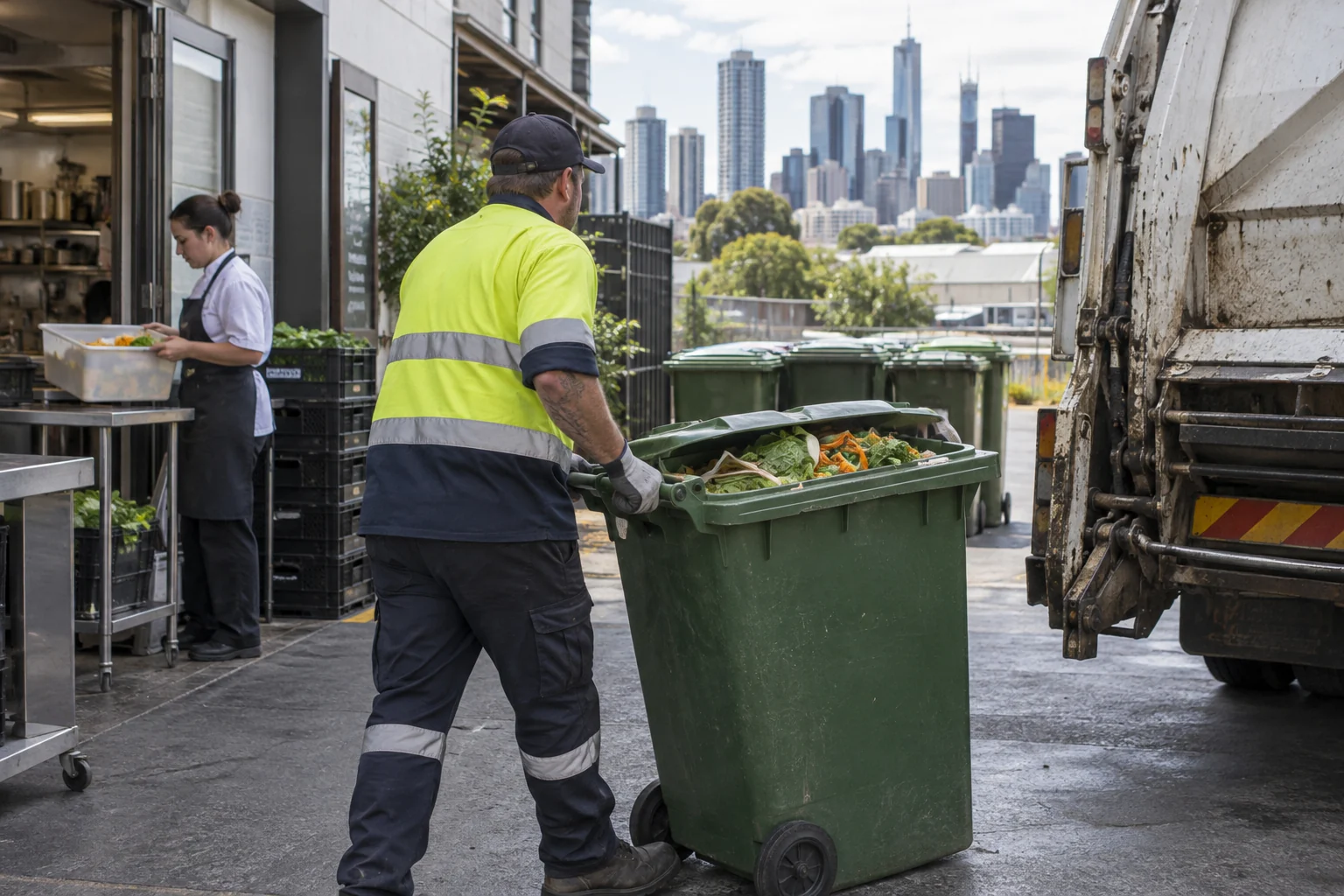
Commercial Food Organics (FOGO) Collection in Melbourne

Commercial Food Organics (FOGO) Collection in Melbourne

Why a separate organics bin cuts your waste bill and gets you ahead of the FOGO mandates

Food waste is the single most expensive thing in most commercial general-waste bins, and the rules are tightening fast. Diverting kitchen scraps into a dedicated food organics (FOGO) service is now one of the clearest ways for a Melbourne business to cut its waste bill, stay compliant, and stop paying the rising Victorian landfill levy on material that should never go to landfill in the first place.

What "commercial food organics" actually means

Food organics covers the wet, compostable material your kitchen produces every day: food prep offcuts, plate scrapings, spoiled stock, coffee grounds, and in many services garden organics too — hence the term FOGO (Food Organics and Garden Organics). Instead of going into a general-waste bin bound for landfill, this material is collected separately and sent to a composting or anaerobic digestion facility, where it becomes compost or energy.

For a cafe, restaurant, pub, supermarket, aged-care kitchen, school canteen or food manufacturer, food can make up 30-50% of total waste by weight. That is the part of your bill quietly inflating, because heavy, wet waste is exactly what the landfill levy is calculated on.

The regulatory wall is coming — and it's already here in NSW

From 1 July 2026, New South Wales introduces a mandatory commercial food organics requirement. Large food-waste generators — those producing roughly 3,840 litres per week of general waste (about sixteen 240L bins, or two skips) — must separate food waste from general rubbish. The threshold then steps down: from 1 July 2028 it captures businesses at ~1,920L/week, and from 1 July 2030 down to ~720L/week (about three 240L bins), eventually pulling in most cafes and small venues.

Victoria is on the same trajectory. Under Recycling Victoria and the Circular Economy Act, every Victorian council must provide FOGO or an equivalent service as part of a standardised four-bin system, with the rollout mandated by 2030 (many councils land in 2027). Commercial operators are not formally captured the way NSW businesses are yet — but the direction is unmistakable, and the smart move is to get ahead of it rather than scramble later. If you operate across both states, NSW already forces your hand.

The money: organics vs general waste

This is where it stops being a compliance chore and starts being a cost decision. A 240L organics service in metro Melbourne typically runs $40-$80 per month depending on lift frequency and location — usually cheaper per lift than general waste, because the receiving facility charges less than landfill. The real saving, though, is what you stop sending to landfill.

Cost factorGeneral waste (to landfill)Food organics (FOGO)
Victorian metro landfill levy 2025-26$169.79 / tonneLevy not applied
Typical 240L serviceHigher per-lift rate~$40-$80 / month
Gate fee at facilityLandfill gate + levyLower composting gate fee
Bin space freed upSmaller / fewer general bins

The levy alone jumped from $129.27 to $169.79 per tonne for 2025-26 metro waste — a 31% rise in one year. Every tonne of food you divert is a tonne you no longer pay that levy on, and it usually lets you downsize or reduce the lift frequency of your general-waste bin, which compounds the saving. For a busy venue, moving food into organics frequently knocks more off the general-waste line than the organics service costs.

What goes in (and what ruins the bin)

Accepted: all food waste — meat, bones, seafood, dairy, fruit, vegetables, bread, coffee grounds, tea, plate scrapings, and (where the service allows) certified compostable liners and garden organics.

Keep out: plastic bags and packaging, takeaway containers, coffee cups, cutlery, gloves, cling film, oils and liquids, and anything labelled "biodegradable" but not certified compostable. Contamination is the one thing that breaks the economics — a load rejected at the composting gate gets redirected to landfill at full levy plus a contamination penalty, wiping out the saving. Note Victoria is also reviewing whether to exclude compostable packaging from FOGO, so confirm what your specific processor accepts before you buy liners in bulk.

How to roll out FOGO at your venue

  • Audit first. Look in your general-waste bin. If a third or more is food, the business case is already made.
  • Right-size the service. Match bin volume and lift frequency to your real food output — wet waste smells, so frequency matters more than capacity in summer.
  • Put bins where the waste is made. A caddy at each prep station and the dish-return point captures far more than one bin by the back door.
  • Signage and a five-minute staff brief. Clear photo signage on every bin is the cheapest contamination control there is.
  • Shrink the general bin. Once food is diverted, downsize the general-waste service — this is where the bill actually drops.
  • Review after 30 days. Check contamination and adjust. See our restaurant waste management guide for venue-specific tactics.

Where Bundle Waste fits

We are an independent broker, not a hauler. We benchmark food organics rates across a network of Victorian providers, set up the right service at the right frequency, and renegotiate your general-waste contract to capture the downsizing saving — paid only from what we save you. Compare our food and organic waste service, see how the broker model works on the waste broker Melbourne page, or send us a recent invoice for a no-obligation review.

Frequently asked questions

Is commercial food organics collection mandatory in Victoria yet?+
Not for most businesses yet. Victorian councils must provide FOGO or an equivalent as part of the four-bin system, mandated by 2030 (many roll out in 2027). Commercial operators are not formally captured the way NSW businesses are, but the direction is clear — and if you operate in NSW too, the mandate already applies there from 1 July 2026.
Who does the NSW commercial food organics mandate affect from 1 July 2026?+
From 1 July 2026 the largest food-waste generators — roughly 3,840 litres of general waste per week (about sixteen 240L bins or two skips), such as supermarkets, large pubs, hotels and hospitals — must separate food waste. The threshold steps down to ~1,920L from 2028 and ~660L from 2030, eventually capturing most cafes and small venues.
How much does a commercial FOGO bin cost in Melbourne?+
A 240L food organics service typically runs about $40-$80 per month depending on lift frequency and location — usually cheaper per lift than general waste. The bigger saving is avoiding the $169.79/tonne Victorian metro landfill levy on diverted food and downsizing your general-waste bin.
How much can a business actually save by switching to FOGO?+
It varies by waste volume, but food is often 30-50% of a venue's waste by weight. Diverting it removes the $169.79/tonne levy on that material and usually lets you reduce general-waste lifts or bin size. For many busy venues the general-waste reduction exceeds the cost of the organics service, so the net bill drops.
What can and can't go in a commercial food organics bin?+
In: all food waste — meat, bones, seafood, dairy, fruit, vegetables, bread, coffee grounds and plate scrapings, plus certified compostable liners where allowed. Out: plastic bags and packaging, takeaway containers, coffee cups, cutlery, gloves, oils, liquids, and 'biodegradable' items that aren't certified compostable. Always confirm what your specific processor accepts.
What happens if the organics bin gets contaminated?+
A load with too much plastic or non-organic contamination can be rejected at the composting facility and redirected to landfill — at the full levy plus a contamination charge. That single load can wipe out the month's saving, so clear signage, station caddies and a quick staff brief are essential to keep the economics working.
Do I have to keep my haulier to start a FOGO service?+
No. As an independent broker we benchmark food organics rates across a network of Victorian providers and arrange the right service at the right frequency, then renegotiate your general-waste contract to capture the downsizing saving. We're paid only from what we save you, so there's no fee if there's no saving.

Related guides

See what you could save

Send us a recent waste invoice. We'll benchmark every charge against a network of Melbourne providers and show you the savings — free, no obligation, no win no fee.

Get Your Free Waste Audit →