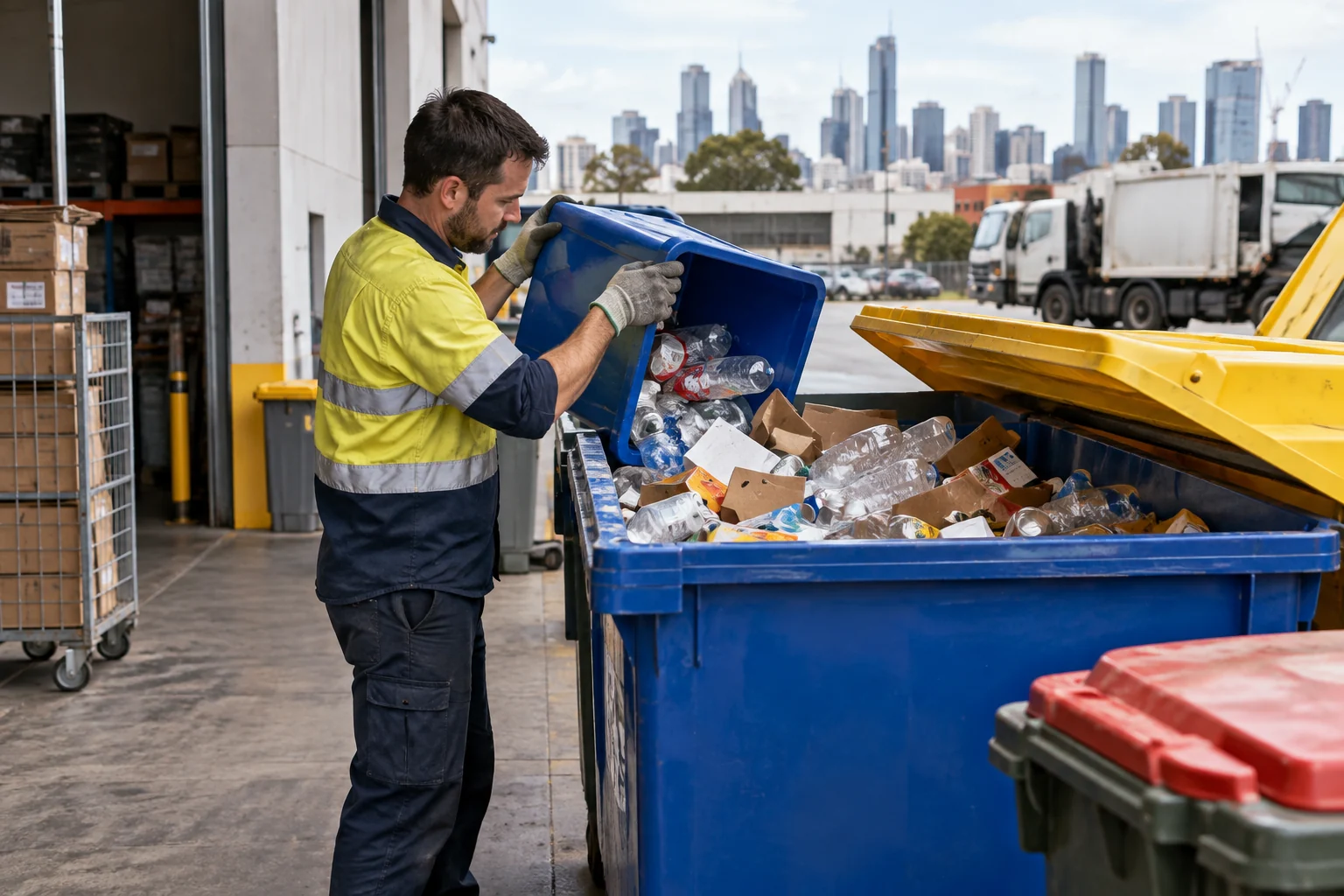
Commingled recycling — sometimes called mixed or single-stream recycling — is the most common dry recycling service Melbourne businesses use, yet it is also the most misunderstood. Get the contents right and it is markedly cheaper than general waste; get them wrong and you pay general-waste rates anyway through contamination charges. This guide explains exactly what commingled recycling is, what belongs in the bin, and when it beats a multi-bin setup for your site.
What "commingled" actually means
Commingled recycling means all your dry recyclables — paper, cardboard, glass, metals and rigid plastics — go into a single bin, mixed together. The collected material is taken to a Materials Recovery Facility (MRF), where machines and people separate it back out into individual commodity streams for reprocessing. The trade-off is simple: you give up sorting effort on site, and the MRF does the sorting downstream.
This is the opposite of source-separated recycling, where each material gets its own bin at the point it is generated — a paper-and-cardboard bin, a separate glass bin, a separate plastics bin, and so on. Source separation produces cleaner, higher-value bales because there is less cross-contamination, but it needs more bins, more floor space and more staff discipline. Victoria's broader four-stream waste system sits between the two: it keeps glass and food organics out of the dry-recycling stream, while everything else dry stays commingled.
What goes in a commingled recycling bin
Accepted materials are consistent across most Melbourne processors. The general rule is rigid, clean and dry. Typically accepted:
- Paper and cardboard — office paper, newspaper, magazines, flattened boxes, paper packaging.
- Rigid plastics — bottles, tubs and containers, generally codes 1 to 7, emptied and lids off where required.
- Metals — aluminium and steel cans, clean foil, empty aerosols.
- Glass bottles and jars — accepted in many commingled services, though some processors and the four-stream model prefer glass kept separate to avoid shards contaminating paper.
What does not belong is where most businesses come unstuck:
- Soft plastics — bags, film, bubble wrap, satchels. These tangle MRF machinery. (REDcycle paused in November 2022; a replacement Soft Plastics Stewardship scheme was ACCC-approved in November 2025, but it is not a commingled-bin item.)
- Food and liquids — half-eaten lunches and dregs in containers contaminate everything around them.
- Polystyrene, ceramics, textiles and nappies.
- E-waste — banned from Victorian landfill since 1 July 2019 and never a commingled item; see our e-waste disposal guide.
Why contamination is the real cost
A commingled bin is priced on the assumption it contains recyclable material. The moment contamination crosses a threshold — commonly around 5–10% by volume, depending on the contract — the load can be downgraded, rejected at the MRF, or charged at general-waste rates. In practice that means the wrong items do not just fail to recycle; they convert your cheap recycling lift into an expensive landfill lift after the fact.
The classic culprits are bagged recyclables (the bag itself is a contaminant), soft plastics, and liquids. One leaking container can wet an entire bin of paper and render it unrecoverable. We break down the financial mechanics in detail in our guide to what contamination really costs a business.
Commingled recycling vs general waste: the cost case
The reason recycling pays is the Victorian landfill levy. For 2025–26 the metropolitan levy is $169.79 per tonne, up from $129.27 the year before — a cost that sits inside every general-waste price you pay. Commingled recycling generally attracts no levy, so every tonne you shift across is a tonne that avoids it.
| Factor | General waste (landfill) | Commingled recycling |
|---|---|---|
| Vic landfill levy 2025–26 | $169.79/tonne applies | Generally no levy |
| Typical per-lift cost | Higher | Usually lower |
| On-site sorting effort | None | Low — one bin |
| Risk if used wrong | — | Charged as general waste if contaminated |
Exact gate fees vary by provider, volume and suburb, which is why we publish a live Melbourne waste cost index rather than quote a single number. The headline holds, though: a clean commingled bin is one of the cheapest lifts available to a typical office or retail site.
When commingled beats four-stream — and when it doesn't
For most offices, professional services firms and small retailers, commingled is the right default. The waste is mixed and low-volume, floor space is tight, and staff will not reliably maintain four separate bins. A single well-labelled recycling bin alongside general waste captures the bulk of the benefit with minimal friction.
Source separation starts to win when you generate large, clean, single-material volumes. A warehouse producing pallet-loads of cardboard is better off baling it separately for rebate; a venue or bottle shop with high glass volumes benefits from a dedicated glass stream; a kitchen needs food organics kept out entirely. As volumes grow, the maths tips toward separation because clean single streams attract rebates or lower rates that a mixed bin never will.
If you are unsure which model fits, the honest answer depends on your tonnage mix — and that is exactly what an audit reveals. Our recycling service benchmarks your current setup against a network of providers and tells you whether to consolidate into commingled or split into separate streams, paid only from the savings we find.
Getting it right on site
Three habits prevent most contamination: label bins with pictures, not just words; keep the recycling bin lid-on and away from the kitchen; and never bag recyclables — tip them in loose. If you are setting up or reviewing your bins, talk to us first — a five-minute look at your invoice usually shows whether you are paying landfill rates for material that should be recycled.
Frequently asked questions
What is the difference between commingled and source-separated recycling?
What can go in a commingled recycling bin?
What should never go in a commingled bin?
How does contamination affect my recycling cost?
Is commingled recycling cheaper than general waste in Melbourne?
Should my business use one commingled bin or separate streams?
Related guides
See what you could save
Send us a recent waste invoice. We'll benchmark every charge against a network of Melbourne providers and show you the savings — free, no obligation, no win no fee.
Get Your Free Waste Audit →