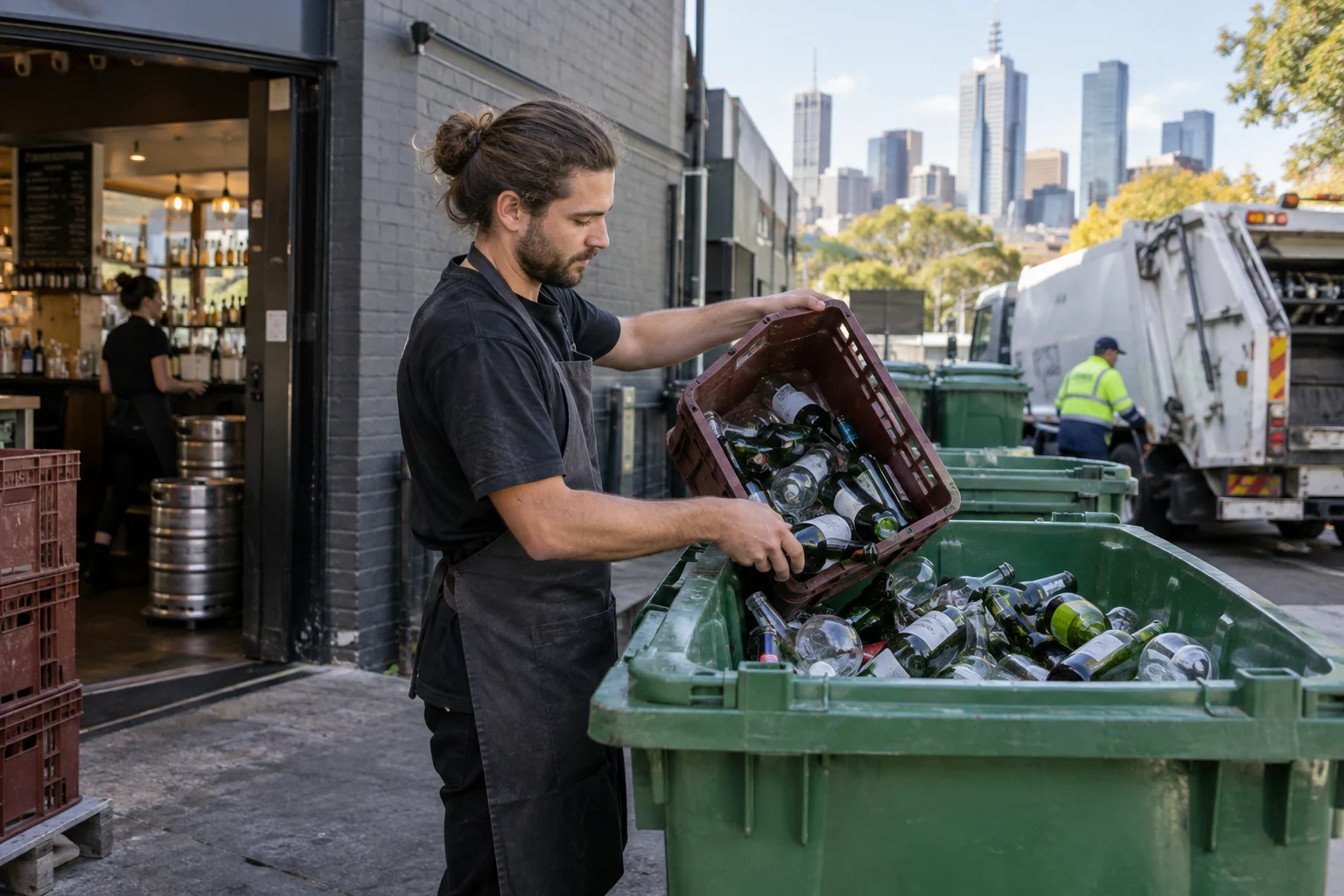
Glass is the heaviest thing most venues throw away — and you pay for waste by weight. For a busy Melbourne pub, club or function venue, the empties piling up behind the bar are quietly one of your most expensive waste lines, because every tonne sent to landfill now carries a $169.79 metro levy on top of the haulage charge. Splitting glass into its own stream is one of the few waste decisions that almost always pays for itself. Here is how to set it up and what it saves.
Why glass costs you more than it looks
A standard wine bottle weighs around 400–500g empty; a stubby is lighter but you get through hundreds of them a night. A single 240-litre bin packed with bottles can weigh well over 100kg — more than its safe lift limit — densely packed glass is one of the heaviest waste types per cubic metre. Most commercial general waste is charged on a per-lift or per-tonne basis, and either way the levy applies to whatever goes to landfill.
The Victorian metropolitan landfill levy rose to $169.79 per tonne in 2025-26, up from $129.27 the year before — a 31% jump in a single year. That levy is buried inside your per-lift price whether or not you can see it on the invoice. The practical result: every tonne of glass you keep out of the general bin removes a known, rising cost, not a vague "sustainability" benefit. Glass is also fully recyclable an unlimited number of times with no loss of quality, so there is no downside to diverting it.
Dedicated glass bins vs commingled recycling
You have two realistic options for venue glass. The right one depends on volume and the space you have out the back.
| Factor | Dedicated glass bin | Commingled recycling |
|---|---|---|
| Best for | Pubs, clubs, bars, function venues, breweries | Offices, retail, low-glass sites |
| Contamination risk | Low — one material, hard to get wrong | Higher — glass breaks and spoils paper/cardboard |
| Recovery value | Cleaner glass = better recyclate, lower gate fees | Broken glass downgrades the whole load |
| Typical cost | Often cheaper per lift than general waste | Mid-range; risk of contamination charges |
| Staff effort | Bottles straight into one bin | Sorting plus glass-handling care |
For any venue moving real volume, a dedicated glass bin wins almost every time. Broken glass is the single biggest contaminant in commingled recycling — it shreds paper, lodges in cardboard and can see a whole load rejected and redirected to landfill at full cost. Keeping glass separate protects both streams. Lower-glass sites such as offices are usually fine putting bottles and jars in the commingled bin; our commercial recycling guide covers that setup.
How the CDS Vic 10c refund interacts with venue glass
Victoria's Container Deposit Scheme pays 10c for eligible drink containers between 150mL and 3 litres carrying the 10c refund mark. For venues this is real money — but there is a crucial catch for the on-premise trade. CDS Vic excludes glass wine bottles and pure-spirit bottles. Those are precisely the containers a restaurant or bar gets through most of, so do not budget for refunds on your wine and spirits glass.
Where CDS does help is beer, cider, RTDs, soft drink and water in eligible bottles and cans. A high-turnover bottle shop, club or beer-led venue can recover a meaningful sum, or donate refunds to a community group for goodwill. The practical model for most venues: run the bulk of your glass through a dedicated recycling bin (the easy, high-volume path), and channel clearly-eligible containers through a CDS return point or collection. Our deep-dive on the Container Deposit Scheme for business walks through refund logistics and bulk-return options.
What a glass split actually saves
The maths is simple once you know your glass tonnage. Take a mid-size pub generating roughly 2 tonnes of glass a month. Moved out of general waste, that is 24 tonnes a year of levy-bearing material removed from the most expensive bin you own.
| Line item | Glass in general waste | Glass in dedicated bin |
|---|---|---|
| Landfill levy (24 t/yr @ $169.79) | Charged | Avoided |
| Disposal gate fee | Full landfill rate | Lower recycling rate |
| Contamination charges | Possible (broken glass) | Minimal |
| Net direction | Rising every year | Predictable, lower |
These are illustrative figures — your actual savings depend on volume, bin sizes and your contract — but the direction is reliable. Because the levy climbs most years, diverting glass is a saving that grows automatically. This is exactly the kind of stream we model in the Melbourne waste cost index.
How to set up venue glass collection
- Audit one week. Weigh or count your empties for seven days to size the stream. Glass is heavy, so even a rough count reveals the opportunity.
- Right-size the bin. Glass-only bins (often 240L) handle weight better than wheelie bins overloaded with mixed waste. Heavy bins damage standard lift gear.
- Match the collection frequency. Glass does not rot, so you can often run it less frequently than general waste — but full glass bins are heavy and immovable, so balance frequency against handling safety.
- Train the bar team. One rule — "all bottles in the green-lidded glass bin" — is easy to enforce. No lids, caps or food contamination needed for glass.
- Benchmark before you commit. Don't accept the first per-lift quote. Glass recycling pricing varies widely between providers in Melbourne.
That last point is where an independent broker earns its keep. We benchmark a network of providers, separate your glass from general waste correctly and renegotiate the rate — and because we are paid only from the savings we find, there is no fee if we cannot beat your current deal. See how our commercial recycling service works, or send us a recent invoice and we will tell you what your glass stream should cost.
Frequently asked questions
Do I need a separate glass bin or can bottles go in commingled recycling?
Can my venue claim the 10c CDS refund on wine and spirit bottles?
How much can a Melbourne venue save by diverting glass from general waste?
Why is glass charged differently from other waste?
Does glass need to be cleaned or sorted by colour before collection?
How do I set up glass collection for my venue?
Is putting glass in the general bin actually a compliance risk?
Related guides
Related questions
See what you could save
Send us a recent waste invoice. We'll benchmark every charge against a network of Melbourne providers and show you the savings — free, no obligation, no win no fee.
Get Your Free Waste Audit →