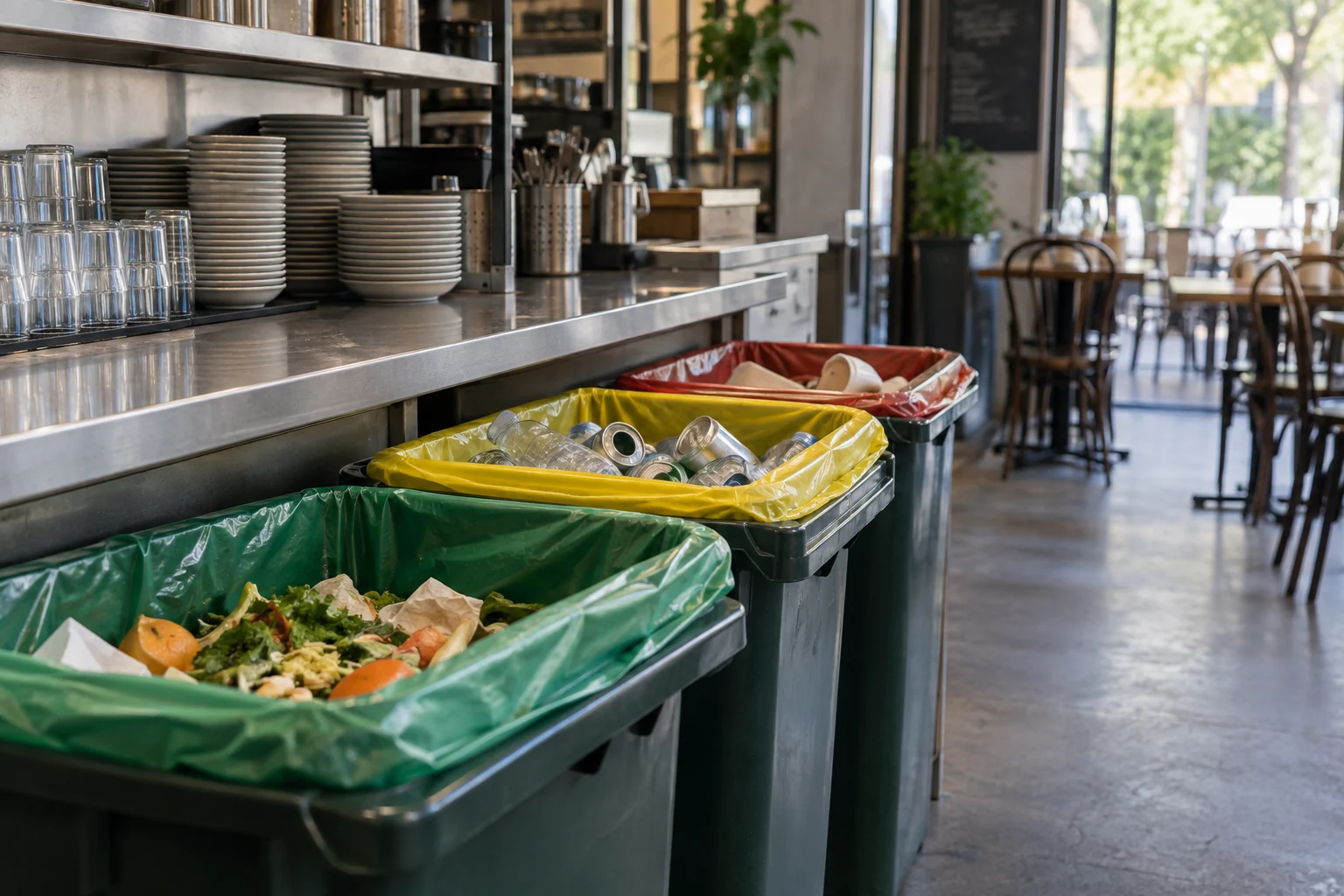
Cafes, pubs, clubs and function venues generate a waste profile unlike any other business in Melbourne: heavy on glass, spiky in volume, and squeezed into front-of-house spaces that were never designed for five bins. This guide covers the core streams, how to handle peak-period overflow without paying for it twice, and where most venues are quietly overspending on collections.
Why hospitality waste is different
If you run a restaurant, our restaurant waste management guide covers the kitchen-led setup in detail, and hotels have their own profile in our hotel waste guide. Cafes, pubs, clubs and venues sit in the middle: a smaller kitchen than a fine-diner, but far more beverage packaging and a demand curve that swings violently between a quiet Tuesday and a Saturday function or a Friday-night trade.
That combination breaks the standard "one general bin, one recycling bin" arrangement. A pub can fill a glass cage in a single weekend; a cafe drowns in cardboard and coffee cups by mid-morning; a club running TAB, bistro and functions juggles four or five streams at once. The cost of getting this wrong is rarely the headline bin price — it is contamination charges, overflow lifts, and paying landfill rates on material that should never have gone to landfill.
The five core streams for a Melbourne venue
Most hospitality sites can run efficiently on five streams. The mix shifts with your format — a cafe leans on cardboard and organics, a club leans on glass and commingled.
| Stream | Main sources | Why it matters |
|---|---|---|
| Food organics | Bistro prep, plate scrapings, bar fruit, coffee grounds | Diverts the heaviest material away from the $169.79/tonne metro landfill levy |
| Glass | Beer, wine and spirit bottles, mixers | Dense and high-volume; collected separately it is fully recyclable and lighter to landfill if it slips into general waste |
| Cardboard | Stock cartons, keg trays, takeaway packaging | Flattened and baled it is often a low-cost or rebate stream, not a paid one |
| Commingled recycling | Cans, mixed plastics, some containers | Captures front-of-house drink packaging and reduces general-waste volume |
| Grease trap and cooking oil | Bistro fryers, dishwashing | A regulated trade-waste stream — see below |
Separating organics is the single biggest lever for most venues, because food waste is heavy and you pay by the tonne. Diverting it to a food and organic collection shrinks your general-waste bin and your landfill levy exposure at the same time.
Glass, cans and the Container Deposit Scheme
Glass is the defining stream for pubs and clubs. Kept separate it is dense, clean and recyclable; mixed into general waste it adds weight you pay the levy on and contaminates other streams. Run a dedicated glass cage or bin and train staff to clear it during service, not at the end of the night when it overflows.
Worth knowing for back-of-house planning: Victoria's Container Deposit Scheme pays 10c for most eligible aluminium, glass and plastic drink containers between 150mL and 3 litres — so beer bottles and cans qualify, but plain milk, wine and spirit bottles are excluded. High-volume venues sometimes set up a return arrangement to recover deposits, though for most operators the priority is simply keeping glass out of general waste.
Grease trap and trade waste
If you run a bistro, fryer or commercial dishwasher, you have a trade-waste obligation. Grease trap waste must be pumped by a licensed contractor on a schedule, and cooking oil should go to a separate recycler — never down the drain or into a bin. Getting the pump-out frequency right matters: too infrequent risks blockages and council notices, too frequent burns money. Our guides on grease trap waste and trade waste agreements in Victoria cover the compliance detail.
Peak-period overflow: the hidden cost
The classic hospitality trap is sizing bins for an average week and then paying through the nose every time you have a big one. When a function, a long weekend or a sporting final fills your bins early, you face one of three bad outcomes: overflowing bins on the kerb (a council and amenity issue), an emergency lift at premium rates, or material crammed into the wrong stream and hit with contamination charges.
Better options, in order of cost-efficiency:
- Match collection frequency to your trading pattern — add a Monday lift after weekend trade rather than running larger bins all week.
- Compact where it pays — a cardboard baler or a compactor can cut lift frequency dramatically for high-volume clubs and venues.
- Use seasonal schedules — scale collections up over summer and the festive function season, then back down.
- Pre-book function waste — treat a 200-guest event as a planned spike, not a surprise.
Setting up multi-stream in a tight footprint
Most venues fail on bins not because staff do not care, but because the system is awkward. A few principles that work in cramped back-of-house areas:
- Put the right bin where the waste is created — organics at the prep bench, glass at the bar, cardboard at the back door.
- Colour-code and label clearly; new and casual staff should not have to guess.
- Keep the general-waste bin the smallest and least convenient, so it is the last resort, not the default.
- Review contamination quarterly — one mislabelled bin can turn a clean recycling load into a charged general-waste load.
Contamination is expensive: a recycling bin rejected at the depot is re-graded and billed as general waste. Our breakdown of what contamination costs your business shows how quickly it adds up across a busy venue.
Where venues overspend — and how to fix it
Across the hospitality sites we benchmark, the same overcharges recur: bins lifted half-empty on a fixed schedule, recycling paid at general-waste rates, rise-and-fall CPI clauses that quietly inflate the bill, and "bin rental" or admin fees nobody agreed to. Because contracts are rarely reviewed once signed, these costs compound year on year.
As an independent broker, Bundle Waste benchmarks your invoices against a network of providers and renegotiates on your behalf — we are paid only from the savings we find, so there is no fee if we cannot cut your bill. You can see typical pricing in our Melbourne waste cost index, or send us a recent invoice through the waste broker service for a free benchmark.
Frequently asked questions
What waste streams does a typical Melbourne pub or club need?
How do I handle waste overflow during functions and peak periods?
Can my venue claim Container Deposit Scheme refunds on bottles and cans?
Do cafes and pubs need a trade waste agreement for grease traps?
How much can a hospitality venue save on waste collection?
Why does separating organics matter so much for hospitality?
Related guides
See what you could save
Send us a recent waste invoice. We'll benchmark every charge against a network of Melbourne providers and show you the savings — free, no obligation, no win no fee.
Get Your Free Waste Audit →