 Bundle Waste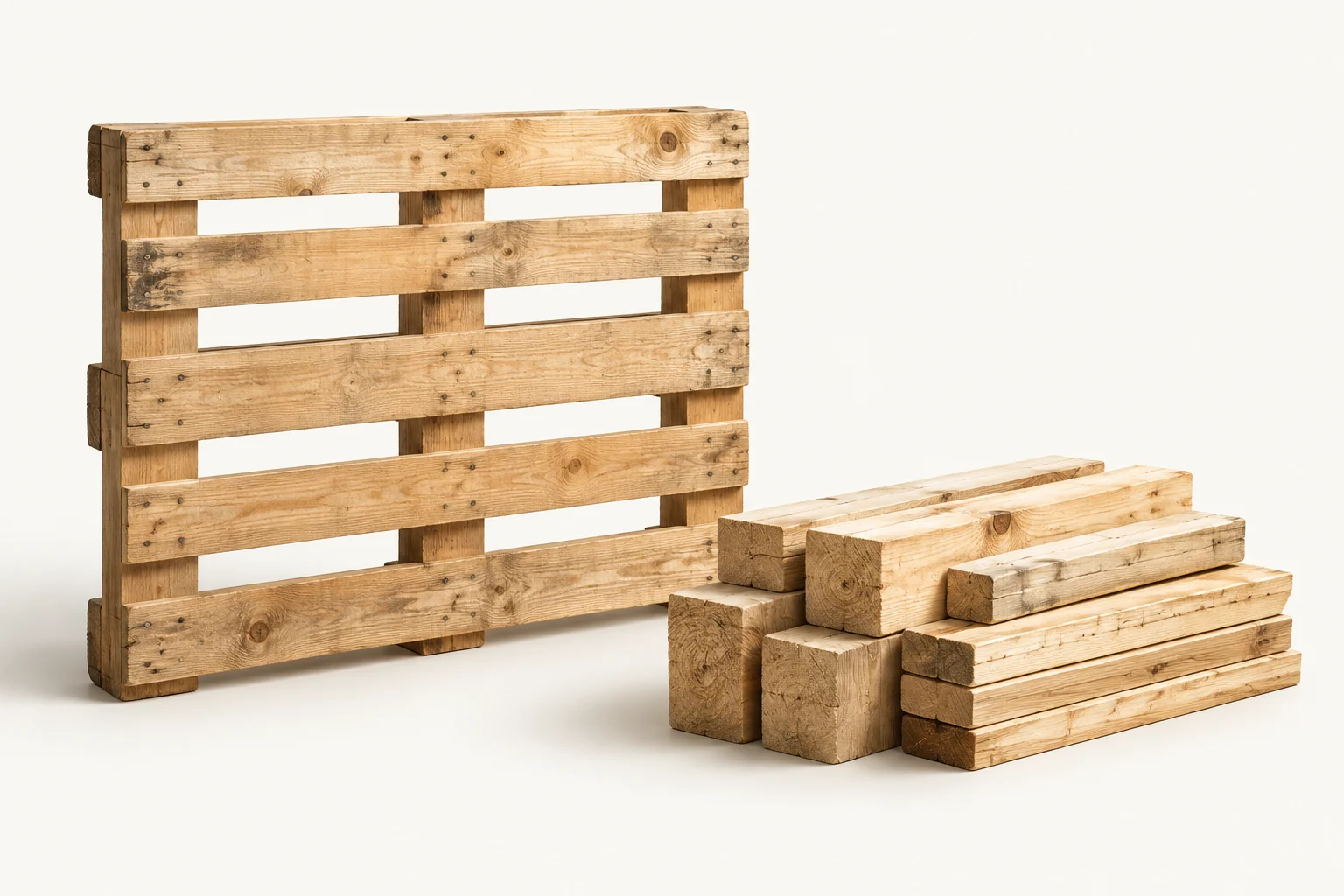
Check ownership and return options before treating a pallet as waste. Then confirm material condition, contamination and acceptance with the proposed recipient.
The facts behind the comparison
CHEP Australia publishes equipment return and pickup contacts; use the relevant owner's process where a pallet belongs to a pooling system. Source: CHEP Australia — Key contacts at CHEP Australia. Timber packaging in international trade is regulated under ISPM 15, Regulation of wood packaging material in international trade, which covers pallets and dunnage and requires approved treatment and a mark (IPPC — International Standards for Phytosanitary Measures (ISPM 15)). The Australian standard flat pallet is 1165 × 1165 mm under AS 4068-1993.
Check who owns the pallet first
This is the step that most often goes wrong, and it goes wrong expensively. A large share of pallets moving through an Australian warehouse are pooled rather than owned: they carry a pooling company's markings, they remain that company's property, and they are meant to go back through that company's return process rather than into a skip or a resale pile. Selling or destroying one is not a disposal decision, it is a decision about somebody else's asset.
So before anything else, split the stack three ways: pallets you own, pallets that carry someone else's markings, and pallets you are not sure about. Route the second group through the owner's process — CHEP Australia publishes issue, return and pick-up contacts for exactly that — and resolve the third group before you touch it. Only what is left is genuinely yours to recover, sell or dispose of.
What to compare
| Decision | Timber pallets | Plastic pallets |
|---|---|---|
| Ownership | Check markings and the supplier's return arrangements. | Check markings and the supplier's return arrangements. |
| Condition | Record damage, coatings and contamination. | Record resin identification where available, damage and contamination. |
| Reuse or repair | Ask whether a recipient accepts the specific condition. | Ask whether a recipient accepts the model and condition. |
| Recovery quote | Confirm accepted grade, quantity and transport terms. | Confirm accepted material type, quantity and transport terms. |
Timber pallets at end of life
Timber has the more developed end-of-life network of the two, because a damaged timber pallet has two lives left rather than one: it can be repaired and put back into service, and if it cannot, the timber itself is still a material with buyers.
What works in its favour: repair and recovery are routine rather than specialised, broken-down timber has established end uses in mulch, animal bedding, panel board and biomass fuel, and recyclers will often collect above a quantity they set themselves. A standard-size pallet in sound condition is the easiest of all to place.
What works against it: value falls sharply with damage and with non-standard sizes, the units are heavy to store and handle, and a chemical or oil spill can take a pallet out of the recovery stream entirely. Timber packaging crossing borders also has to satisfy ISPM 15 treatment and marking, which is a cost on the purchase side and occasionally a restriction on the recovery side.
Plastic pallets at end of life
Plastic is built for a different job. It is designed to come back — which is also what determines whether disposing of it is ever the right question.
What works in its favour: the unit survives many more cycles than a timber equivalent, it washes down, which is why food and pharmaceutical operations use it, it needs no phytosanitary treatment, and a clean single-resin pallet is a recoverable material rather than a mixed one.
What works against it: the recovery network is narrower and more specialised — standard timber pallet recyclers are not set up for it — so a recipient has to be found rather than assumed, and acceptance depends on the resin type and the model. Mixed-material pallets and units with metal inserts are harder again. Purchase cost is higher, which is only recovered if the pallet genuinely stays in a loop.
Contamination, treatment marks and what blocks recovery
Two things take a pallet out of the ordinary recovery route, and both are worth checking before a truck is booked.
- Contamination. Chemicals, oils and hazardous residues put material outside standard channels. In Victoria, contaminated material may fall into the priority waste or reportable priority waste categories under the Environment Protection Act 2017, which carry their own handling, transport and notification duties (EPA Victoria — Manage clinical and related industrial waste). The old "prescribed industrial waste" label belongs to the superseded framework; check the current classification rather than an old one.
- Treatment marks. Under ISPM 15, wood packaging used in international trade carries a mark showing it has had an approved treatment. Some recipients will not take particular treatment marks, so read the stamp and ask before assuming a load is acceptable.
In both cases, disclose to the recipient in advance. A load rejected at the gate costs the transport twice and leaves the material back on your site.
Before you decide
- Separate owned, pooled and uncertain-ownership pallets.
- Contact the owner or supplier before arranging destruction or sale.
- Ask the proposed recipient to approve photos and a material description.
- Keep pickup, return or disposal records and the quoted charges.
When each material suits the operation
- Timber suits one-way movement. Where the pallet leaves with the goods and does not come back, replacement is straightforward and the end-of-life route is well established.
- Plastic suits a closed loop. Where the pallet returns to you, or stays inside your own operation, the longer service life is what pays for the higher purchase price.
- Hygiene decides it outright in food and pharmaceutical settings, where a washable unit is a requirement rather than a preference.
- Running both is normal — timber outbound, plastic internally — and usually beats standardising on one for its own sake.
Whichever way it goes, price the end-of-life route at the same time as the purchase. A pallet that is cheap to buy and awkward to place at the end is not necessarily the cheaper pallet.
What this comparison cannot tell you
This page does not establish that every timber pallet is recyclable, every plastic pallet has a rebate, or marked pallets can be sold. Ownership and contamination can change the available route. No purchase price, resale price, collection charge or recovery rate is established here.
Frequently asked questions
Can I sell my used timber pallets in Melbourne?
How many pallets do I need for a free collection?
What happens to recycled timber pallets?
Are there any pallets that cannot be recycled?
Should my warehouse switch from timber to plastic pallets?
Related decisions
Explore the related comparison · Pallet removal · Explore waste services
Discuss your waste setup with Bundle Waste.
Sources
- CHEP Australia — Key contacts at CHEP Australia. Issue and return queries; Deliveries and pick ups. Checked 21 September 2026.
- IPPC — International Standards for Phytosanitary Measures (ISPM 15). ISPM 15, Regulation of wood packaging material in international trade: scope covering wood packaging material including pallets and dunnage, approved treatments and the mark. Checked 21 September 2026.
- EPA Victoria — Manage clinical and related industrial waste. Transport and receipt duties, including the duty to notify EPA of reportable priority waste transactions, under the Environment Protection Act 2017. Checked 21 September 2026.
- Standards Australia — AS 4068-1993, Flat pallets for materials handling. Australian standard pallet footprint 1165 × 1165 mm.