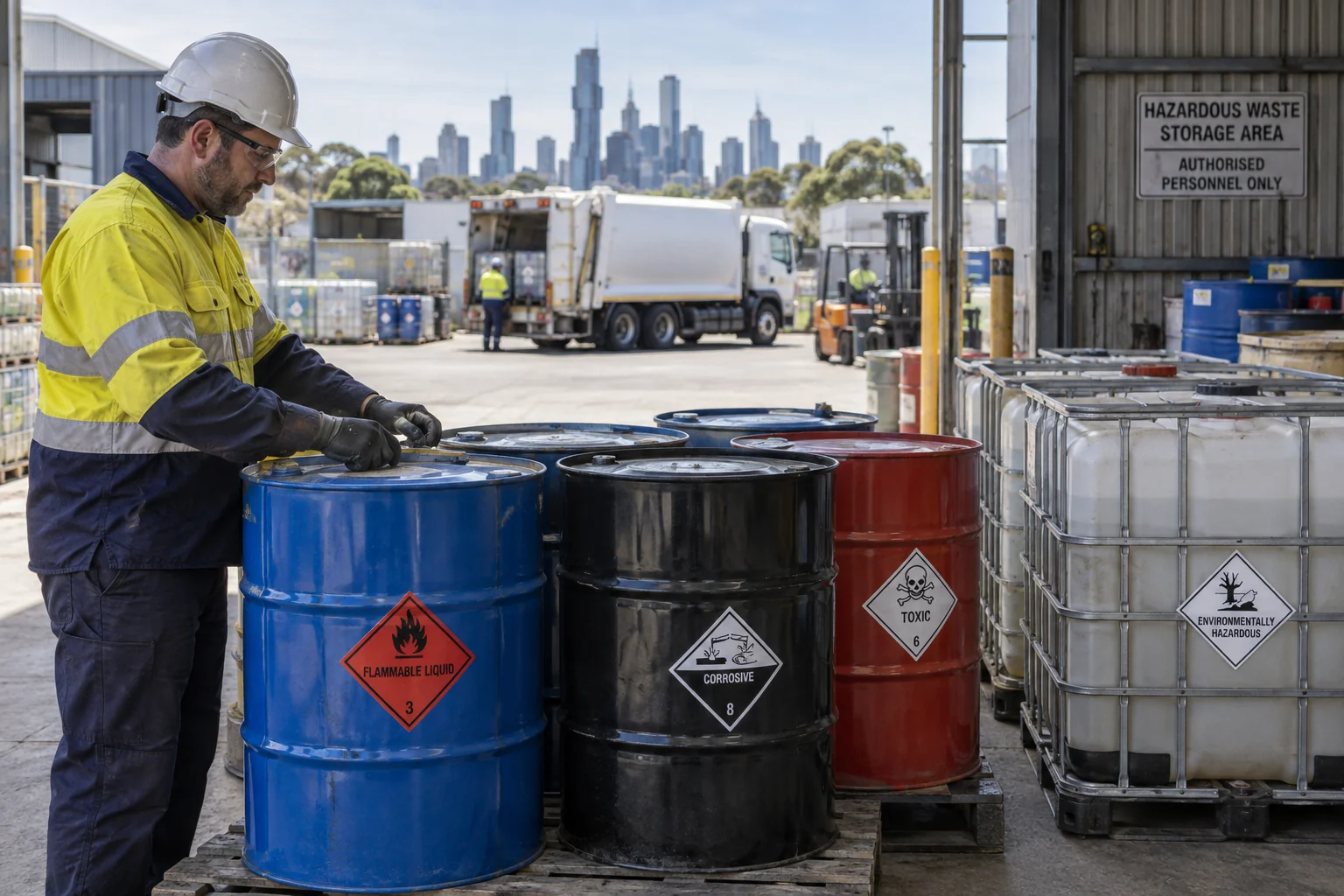
Hazardous Waste Disposal Melbourne: What It Costs in 2026

Hazardous Waste Disposal Melbourne: What It Costs in 2026

Per-drum and per-litre rates across Melbourne, the reportable priority waste rules that set the price floor, and where hazardous bills hide their padding.

Hazardous waste disposal in Melbourne typically costs $38–80 per 20L drum, $155–320 per 205L drum, $400–750 per 1000L IBC, and $0.30–0.65 per litre for bulk tanker collection in 2026. Prices are higher than general waste because most hazardous streams are reportable priority waste under EPA Victoria's framework — permissioned transport, tracking and licensed treatment are built into every rate. Here's the full cost breakdown, and where the savings genuinely are.

2026 hazardous waste rates across Melbourne

Typical market rates for licensed hazardous waste collection, by container and region:

ContainerMelbourne CBDInner suburbsNorth/West
20L drum$45–80/pickup$42–75/pickup$38–68/pickup
205L drum$180–320/pickup$170–300/pickup$155–280/pickup
1000L IBC$450–750/pickup$430–720/pickup$400–670/pickup
Bulk tanker$0.35–0.65/litre$0.33–0.60/litre$0.30–0.55/litre

On top of the collection rate, expect possible line items for waste classification/analysis (new streams), dangerous goods documentation, and minimum-load charges on small pickups. Every additional line is checkable — our hidden charges guide covers the patterns.

Why hazardous waste costs what it costs

Most commercial hazardous streams in Victoria — solvents, paints, oils, chemicals, contaminated liquids, batteries and more — are classified as reportable priority waste under the Environment Protection Act 2017 framework. That classification is the price floor:

  • Permissioned transport — only EPA-permissioned vehicles can carry it, and movements are tracked end to end through Waste Tracker.
  • Licensed receiving facilities — treatment, neutralisation or secure disposal at licensed sites, whose gate fees dwarf ordinary landfill.
  • The duty chain — you remain legally responsible for the waste until it's lawfully received. The general environmental duty carries corporate penalties up to about $2.03 million, which is why cheap unlicensed operators are a risk you never take. The full compliance picture is in our prescribed industrial waste guide and EPA Victoria regulations guide.

What actually cuts hazardous waste costs

  1. Classify correctly — once. Over-classification is the silent overcharge: paying priority-waste rates on streams that assess as ordinary industrial waste. A one-off proper classification pays for itself.
  2. Segregate streams. Mixed hazardous loads price at the most expensive component. Keeping solvents, oils and aqueous streams separate keeps each at its own rate.
  3. Right-size containers and frequency. Four 20L drum pickups cost more than one 205L pickup for the same volume. Minimum-load charges punish little-and-often scheduling.
  4. Consolidate providers. Sites often run hazardous collection with a specialist while general waste sits elsewhere — bundling both into one negotiation moves the total. Our hazardous waste service page covers what Bundle Waste arranges.
  5. Benchmark the account. Hazardous rates are custom-quoted and rarely compared. The spread between quotes for identical drum pickups routinely exceeds 30% — exactly what a free waste audit surfaces. No savings, no fee.

Common Melbourne hazardous streams and their handling

StreamTypical sourceHandling route
Solvents, paints, thinnersManufacturing, panel shops, printingDrummed, licensed treatment/recovery
Waste oils and coolantsWorkshops, transport depotsDrum or tanker; oil is often recoverable
Oily water, wash-bay waterDepots, fuel sites, car washesVacuum tanker — see our bulk liquid waste guide
Chemical residuesLabs, cleaning, agricultureClassified, drummed, licensed disposal
Batteries and e-wasteAll businessesBanned from landfill — dedicated recovery routes

Frequently asked questions

How much does hazardous waste disposal cost in Melbourne?+
Typical 2026 market rates: $38–80 per 20L drum, $155–320 per 205L drum, $400–750 per 1000L IBC, and $0.30–0.65 per litre for bulk tanker collection, varying by region and stream. Classification, dangerous goods documentation and minimum-load charges can add to small or new accounts.
Why is hazardous waste so much more expensive than general waste?+
Most hazardous streams are reportable priority waste under EPA Victoria's framework: only permissioned transporters can carry them, movements are tracked end to end, and disposal happens at licensed treatment facilities with high gate fees. Compliance is built into every rate — legitimately.
Can I put small amounts of hazardous waste in general bins?+
No. Solvents, paints, oils, chemicals and batteries are prohibited from general waste. Victoria's general environmental duty carries corporate penalties up to about $2.03 million, and you remain legally responsible for waste until it's lawfully received. Small quantities still need a licensed collection route.
What's the cheapest way to handle hazardous waste for a small business?+
Right-size the container (one 205L pickup beats four 20L pickups), segregate streams so mixed-load pricing doesn't apply, schedule collections to avoid minimum-load charges, and benchmark quotes — spreads over 30% between providers for identical pickups are routine.
Is my business's waste classified as reportable priority waste?+
If it's a solvent, paint, oil, chemical, contaminated liquid or similar industrial stream, very likely yes — but the exact classification determines your rate, and over-classification is a common silent overcharge. A proper one-off classification against EPA Victoria's waste framework frequently pays for itself.
Who can legally transport hazardous waste in Victoria?+
Only transporters holding the relevant EPA permissions, with reportable priority waste movements tracked through Victoria's Waste Tracker system. Always verify a provider's permissions before engaging — using an unlicensed carrier leaves your business exposed under the duty chain.

Related guides

See what you could save

Send us a recent waste invoice. We'll benchmark every charge against a network of Melbourne providers and show you the savings — free, no obligation, no win no fee.

Get Your Free Waste Audit →